

Digital Editions
Newsletters
Subscribe
Digital Editions
Newsletters
Art market
Museums & heritage
Exhibitions
Books
Podcasts
Columns
Art of Luxury
Adventures with Van Gogh
Venice Biennale
Art market
Museums & heritage
Exhibitions
Books
Podcasts
Columns
Art of Luxury
Adventures with Van Gogh
Venice Biennale
News
archive

Georgia and Russia rattle their sabres over war damage

Both sides claim the other damaged historic buildings

John Varoli
1 November 2008
Share

The guns may be silent and an uneasy truce in place, but Russia and Georgia are continuing the public relations war, most recently levelling accusation and counter-accusation of destroying historical and cultural sites during their week-long conflict in August.

At the end of September Georgia issued a 26-page report detailing how Russian air attacks destroyed dozens of churches, monasteries, and museums. Among these are the 12th-century Ikorta Church, the 11th-century Bishop’s House in Nicosi, and a 7th-century monastery, also in Nicosi. Georgia appealed to Unesco to send a mission to Russian-occupied areas to better ascertain the situation regarding cultural sites. Located in the Caucasus mountain region on the border between Europe and Asia, Georgia has one of the most ancient cultures in the world, creating its own state in the 5th century BC. In the 4th century AD it became one of the first states to embrace Christianity, and therefore has many ancient churches and monasteries.

On 7 August Russia invaded Georgia, it said, to protect Russian citizens living in the dissident republic of South Ossetia, which Russia now recognises as independent. Russia says that Georgian troops damaged 11 cultural and historical sites in the local capital, Tskhinval. These include the 18th-century Birth of the Virgin Mary Church; a local synagogue; and buildings in the city’s historical district. Russia’s deputy foreign minister Alexander Yakovenko told journalists his country will raise the issue with Unesco.

Meanwhile, Georgia said it will close the Museum of Joseph Stalin in the city of Gori and reopen the building as the Museum of Russian Aggression.
Subscribe to our daily newsletter

NewsRussiaGeorgiaSt PetersburgCultural heritageWar & Conflict
Share
Subscribe to The Art Newspaper’s digital newsletter for your daily digest of essential news, views and analysis from the international art world delivered directly to your inbox.
Newsletter subscribe
Information
About
Contact
Cookie policy
Data protection
Privacy policy
Frequently Asked Questions
Subscription T&Cs
Terms and conditions
Advertise
Sister Papers
Sponsorship policy
Follow us
Instagram
Bluesky
LinkedIn
Facebook
TikTok
YouTube
© The Art Newspaper

Related content

Vandalismnews
15 January 2024

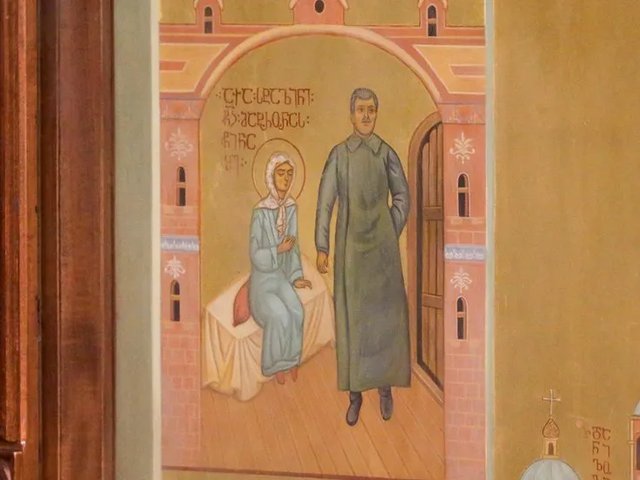
Stalin religious icon splattered with paint in Georgia

The work in the Holy Trinity Cathedral in Tbilisi depicts St Matrona of Moscow, a visionary and healer, blessing the Soviet dictator

Sophia Kishkovsky
Looted artarchive
30 June 2000

Art and archaeology falls casualty to the Chechen war

The collections of two museums in Grozny have disappeared and the region’s distinctive stone towers are caught in the crossfire

John Varoli
Conservation & Preservationarchive
1 January 2005

Russia pledges 120 million rubles to restore warping wooden church

Built without a single nail, the Church of the Transfiguration of the Saviour will have to be taken apart in order to save it

John Varoli
Lootingarchive
31 March 2000

The Museum of Religion in St Petersburg has admitted to having looted items in its possession and is involved in tangled negotiations with the Church

Former atheist goes to confession

John Varoli