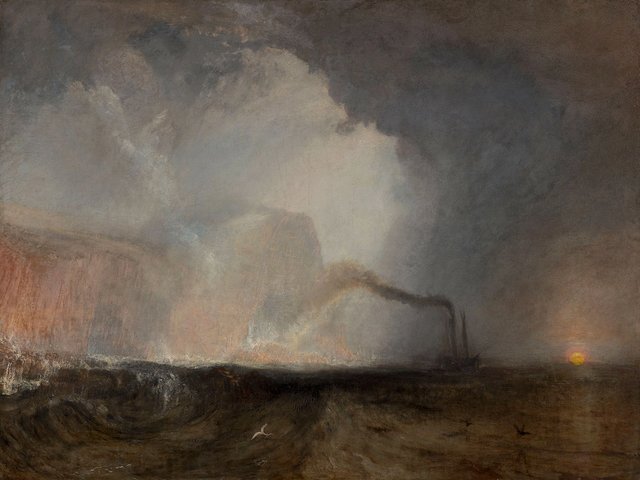
Turner’s late work has long been regarded as paving the way for Modern art, but, astonishingly, “Late Turner: Painting Set Free” will be the first exhibition of works from the artist’s final years. The show starts when he reaches 60, in 1835, covering the period up until his death in 1851. It will comprise 150 works, of which nearly 60% come from the Tate’s own collection.
David Brown, the co-curator with Sam Smiles, hopes the show will dispel the over-simplistic idea that Turner ended up becoming a proto-Impressionist and an abstract artist: “There are elements of this, but alongside traditional painting. Turner does classical compositions, but painted in a new way; when he turns to contemporary subjects, there are echoes of classical landscapes. Both continuities and radical developments can be seen in his late work.”
What is beyond dispute is that he was a highly productive and vigorous artist at what in his time was an advanced age. He continued to travel in Europe and experiment with his work. The exhibition’s apposite subtitle, “painting set free”, comes from an unpublished 1960s paper by the art historian Lawrence Gowing.
Major loans for the show include Modern Rome—Campo Vaccino, 1839, which was bought by the Getty Museum for £30m and exported from the UK in 2011. Among key examples of Turner’s modern subject matter is Rain, Steam and Speed—the Great Western Railway, 1844, coming from the National Gallery.
Discoveries to be presented in the show include a set of three watercolours of a complex of buildings on fire. Although previously assumed to depict the destruction of the Houses of Parliament in 1834, it actually shows a fire at the Tower of London in 1841. The show is due to travel to the Getty Museum, Los Angeles, and De Young Museum, San Francisco, but in a reduced form, with just over half the number of works presented in London.
• Late Turner: Painting Set Free, Tate Britain, London, 10 September-25 January 2015; J. Paul Getty Museum, Los Angeles, 24 February-24 May 2015; and De Young Museum, San Francisco, 20 June-20 September 2015
Originally appeared in The Art Newspaper as 'Turner’s final flourish'