A non-profit foundation led by the businesswoman Feroze Gujral is presenting an exhibition that unites India and Pakistan at the Venice Biennale in the absence of official pavilions for either country. “My East is your West" on show at Palazzo Benzon, on the Grand Canal, includes works by the Mumbai-based artist Shilpa Gupta and Rashid Rana, who is based in Lahore. The pairing is significant given the history of conflicts between India and Pakistan.
The exhibition, an official Biennale collateral event, is organised by the Gujral Foundation, which was founded in India in 2008 by Mohit and Feroze Gujral, the son and daughter-in-law of the Indian Modernist artist Satish Gujral. The organisation supports contemporary art and design on the Indian subcontinent. Amin Jaffer, the international director of Asian art at Christie's, and Richard Armstrong, the director of the Guggenheim, are among the event advisors.
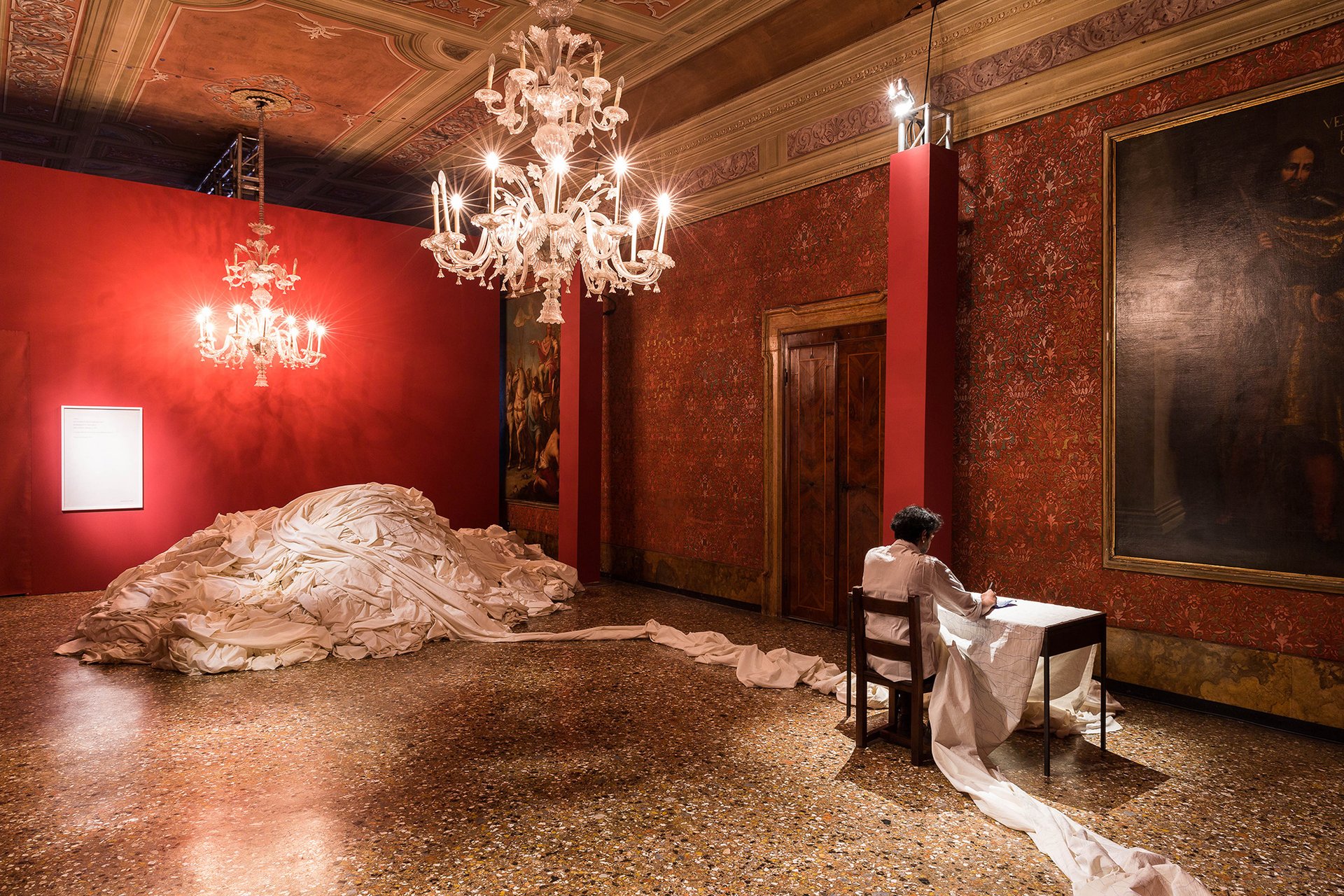
Works on show include Gupta's Untitled piece comprising a performer who uses carbon paper to draw lines on a 3,394m piece of hand-woven cloth; this represents the border between India and Bangladesh, where the longest security fence in the world is under construction. Rashid Rana's My Sight Stands in the Way of Your Memory (2013-15), a nine-channel video work, re-creates Caravaggio's painting Judith Beheading Holofernes (1598), as a mosaic of pixelated news reports and CCTV footage.
"When you think that South Asia is home to a third of the world's population, it seems surprising that we have no formal representation in Venice. We have such a wealth of talent but limited institutional infrastructure to support them in South Asia and internationally," says Feroze Gujral. "At the moment we are bridging that gap, hoping that in the future India and Pakistan will have an even stronger presence here."
India and Pakistan have been poorly represented in Venice. After a carefully curated national pavilion at the 2011 biennale—India’s first official representation—the country did not return in 2013. Before that, the country had shown unofficially in Venice eight times between 1954 and 1982. Pakistan has also had a patchy presence at the biennale, last showing in Venice in 1956. A statement from the Gujral Foundation says that "India stands at a crucial junction of cultural crossroads; soft power needs to be presented".