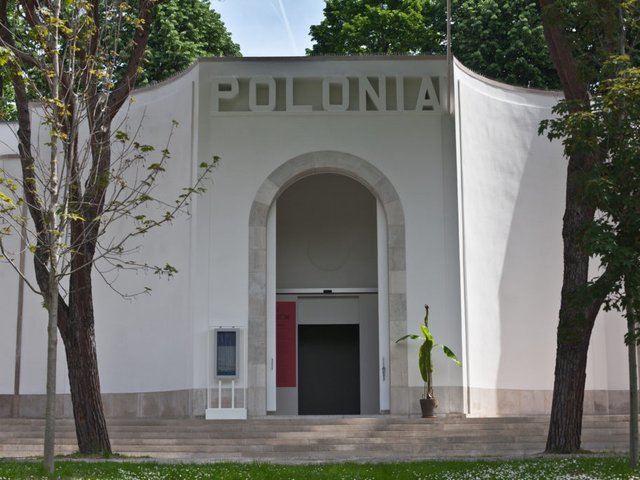
With the help of a vast curved screen two New York-based Polish artists unexpectedly transport viewers from the Polish pavilion into the heart of the Haitian village Cazale where the community have gathered to watch a production of the Polish national opera Halka—a tragic story of a peasant girl set against the backdrop of a peasant revolt of 1846.
The village is home to descendants of Polish soldiers who, having joined the Napoleonic army in the hope of securing support for the struggle for Polish national independence, were instead sent to crush the Haitian Revolution of 1802. Many refused to fight. Identifying with the Haitians’ cause as akin to their own, they received honorary status in the new Haitian republic, where their descendants live to this day. The panoramic film points to the possibility of trying to build on minor histories of solidarity among oppressed peoples around the world, both black and white.
The contrast between the Biennale audience confined to a black box gazing at the immaculate screen and the relaxed Haitian community gathered on ramshackle verandas and doorsteps, replete with picturesque goat tied to a post in the foreground and children wandering about freely, is in your face to say the least. It is thus the ongoing issue of uneven development as well as the fraught histories of cultural colonisation that provide the main interest here.
Related questions are posed in a less upbeat way by the other major Polish contribution to this year’s Biennale, Dispossession, at the exquisitely dilapidated Palazzo Donà Brusa. Put together by two young curators in association with Wroclaw 2016 European Capital of Culture, this hard-hitting group show takes as its co-ordinates the historical axis Lviv-Wroclaw-Dresden.
Packed with historical materials and fascinating oral histories, the exhibition provides poignant personal insights into the complexities of European migration, historical and contemporary. It is clear that the passionate recollections of a 99-year-old Silesian grandmother rhyme with the fates of the million or so people now displaced as a result of the conflict in Eastern Ukraine; the exhibition intelligently inflects the contemporary situation with comparative materials, depressingly proposing that the 21st century is well on the way to repeating the tragedies of the 20th.