The Green Pavilion by Irina Nakhova (b.1955) sees Alexei Shchusev’s 1914 Russian pavilion painted a tasteful dark green and home to a series of wildly different spaces, from the historical-austere to the hyperbolic-contemporary. Margarita Tupitsyn curates the pavilion this year and delights in proving just what environment can still do. Through the main entrance, we squeeze pass an oversized hi-tech soft sculpture of a masked pilot connected by black ventilator to the world outside. A 3D figure is projected inside— crammed uncomfortably into the space as though the pavilion were a cockpit. We feel stuck in a military situation of gigantic proportions but only discernable as a fragment or part-object.
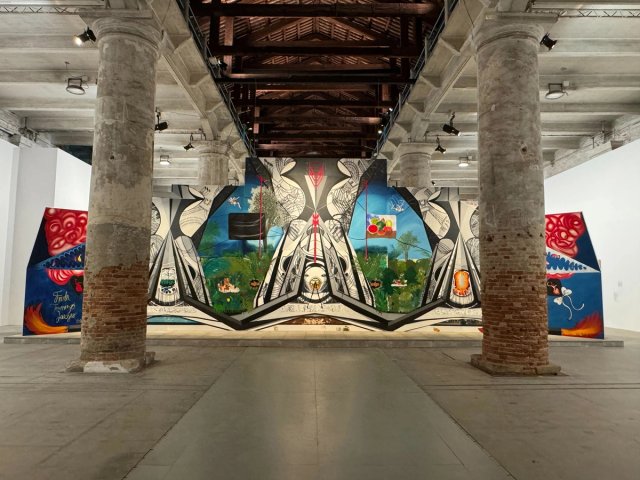
In the central room there is black nothingness. Now we are stuck inside Malevich’s black square; between heaven (periodically visible when square skylight opens to bathe us in Venetian light) and earth (giant writhing earthworms are projected onto the floor below and visible though a glass square in the centre of the floor). We pass through to a total environment all of Nakhova’s own: a red and green high gloss jungle with hints of architecture, apparently bringing together the red of revolution with the green of perestroika.
The Green Pavilion may be an allusion to IIya Kabakov’s Red Pavilion of 1993, interrupting the powerfully male dominated narrative of Moscow conceptualism. An archival environment is included, and shows Nakhova as a young woman in the 1980s being interviewed by Andrei Monastyrski, whose Collective Actions took centre stage in the same pavilion in the last edition of the Biennale. She sits casually on the floor of her historic Room 2 against a dramatic backdrop of torn black and white paper, laconically explaining that the transformed space of her apartment has to do with the fact that she was just bored of her living space. It is a deadpan response, and it must have been as clear to her peers as it is today that she is the real thing.
Along with the worms, we find projections rippling water, black and white photographs, and street scenes of Moscow today. Certain historical faces are circled in blue; when we look back, we see they have been erased. Girls ice-skate, people stand around outside Lenin’s mausoleum, and a protestor carries a banner that reads "not everyone can be thrown into prison!". Worms of History links the physicality of the ground as home to myriad formless invertebrates ingesting and fertilising without rhyme or reason, to the conceptual ground of historical memory—another living, shifting foundation. Political and cultural endgames collide in each overwhelming space.
The Russian Pavilion is supported by the Stella Art Foundation and the Mercury Group.