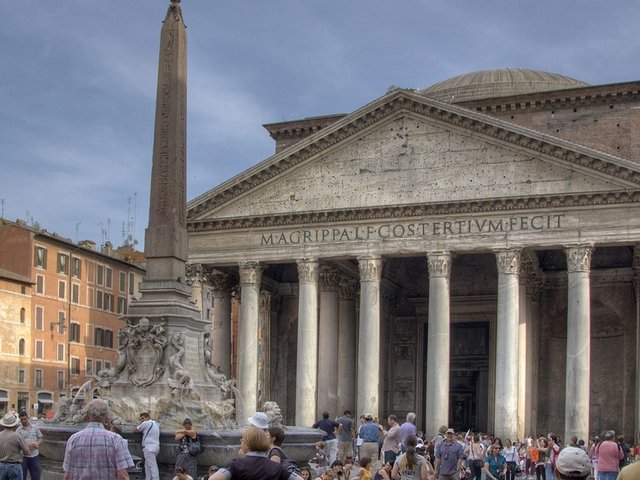
The Pantheon in Rome is indisputably one of the world’s greatest buildings. Michelangelo described it as “angelic, not human”. The Pantheon, a collection of 13 essays, gives a fascinating picture of the current state of scholarship concerning its enigmatic history. It explains that many of the common assumptions about it are mistaken.
The first Pantheon built by Augustus’s right-hand man, Agrippa, faced north, like the present one, and also had a portico in front of a circular structure, possibly with a timber roof. This Pantheon was destroyed by fire in AD110, and the new one was begun by Trajan, not Hadrian, the construction probably beginning in 112 and being completed about 124. The architect may have been the intriguing Apollodorus of Damascus.
All three parts—the portico, the link building and the rotunda—date from this campaign. There is evidence to suggest the explanation for the curious second pediment, above the portico: it may have been that the original intention was to use 60ft-high columns, but columns of only 40ft were used instead.
The so-called “Grottoni” attached to the back were built during construction after a large crack appeared. The later history also requires revision. The apparently amazing state of preservation of the interior decoration is misleading, and much is due to restoration. The bronze trusses from the portico were removed by Pope Urban VIII for cannon at the Castel Sant’Angelo. The pair of bell turrets he erected were designed, not by Bernini, but by Maderno with advice from Borromini.
• Peter Howell taught for 35 years in the department of classics, Bedford and Royal Holloway Colleges. He is currently writing a book on the triumphal arch from Roman times to the present
The Pantheon from Antiquity to the Present
Tod Marder and Mark Wilson Jones, eds
Cambridge University Press, 503pp, £65 (hb)