

Digital Editions
Newsletters
Subscribe
Digital Editions
Newsletters
Art market
Museums & heritage
Exhibitions
Books
Podcasts
Columns
Art of Luxury
Adventures with Van Gogh
Venice Biennale
Art market
Museums & heritage
Exhibitions
Books
Podcasts
Columns
Art of Luxury
Adventures with Van Gogh
Venice Biennale
News

Secret flight path of the Parthenon statue

Hermitage director reveals "circuitous" route that marble sculpture took from London to St Petersburg to avoid Greek seizure

Sophia Kishkovsky
9 March 2016
Share

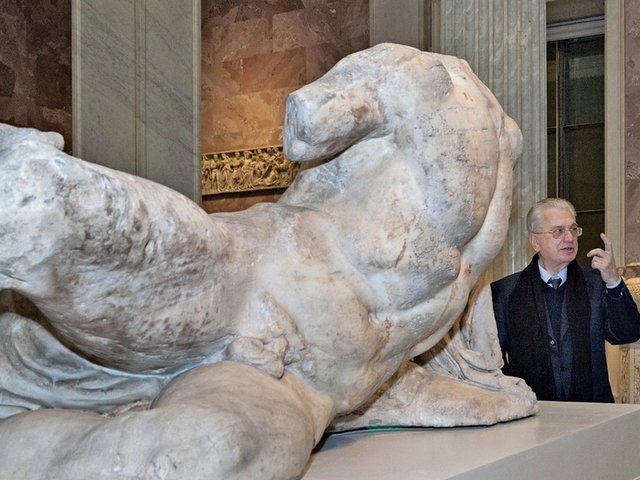
When the British Museum in London lent a Parthenon sculpture to the State Hermitage Museum to mark the Russian institution’s 250th birthday in late 2014, there were fears that Greece might try to seize the statue en route to St Petersburg. To prevent this, the loan was shrouded in secrecy until the sculpture of the river god Ilissos went on show in the Hermitage (6 December 2014-18 January 2015). The Art Newspaper has learned that the route it took was designed to avoid European Union territory as an extra precaution.

Mikhail Piotrovsky, the director of the Hermitage, tells us that to forestall any attempt to intercept the sculpture, it was flown from London to St Petersburg “circuitously”. He says: “It could not be transported through Europe, because Greece believe that it belongs to them and they could have attempted to seize it at some airport en route, and according to the laws of the European Union, this would have been legitimate.” The exact route it took is a mystery, however. Did it travel via the Arctic or over North Africa? Piotrovsky declines to say, and a spokeswoman for the British Museum will only say: “When flying any loan overseas, the British Museum chooses the most direct route possible. This was true for the loan of Ilissos to the Hermitage.”

But any hard feelings between Russia and Greece are, it seems, in the past. In March, a statue found near the Parthenon will be lent to the Hermitage by the Acropolis Museum in Athens. In return, the Hermitage is lending three pieces of Scythian gold found in eastern Crimea.
Subscribe to our daily newsletter

NewsLoansMuseums
Share
Subscribe to The Art Newspaper’s digital newsletter for your daily digest of essential news, views and analysis from the international art world delivered directly to your inbox.
Newsletter subscribe
Information
About
Contact
Cookie policy
Data protection
Privacy policy
Frequently Asked Questions
Subscription T&Cs
Terms and conditions
Advertise
Sister Papers
Sponsorship policy
Follow us
Instagram
Bluesky
LinkedIn
Facebook
TikTok
YouTube
© The Art Newspaper

Related content

Museumsarchive
30 April 1999

A room full of MoMA in St Petersburg's Hermitage Museum

This marks the first in a series of planned loans of modern and contemporary American works from MoMA to the Hermitage

John Varoli
News
4 May 2017

Museums show limited interest in borrowing Parthenon Marbles

British Museum’s vision of the ancient sculptures travelling to China and Africa has so far come to nothing

By Martin Bailey
News
11 October 2015

Hermitage to lend avant-garde collection

Sophia Kishkovsky