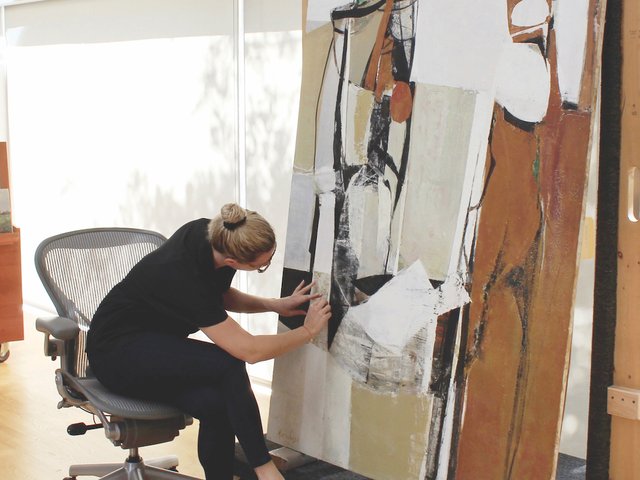
From now until January 2017, entry to the Museum of Fine Arts, Boston, includes a performance, a ballet of sorts, starring conservators and one very big 300-year-old Buddhist painting. Visitors can watch the restoration of The Death of the Historical Buddha (1713), a 16ft-tall scroll made by the Osaka-born painter, calligrapher and poet Hanabusa Itcho (1652-1724), in a temporary conservation studio installed in the institution’s Asian art gallery. A specialist will be on hand to explain what the conservators are doing and answer questions.
The idea of staging a real-time conservation project in public was inspired by a trip to Japan that Jacki Elgar, the museum’s head of Asian conservation and international projects, made in the early 1990s. There she witnessed conservators treating a large painting of the nehan (the death of the historical Buddha). “It was like watching a ballet performance. Everyone knew their role and played their part,” she says. “I always thought this was something that Westerners should see.”
A show-off piece On display for the first time in 25 years, the hanging scroll is shown with a later painting of the same subject and four “death pictures” that depict kabuki actors in a pose that mimics the nehan.
Itcho’s painting was a well-known work in the 18th century. It would have been owned by a Buddhist temple and brought out once a year to mark the anniversary of the nehan. Religious images such as this provided artists with an opportunity to show off their technical skills. Itcho signed the piece, which Elgar says is rare. His animals are particularly lifelike—aside from an elephant with menacing claws. It is unlikely that the artist had ever seen a real elephant.
The work, which will travel to Japan for an exhibition that is due to open in 2017, was last treated in 1850. The painting and its mount will need to be taken apart and remounted so that the painting can be flattened. Although the work does not suffer from major paint loss, it does have creases, which can cause the paint to flake off.
Like many of the Asian art conservation department projects, this one is a global endeavour. Specialists have had to be found, including a Japanese manufacturer to reproduce textiles used in the scroll’s outer border, and the Tokyo-based Sumitomo Foundation is funding the work. “This global network is sort of a big family,” Elgar says. The museum is also getting help a little closer to home as conservators from the Smithsonian’s Freer Gallery of Art in Washington, DC, are partners in the project.
“What makes this project so special is that people are witnessing [the work] in real time. It’s raw and out there, and I kind of like that,” Elgar says. She hopes the project will inspire people to consider Asian painting conservation as a career as the field could use an injection of specialists in this area.