Digital Editions
Newsletters
Subscribe
Digital Editions
Newsletters
Art market
Museums & heritage
Exhibitions
Books
Podcasts
Columns
Art of Luxury
Adventures with Van Gogh
Venice Biennale
Art market
Museums & heritage
Exhibitions
Books
Podcasts
Columns
Art of Luxury
Adventures with Van Gogh
Venice Biennale
Auctions
news

Kandinsky painting bought directly from the artist by Solomon Guggenheim returns to auction

The picture, estimated at $18m-$25m, will lead Christie's November Modern and Impressionist art sale

Pac Pobric
15 September 2016
Share

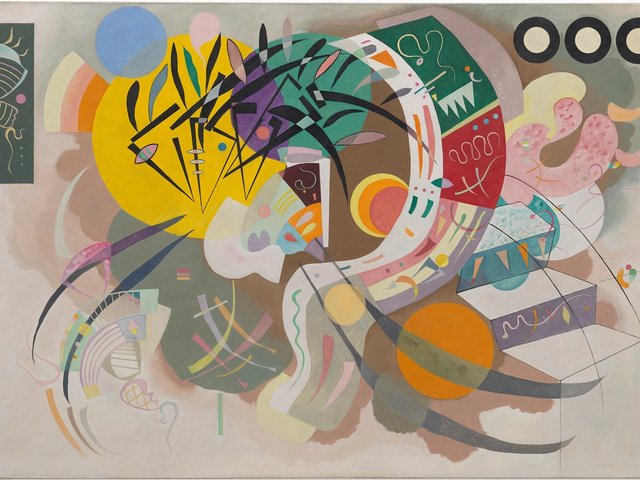
A painting by Wassily Kandinsky returns to the market after more than 50 years at Christie’s Impressionist and Modern evening auction in New York on 16 November. Rigide et courbé (rigid and bent) (1935), which the artist painted in Paris two years after he was forced into exile from Germany, is the auction’s top lot and is estimated at $18-25m with a guarantee.

The painting was first bought in 1936 by Solomon Guggenheim directly from the artist and was included in eight exhibitions through 1949 in New York, Philadelphia, Pittsburgh, Chicago, Baltimore and Charleston. When the Guggenheim Museum was looking to raise funds in 1964, the picture was among a group of 50 by the artist sold at Sotheby’s in London, raising an uproar in the New York art world. (A letter to the editor of the New York Times called it “shocking, grievous news”.) The painting has remained with the same American family ever since.

Rigide et courbé is noteworthy in part for its scale. At 45 by 63.5 inches, it “ranks alongside the biggest pictures of his last years,” says Conor Jordan, the deputy chairman of Impressionist and Modern Art at Christie’s. A smaller work by Kandinsky (38.5 by 27.5 inches) titled Studie für Improvisation 8 (1909) sold at Christie’s in New York in 2012 for $23m, which is the artist’s auction record.

The picture, notably, includes sand. “He may have been inspired by Georges Braque, who often used sand, particularly in paintings from the 1920s and 1930s,” Jordan says, although Bauhaus artists like Kandinsky were always experimenting with new techniques.

Although the work is abstract, there are some identifiable forms, some of which speak to the period in which it was made. At the left, a group of bound vertical shapes may allude to the fascio, a bundle of rods with an axe that was used as a Fascist symbol. At the right, a figure with horns may allude to the myth of the rape of Europa.
Subscribe to our daily newsletter

Auctions
Share
Subscribe to The Art Newspaper’s digital newsletter for your daily digest of essential news, views and analysis from the international art world delivered directly to your inbox.
Newsletter subscribe
Information
About
Contact
Cookie policy
Data protection
Privacy policy
Frequently Asked Questions
Subscription T&Cs
Terms and conditions
Advertise
Sister Papers
Sponsorship policy
Follow us
Instagram
Bluesky
LinkedIn
Facebook
TikTok
YouTube
© The Art Newspaper

Related content

Buyer's Guideanalysis
31 January 2020

Charles White: a buyer's guide

He chronicled the African American experience when white male abstraction ruled. Now record prices for his work are frequently reset

Margaret Carrigan
Three to seereview
27 November 2020

Three online shows to see this weekend

From a sweeping survey of Kandinsky to a provocative show on the present day experience of Native American communities

Gabriella Angeleti and Kabir Jhala
Three to seereview
8 October 2021

Three exhibitions to see in New York this weekend

From Kandinsky at the Guggenheim to Erna Rosenstein at Hauser & Wirth

Gabriella Angeleti
Art marketnews
29 March 2018

Sotheby's to offer Jackson Pollock drip painting in May sale series

The 1949 work, unveiled in Hong Kong this week, could surpass the artist's auction record

Sarah P. Hanson