

Digital Editions
Newsletters
Subscribe
Digital Editions
Newsletters
Art market
Museums & heritage
Exhibitions
Books
Podcasts
Columns
Art of Luxury
Adventures with Van Gogh
Venice Biennale
Art market
Museums & heritage
Exhibitions
Books
Podcasts
Columns
Art of Luxury
Adventures with Van Gogh
Venice Biennale
News

What might have been: the Victoria and Albert Museum's never-built tower

London institution's first director, Henry Cole, designed the landmark in 1868

By Martin Bailey
9 May 2017
Share

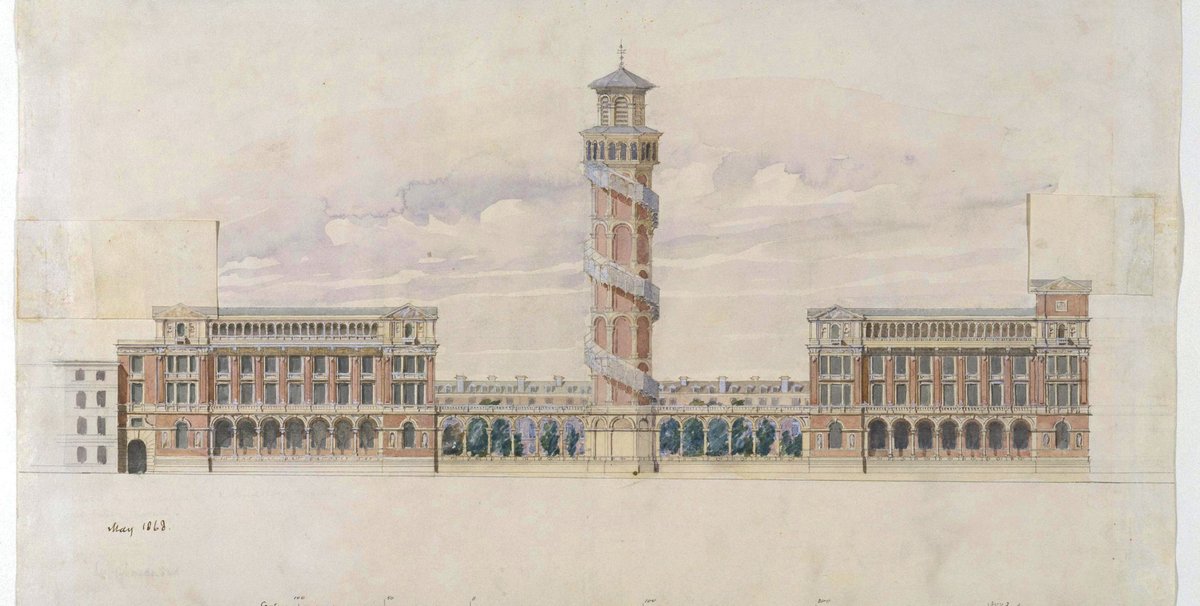
The Victoria and Albert Museum (V&A) once dreamed of building a landmark to dominate the London skyline. That was in 1868, when Henry Cole, the museum’s first director, personally designed a 250ft-high octagonal tower with an external spiral staircase.

Cole’s watercolour plan is on show at the museum as part of a special display tracing the history of its buildings from the 1850s to the present (Designing the V&A, until 31 December). The image also appears in an accompanying book by Julius Bryant, the museum’s keeper of Word & Image. Bryant describes Cole’s tower as “either clever marketing or a museum director’s folie de grandeur”.

The tower could have contained water tanks and a chimney for the museum’s boilers, while external stairs would have spiralled up to a viewing platform for visitors. At the time, only the towers of the Palace of Westminster were higher. The only taller religious building was St Paul’s Cathedral. Cole’s construction would have been visible from much of London, advertising the presence of what was then known as the South Kensington Museum.

Cole resigned as director in 1873, in protest against the lack of government funding for the museum, and his tower plan was then dropped. In 1891, the architect Aston Webb won a commission for the site, designing a stone screen with columns to hide the unsightly boilers from pedestrians.

The screen has now been punctured to create a new entrance, due to open on 30 June as part of the V&A’s Exhibition Road extension designed by Amanda Levete’s firm AL_A. Rather than build upwards, the museum has burrowed underground to create a large temporary exhibition gallery.
Subscribe to our daily newsletter

News
Share
Subscribe to The Art Newspaper’s digital newsletter for your daily digest of essential news, views and analysis from the international art world delivered directly to your inbox.
Newsletter subscribe
Information
About
Contact
Cookie policy
Data protection
Privacy policy
Frequently Asked Questions
Subscription T&Cs
Terms and conditions
Advertise
Sister Papers
Sponsorship policy
Follow us
Instagram
Bluesky
LinkedIn
Facebook
TikTok
YouTube
© The Art Newspaper

Related content

Victoria & Albert Museumnews
10 April 2018

Smithsonian to open first base outside US at former Olympic site in London

US Institution will collaborate with Victoria and Albert Museum at its new outpost in East London

Martin Bailey
Museums & Heritagearchive
1 January 1999

Feasibility study under way for a regional V&A

off to Blackpool?

Martin Bailey
Exhibitionsarchive
30 September 1998

Grinling Gibbons, a superstar rediscovered at the V&A

Fires at the Pitti Palace and Hampton Court have led to this survey of baroque sculptor, Grinling Gibbons

Anna Somers Cocks
Victoria & Albert Museumarchive
31 August 2007

V&A sets its sights on expansion—again

New plans for developing the former 'Spiral' space

Martin Bailey