At a time when many Russian private museums are struggling for survival and some have been forced to close, a billionaire couple from St Petersburg have nonetheless founded a new one, scheduled to open in Moscow on 2 December.
Called Zilart, the museum was conceived to show the collection of its founders, Andrey and Yelizaveta Molchanov. The owner of the St Petersburg property developer LSR, Andrey Molchanov, 54, was a member of the Federation Council, Russia’s upper chamber of parliament, from 2008 to 2013.
In an email, the museum’s press office tells The Art Newspaper that the collection “brings together Russian avant-garde, Soviet nonconformist art, Russian and international contemporary art” as well as “masters of Russian and international photography, furniture in the Russian style of the early 20th century, decorative and applied arts, and many other areas”. The collection includes works by Vik Muniz, Tony Matelli, Helmut Newton, Mike Kelley, Stephan Balkenhol and Ron Arad.
The Molchanovs also own more than 1,000 works of African art ranging from bronze and terracotta sculptures from Nigeria and the Kingdom of Benin to kifwebe masks of the Songye and Luba peoples of the Congo River basin—a collection they bought from Mikhail Zvyagin, a New York-based artist who was born in St Petersburg.
As President Vladimir Putin has tightened his grip on power and suppressed artistic freedoms, Russia’s private museums have increasingly been forced to tread carefully; any hint of dissent can lead to security raids and harassment. The wealthy owners of several museums have fled the country, as have many high-profile curators. Sanctions, meanwhile, make collaborations with Western museums impossible.
Zilart launches with connections to the state: Andrey Molchanov’s profile in the Russian Forbes list of billionaires, which puts his net worth at $1.3bn, notes that his stepfather, Yuri Molchanov, worked with Putin at St Petersburg State University. The Molchanovs’ art adviser is Alexander Borovsky, the head of contemporary art at the State Russian Museum in St Petersburg.
A 10,000-strong collection
“The museum is private and entirely funded by LSR Group and receives no financial support from the City of Moscow or the state,” Zilart’s press office says. It quotes Molchanov as saying: “While collaborations with other Russian museums are under consideration, the museum’s own collection currently numbers around 10,000 works, providing the basis for at least the next ten exhibitions.”
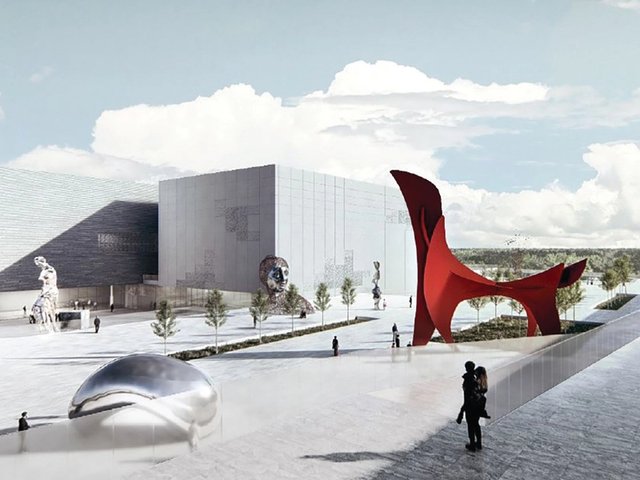
Zilart’s founding has not been frictionless. Conceived in 2015 as a Modern art outpost of the State Hermitage Museum, its first design, by the New York architect Hani Rashid, was inspired by El Lissitzky. But Rashid was abruptly dropped from the project in 2021, to be replaced by the Russian-born German architect Sergei Tchoban. After emigrating to Germany in the 1990s, Tchoban started his Moscow firm, Speech, with Sergey Kuznetsov, who since 2012 has served as the chief architect and first deputy chairman of the Committee for Architecture and Urban Planning of Moscow.
Rashid tells The Art Newspaper that the museum’s current design is “a significantly diluted and distorted version of the original proposal”. Zilart’s press office says Tchoban created an entirely new design.
Since 2023 the Hermitage has also no longer been involved. Dimitri Ozerkov, then in charge of contemporary art at the Hermitage and its plans for the new Moscow branch, left Russia in 2022 in protest at the invasion of Ukraine. “As circumstances evolved, we realised that we had the vision and resources to create a museum independently,” Zilart’s press office says. Irina Tolpina, who previously ran Manege, an exhibition space near the Kremlin, is Zilart’s founding director.
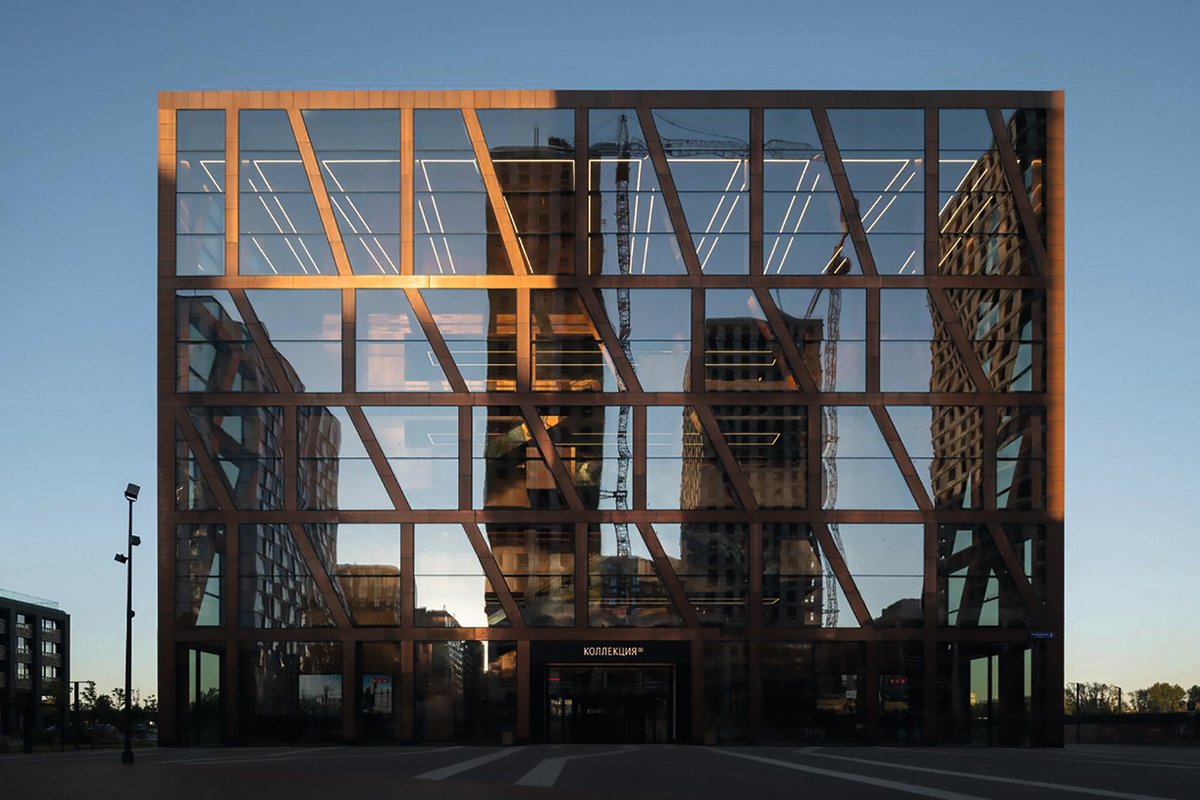
The museum’s final design was by Sergei Tchoban Photo: Ilya Ivanov
A cube of glass transected by tilted copper beams, the museum is built on what was formerly the site of the 400-hectare Soviet ZiL car factory. It is now a residential complex developed by LSR, featuring streets named after avant-garde artists including Wassily Kandinsky, El Lissitzky and Alexander Rodchenko. A sculpture from the Dump Truck series by the Belgian artist Wim Delvoye, acquired by the Molchanovs about ten years ago, was installed in front of Zilart in September, launching the museum’s public art programme.
The neighbourhood is promoted as an urban renewal achievement on City of Moscow websites. Analysts say Moscow’s infrastructure and digital transformation, led by the mayor, Sergei Sobyanin, has muted protests against repression and Russia’s invasion of Ukraine.
An initial 2011 proposal put forward by Yury Grigoryan of the Moscow architecture studio Meganom—which envisaged revamping the ZiL factory district while partially preserving its once-imposing 1920s-30s industrial architecture and workers’ housing—was never realised, says Anna Bronovitskaya, an architectural historian. The cost of cleaning the chemical contamination of the buildings was considered prohibitively expensive, so instead they were demolished, she says. The masterplan that was adopted, also proposed by Grigoryan, aims to create a modern “city within a city”.
“This vast and ambitious project—a completely new residential district on a former industrial site—was marketed to higher-income families,” Bronovitskaya says. “To compensate for its not-so-central location, it was branded Zilart, implying the presence of high-quality public art, architecture with artistic value designed by leading Russian and international firms, and an art museum.”