You could be forgiven for thinking at various points in the past year that it might be the end times for the global art industry. An ongoing wave of gallery closures, long stretches of lacklustre auction results, art fairs “pausing” or cancelling their forthcoming editions—it has all felt a bit grim, and it’s only human to worry that the grimness will never end.
After 20 years in this business, I’m confident things will recover. But can the machine rev back up to the levels it had reached before it started sputtering early in 2023? Maybe so, but the better question to ask is: should it?
Several experts I’ve talked to agree that the answer to the second question is no. There is another way of looking at the shake-ups and shutdowns that have defined the art trade in 2025. Instead of a collapse, the process might better be thought of as the right-sizing of an industry where collectors were not alone in making big speculative bets on enormous growth that simply did not materialise—at least, not on the timeline needed for them to pay off. With sympathy to the people who fell on hard times as a result, the industry overall may be wiser and better equipped after the pain.
Bigger is not always better
Philip Hoffman, the founder and chair of the Fine Art Group, one of the leading art advisory firms, points to a contrast between the expansion-rich years preceding 2023 and now. “What we saw is a massive ramping up of old models when the business was good in anticipation that the sky would go on forever,” he says. “The last three years have shown that’s not true at all.”
Hoffman’s new venture looks to respond to the art-market landscape as it is, not as he wishes it would be. He is a co-founder of New Perspectives Art Partners, an advisory firm launched earlier this year by five veteran power players with complementary client lists and regional expertise. One of the group’s chief goals is to be global without being gargantuan.
“I realised that probably 60% of the market is purchased and sold by less than 250 clients,” Hoffman says of New Perspectives’ origins. Noting that the auction houses Christie’s and Sotheby’s have thousands of staff combined, he advocates a different scale, adding: “We can access the bulk of the market with the five of us plus the infrastructure the Fine Art Group’s got, which is less than 100 staff.” To him and his colleagues, this is a model purpose-built for the realities of a shifting industry.
Adapt or else
Oppressive as the pressure on the trade has felt in 2025, it has also propelled several art businesses to evolve in ways often discussed but much less often acted upon in the past several years.
Multiple duos or trios of dealers in New York, for instance, have embarked on plans to share exhibition space in an ongoing capacity. These range from smaller consortiums—including JDJ, Deanna Evans Projects and the Chozick Family Art Gallery in Tribeca, as well as Candice Madey and Marinaro galleries on the Lower East Side—to at least one blue-chip outfit, with Marian Goodman Gallery periodically giving over one floor of its headquarters to Brooklyn’s Jenkins Johnson Gallery for exhibitions until autumn 2026.
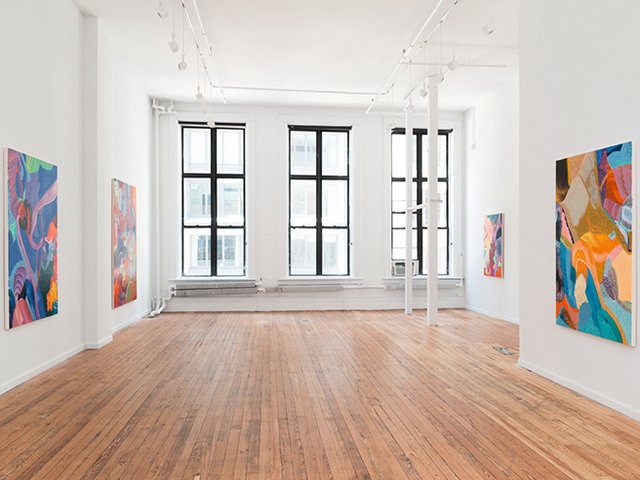
Asked about the motivations to team up with Marinaro, Madey tells The Art Newspaper by email that “everyone is looking for some kind of stability and security—and there is this expectation that galleries are steadfast and should offer a kind of permanence”. Among her core principles for her programme, she adds, is that “provocative thought should drive everything, and this isn’t something I can or want to do alone. There is strength in collective efforts and idea-sharing”.
Other dealers have found ways to expand thoughtfully amid the downturn. The Los Angeles gallerist Hannah Hoffman and the New York dealer Bridget Donahue merged their businesses into a new entity, Hoffman Donahue, with bicoastal reach. Herald Street, which already spans two spaces in London, will launch its first international location in January 2026—not in a classic art-trade hub but in Bologna, Italy.
Although Nicky Verber, a co-founder of Herald Street, cites Bologna’s “strong collecting tradition” as part of the thinking behind the decision, she says the “main motivation” for the move was “to create a new venue and context for our artists to develop exhibitions, both architecturally and in terms of the local cultural landscape”.
In other words, rethinking the geography of an art business goes hand in hand with rethinking its scale. And as the industry turns the corner into the new year, the right conclusion on both fronts may look very different than the picture of success painted before the Covid-19 pandemic.