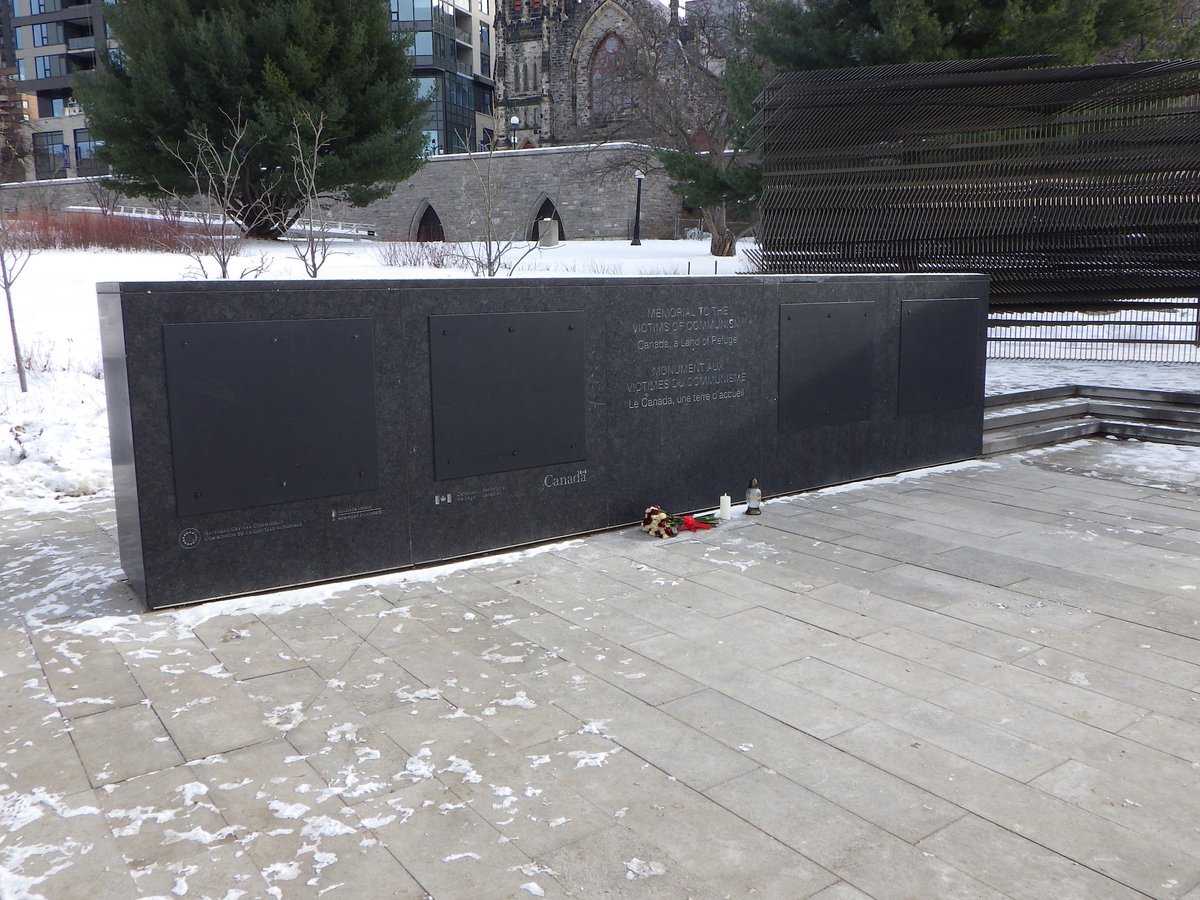
A year after the official opening of Canada’s monument to the victims of communism in Ottawa, the Department of Canadian Heritage has reversed its decision to inscribe individual names on it after a federal government report linked many of the unvetted “victims” to Nazis.
Originally there were to be 553 entries on the memorial’s wall of remembrance, as designed by the Toronto-based architect Paul Raff. But last year, after alarms were raised by Jewish groups and independent Canadian media outlets including Ricochet and The Maple, the department was told that more than half of the 550 names should be removed because of possible affiliations with Nazi or fascist groups.
Department spokesperson Caroline Czajkowski has not responded to The Art Newspaper’s inquiries, but in an email to the Ottawa Citizen last week she wrote: “The government of Canada has emphasised that all aspects of the Memorial to the Victims of Communism must align with Canadian values of democracy and human rights. The Wall of Remembrance will now solely feature thematic content that conveys the broader commemorative and educational intent of the memorial.” She did not elaborate on what that thematic content might be.
Inspiration
The monument was initially proposed as a private initiative in 2007; its budget has since ballooned to C$7.5m (US$5.4m), including C$6m in public funds. The saga began when then Conservative party minister Jason Kenney was inspired by a visit to a monument in the Czech and Slovak enclave of Masaryktown in the Toronto suburbs dedicated to those who “died fighting communism in their homeland”. The 5m-tall statue of a man crucified on a hammer and sickle was created by the Winnipeg-based Czech Canadian sculptor Josef Randa (1933-2005).
Kenney proposed a larger monument to the “victims of communism” in the nation’s capital and the project was championed by the Conservative government of then prime minister Stephen Harper, even as he axed funding to arts and culture. The monument, spearheaded by a group called Tribute to Liberty (TTL), also received letters of support from then Liberal party leader and former prime minister Justin Trudeau, Green Party leader Elizabeth May, former New Democratic Party leader Tom Mulcair and former federal justice minister Irwin Cotler. In September 2009, the National Capital Commission granted approval to TTL to build the memorial.
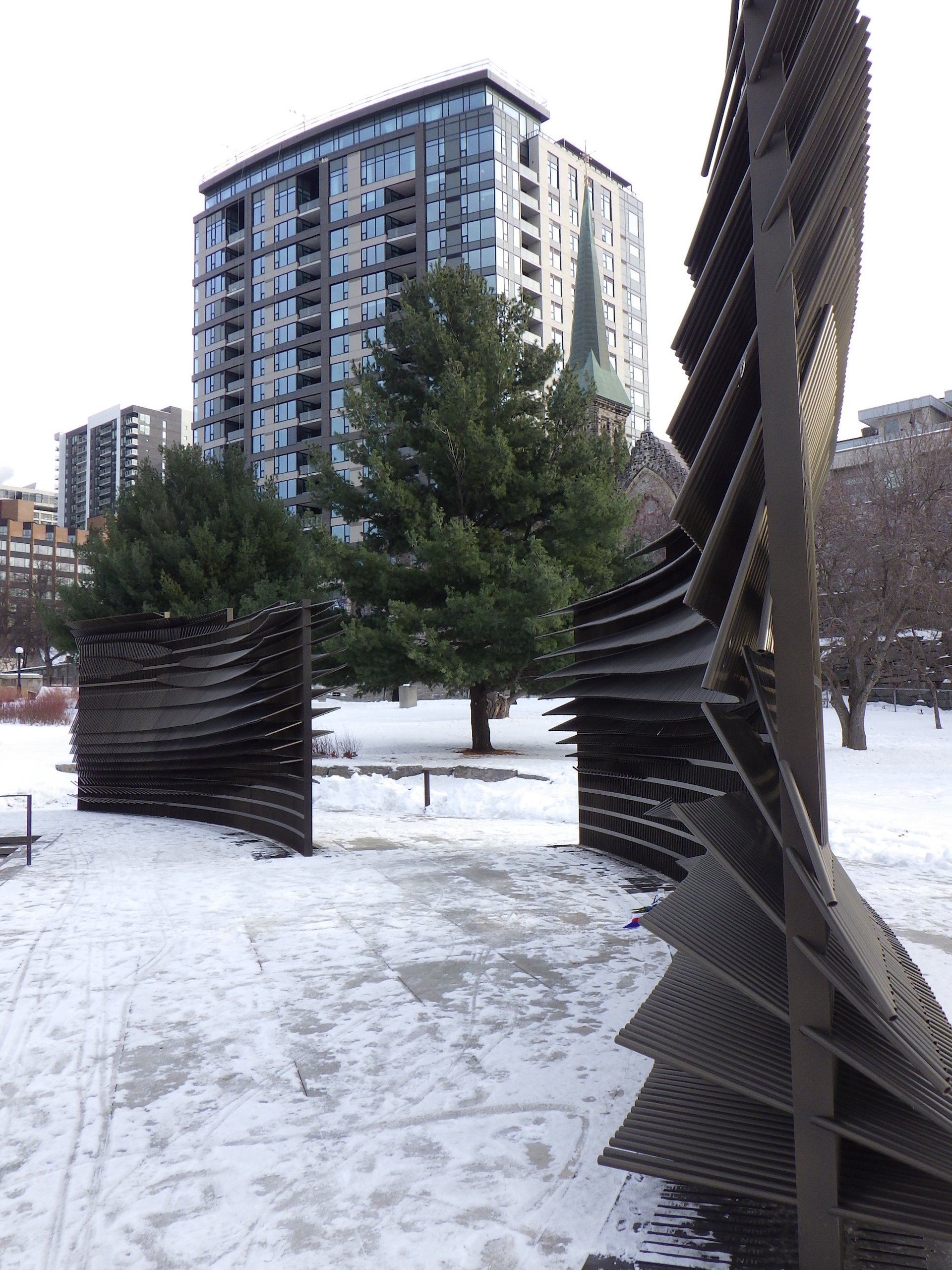
The sculptural calendar portion of the memorial
Photo by Ahunt, via Wikimedia Commons
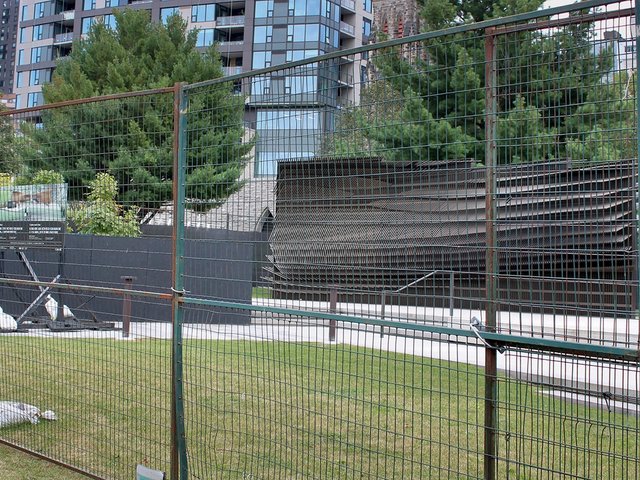
The initial concept for the memorial by Abstrakt Studio Architecture, which consisted of several “folded” rows of concrete covered in 100 million “memory squares” intended to honour 100 million victims of communism, was scrapped due to its “oppressive” design. The final design, by Paul Raff, is named Arc of Memory and described in a Heritage Ministry press release as “a dynamic living calendar, designed to capture the many moments of suffering and injustice to be remembered, in solace and gratitude”. The structure “is divided in the middle at the winter solstice, the darkest day of the year, inviting visitors to step through in a metaphorical journey from darkness and oppression to light and liberty”.
TTL contributed C$1.5m to the monument through private donations, including from anti-communist groups at home and abroad, such as the government of Hungary, which contributed C$121,000. Organisations which are known to have been founded by and/or are apologists for Nazi collaborators and war criminals also committed substantial funding. The General Committee of United Croats of Canada dedicated its contribution to Ante Pavelić, who led the Nazi puppet regime in occupied Croatia in the former Yugoslavia, where around 32,000 Jews, 25,000 Roma and 330,000 Serbs were murdered by the regime. The same organisation purchased a brick dedicated to Mile Budak, a high-ranking official in Croatia’s fascist Ustaše organisation, whom it identified simply as a poet.
The monument is a spiritual cousin to a similar one erected in central Washington, DC, by the same foundation that runs the nearby Victims of Communism Museum. Inaugurated by then US president George W. Bush in 2007, it was decried by critics as a Cold War-era relic of Western propaganda.
Historians now dispute the claim propagated by both the museum in Washington and the TTL in Ottawa that communism has claimed “more than 100 million” victims. The figure, according to critic Billie Anania, “was lifted from The Black Book of Communism, a controversial piece of Western agitprop that has since been delegitimised by its own contributors” and includes every Nazi soldier killed in the Second World War.