This has been a tumultuous year for the art market. Following the closures of influential galleries from Los Angeles and New York to London, and alarmingly low sales at auctions in the first half of the year, Art Basel Miami Beach earlier this month had the unpleasant burden of serving as a Rorschach test for how 2025 might transition into 2026. Depending on who you asked it either capped a three-month rebound, or it showed that everything below the top tier of the market remains stubbornly soft.
The fair’s new digital art section, Zero 10, featured a presentation of leading digital artists curated by Eli Scheinman, formerly of Yuga Labs. These presentations were heavily subsidised, compared to the fair’s main sectors. Scheinman and the Art Basel Digital Council bypassed the typical selection committee process as well as the usual requirement that exhibiting artists be represented by galleries.
With a few exceptions, digital artists today rarely benefit from being supported by devoted gallerists who give vital, critical feedback, curatorial guidance and art historical context. Instead they have followers, fans and social media metrics, perilously reactionary mechanisms for a creator to rely on as sounding boards.
The possibility for digital artists to show in an Art Basel fair was a welcome development. Unfortunately pride of place was given to one of the most controversial names in digital art, whose art world credentials were established overnight in 2021, when 5,000 of his Instagram posts were purchased to the tune of $69.3m (with fees) at a Christie’s auction.
Beeple is an irreverent, middle-aged white man who makes satirical digital images that have the narrative depth and conceptual gravitas of a Saturday morning cartoon. Of course, being irreverent is a powerful thing on the internet, where clout can be accrued through a vaguely self-deprecating, counter-cultural stance. In that regard, Beeple could even be construed as a master of the web.

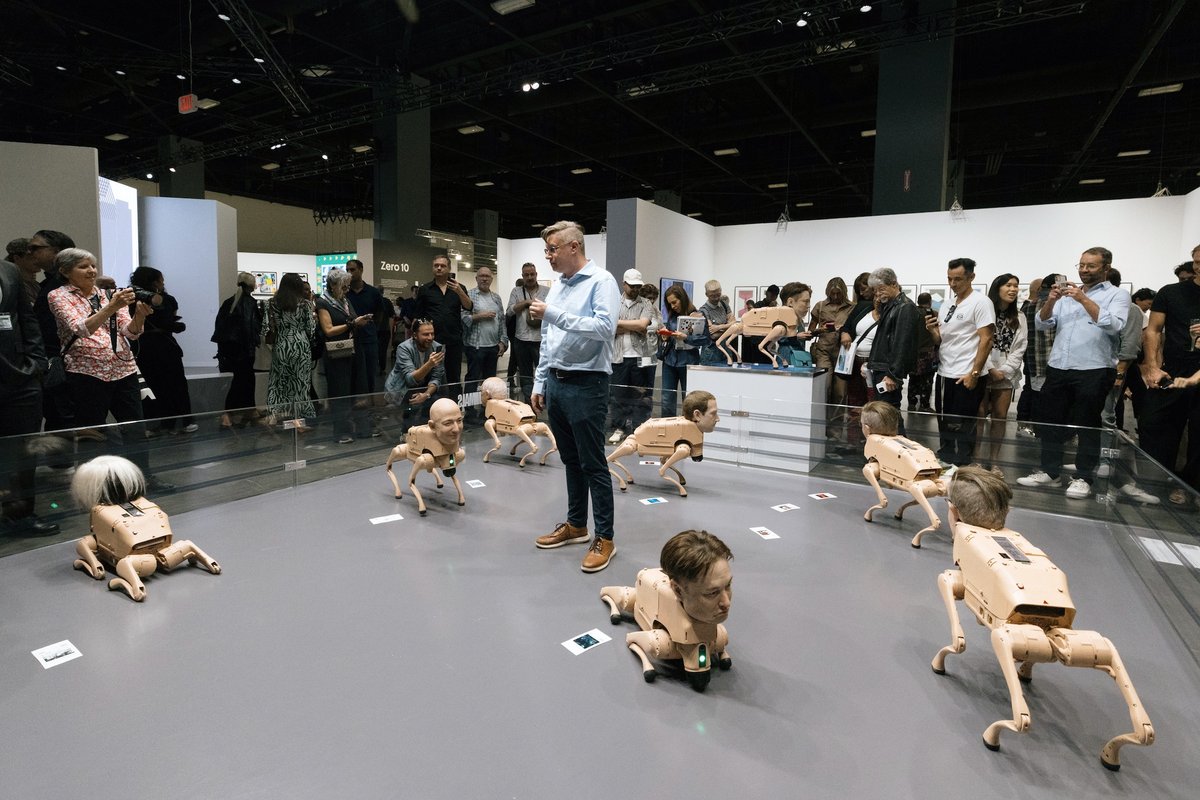
His presentation at Zero 10, Regular Animals (2025), was composed of dog-like robots in the style of those developed by the company Boston Dynamics, most recently tied to controversy due to their use by police forces against civilians, presented in a petting zoo-like pen. Tan-hued with ultra-realistic humanoid masks of Kim Jong-un, Andy Warhol, Pablo Picasso, Jeff Bezos, Mark Zuckerberg, Elon Musk and Beeple himself, the robots scanned their surroundings and “pooped” out collectible images, a groan-inducing attempt at meta-humour by the artist.
The arrogance of Beeple featuring himself among these figures aside, this coterie of dictators, art stars and tech billionaires might have been ripe for real critique. Cuts to US government agencies made by Musk’s Department of Government Efficiency have been linked to the deaths of hundreds of thousands of people following the overnight abandonment of medical assistance, food aid and other programmes. Kim’s government in North Korea is known for executing people who exercise free speech, even for sharing films or other media, among many, many other atrocities. Picasso’s abuse of women is well documented but has done little to dampen his image as a paragon of Modern artistic genius. Bezos’s current net worth of over $239bn was earned in part on the backs of workers whose efforts at unionising are continually opposed.
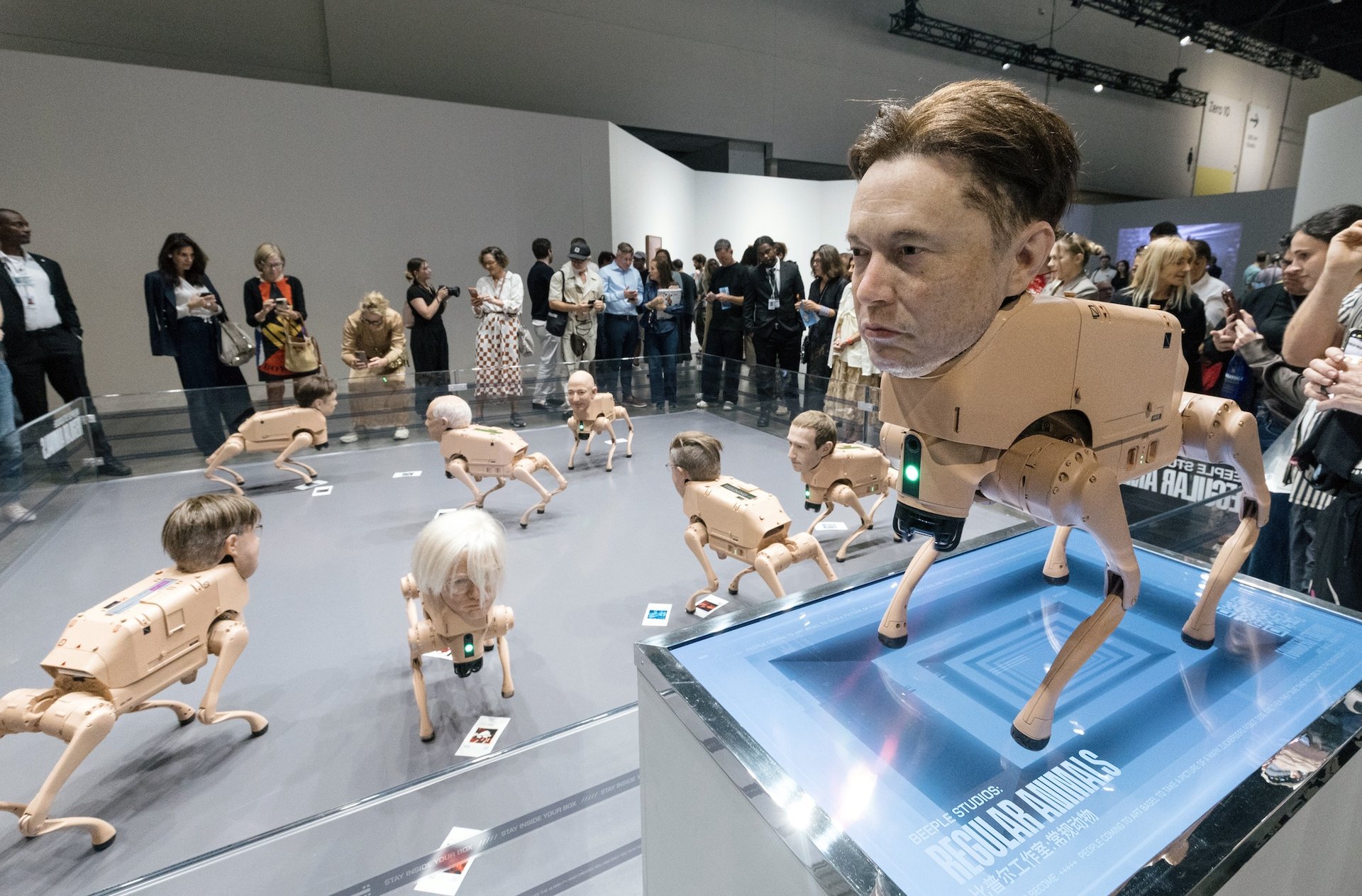
A robot dog depicting Elon Musk, the richest person in the world, was featured in Beeple's project Regular Animals (2025) at Art Basel Miami Beach Liliana Mora
Despite presenting the many contemporary (d)evils of the world, Guernica this installation was not. Regular Animals hinged on the cult of personality and the context of Art Basel Miami Beach, a setting that perhaps exonerates Beeple’s protagonists by virtue of being presented whimsically or defiantly. Perhaps the message is that shallow satire eclipses any misdeeds because it renders the perpetrators artistic and therefore beyond reproach?
Conflating attention with substance is a mistake any artist can be forgiven for making, especially in the spectacle-driven context of Art Basel Miami Beach. Seeking attention at an art fair is not a crime. The crime committed, if it can be called as such, is that Beeple and this installation were rhetorically positioned as the pinnacle of digital art today. The implication seemed to be that the installation’s relative commercial success ($100,000 per robot, which were sold out before the fair even opened to VIPs) and its virality represented a valid and even exemplary path forward for digital art.
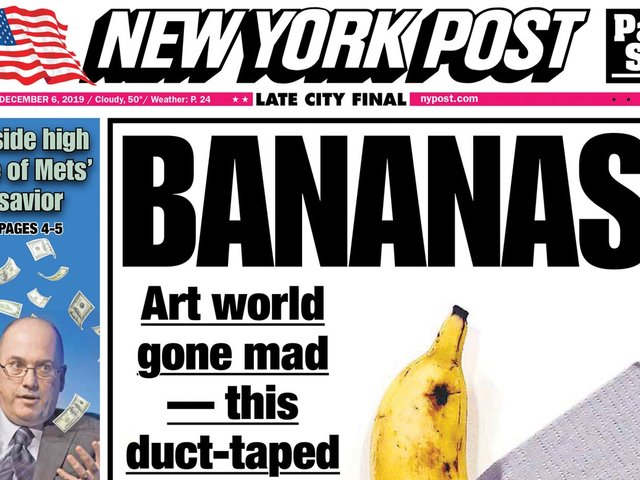
Regular Animals treads thin ice, chasing after the status of Maurizio Cattelan’s Comedian (2019) with an installation that hinges on shock value, while seemingly idolising public figures whose legacies are mixed at best, destructive at worst. It is an eye-watering reminder that the most influential and expensive digital artists at the top of the pyramid might have arrived there because they are very good internet users, not necessarily good artists.
It is crucial for the digital art community, as well as the media that covers it, to recognise that this reactionary, adolescent approach does not have to define digital art. Digital art does not need to be viral or so exhaustingly post-internet. It does not have to be defined or governed by the rules of the internet at all. Cryptocurrency culture has led to a paradigm shift wherein viral fame and shock value, rather than conceptual heft, seem to determine value, and consequently even enabled some artists to present at an Art Basel fair without passing through the traditional art world filters. The implication seems to be that those filters are somehow incapable of vetting digital art and that doing so requires different metrics and channels. Ironically, most digital art that successfully passes through those filters has been much more likely to stand the test of time.
What also warrants investigation is the unwillingness of art and crypto media to interrogate these spectacles with any rigor. You would be hard pressed to find any publication on digital art that criticises Beeple or his cohort. At best this betrays a colossal lack of critical thinking, or perhaps an erroneous belief that fostering community and establishing new champions for one’s field requires unquestioning fandom. At worst it elevates digital art that is kept alive by its own arrogance and its preference for spectacle over substance. For his part, Beeple has tended to dismiss criticism from the traditional art world, taking to X to promote it as proof of the installation’s (and his own) artistic credentials.
Life on the internet does often require emotional callouses of teflon, but the notion that negative feedback confirms an artist’s success by serving as proof that he is misunderstood or ahead of his time is narcissistic. It is also symptomatic of a defensive crypto-bro culture that has alienated public support for digital art in the aftermath of the NFT (non-fungible token) bubble bursting.
The digital art world is not doing its denizens any favours by continuing to champion hollow spectacles. The culture of fandom will continue to create cognitive dissonance in artists who mistake their own celebrity for artistic success, unless we begin to hold all digital art to a higher standard.