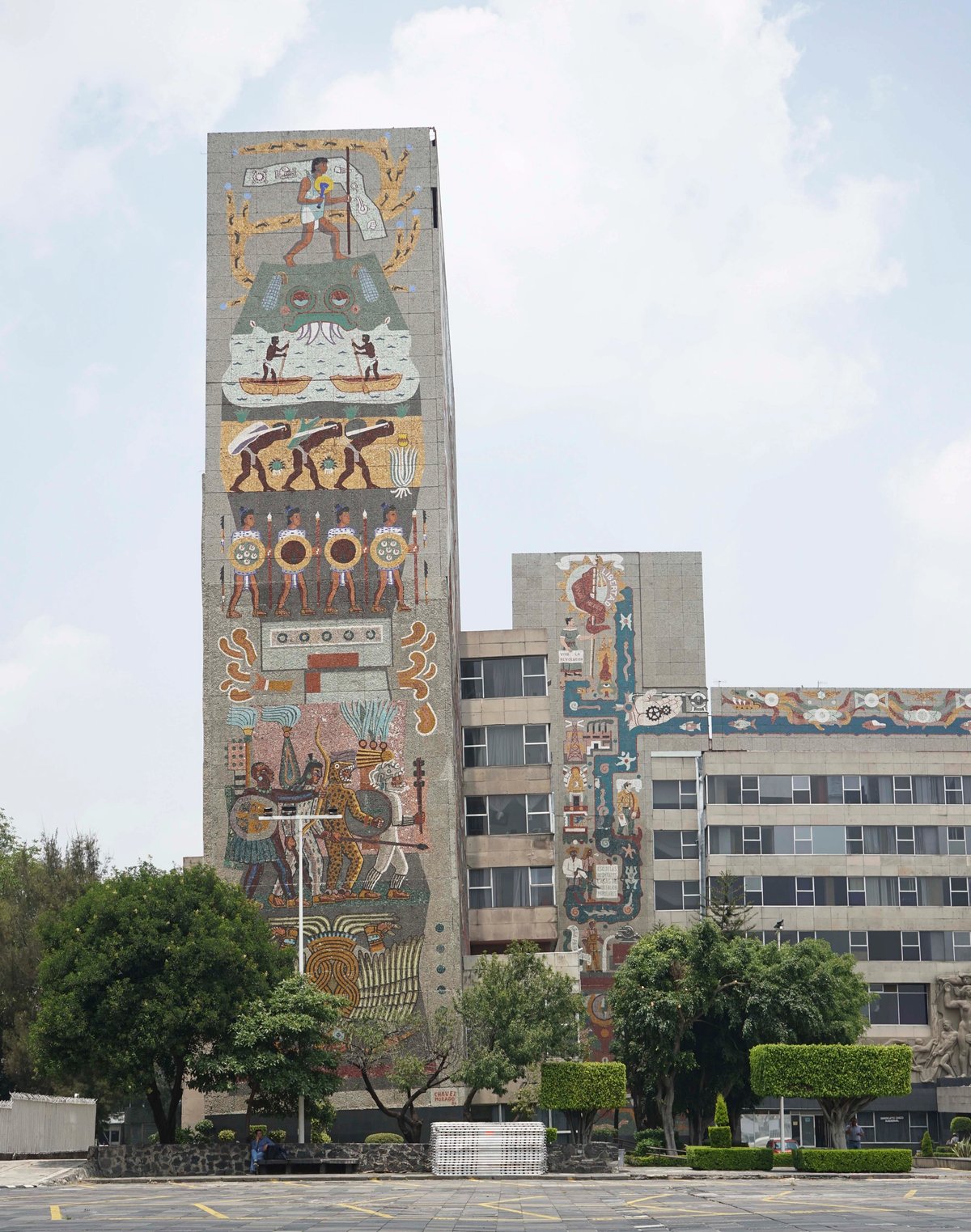
How does one protect heritage that no longer exists as it was intended? This is one of many questions surrounding the 6,000 sq. m of stone mosaic murals, sculptures and reliefs that once adorned Centro SCOP, the former headquarters of Mexico’s Ministry of Communications and Public Works.
Inaugurated in 1954 in Mexico City, the site was home to one of the world’s largest groups of mosaic murals, but it suffered greatly from major earthquakes in 1985 and 2017. After years of controversy, structural instability caused by the latter earthquake led to the complex’s demolition. Its murals were removed and are in storage. Yet the future of the works, and of the site, remains uncertain.
Centro SCOP embodies Mexico’s 1950s “plastic integration”, combining art with functionalist architecture for social purposes—a theoretical approach central to Muralism, whose most well-known practitioner early on was Diego Rivera. At Centro SCOP, Mexican artists like Juan O’Gorman—who worked on the famous stone mosaic murals at the National Autonomous University of Mexico’s (UNAM) library—along with José Chávez Morado and others, created an intricate narrative of national identity across more than a dozen murals. Made using local stones from different regions embedded into concrete panels, the works drew on both pre-Hispanic motifs and Modernism. An adjacent residential complex once housed SCOP’s workers. The architect Carlos Lazo, then-SCOP minister and the planner of UNAM’s campus, was key to the collective project.
“The murals functioned as a backdrop for the authority rituals enacted by the developmentalist state,” Renato González Mello, a Muralism expert at UNAM’s Institute of Aesthetic Research, tells The Art Newspaper. “They were part of a much larger project.”
From the outset, Centro SCOP had its problems. The complex was built atop an unfinished hospital with a defective foundation. On 19 September 1985, an earthquake caused the main building’s top levels to collapse, killing at least 14 workers and destroying a number of murals. Between 1988 and 1995, many murals were reconstructed—with alterations—and installed on temporary structures. In 2017, exactly 32 years to the day after the first disaster, a second earthquake again devastated the compound.
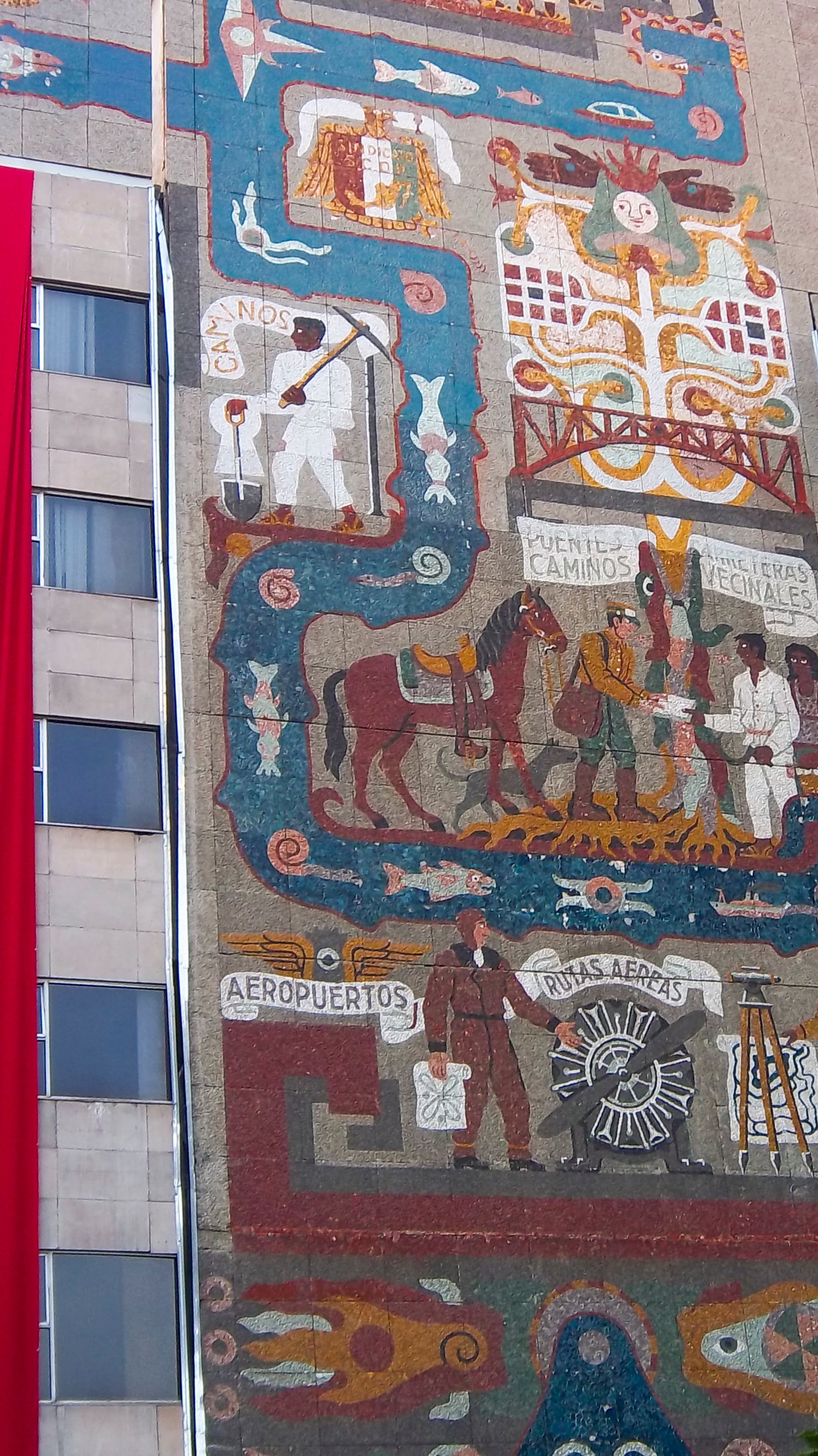
Close-up of one of the Centro SCOP murals Photo: Oswaldo Bautista
A delicate procedure
Initial plans for the future of Centro SCOP were announced in 2018. These included relocating the murals to a new airport. The Mexican restoration firm CAV Diseño e Ingeniería was tasked with removing more than 4,000 sq. m of murals, mainly post-1985 replicas. This relocation prompted opposition from the academic community and the citizen collective En Defensa del Centro SCOP. Joint efforts halted the project. (In fact, the whole airport was scrapped later that year in a corruption scandal.) The public debate also led to a rise in research into the history of Centro SCOP and its murals. The first comprehensive study of the murals appears in a book coordinated by González, Los murales del Centro SCOP. Historia y conservación (2024), which was first envisioned in 2018 as an “intellectual action” to protect them, uncovering key historical documents and photographs in the process.
In 2023, CAV carried out a second, far more delicate phase—removing around 2,000 sq. m of the original murals. “We implemented a vibration-monitoring system to protect the integrity of each panel,” says Ramón Velázquez, CAV’s director. “No panels were lost,” says CAV’s restoration manager, Liliana Olvera.
With the murals removed, Centro SCOP—deemed in danger of collapse—could safely be demolished. The lengthy process for national-heritage recognition, to protect the murals and repurpose the site for public use, concluded in October 2023. “This delay reflects the legal gap in 20th-century Mexican heritage protection,” González says, noting that the compound’s previous government use may also have contributed.
In December 2023, the construction firm Ignitia Desarrollos was chosen to develop the site into a public space and museum called Mexican Muralism Park, with the murals reinstalled on new structures near their original locations—the old buildings’ foundations remain, as it was too complicated to remove them. Daniel Filloy, an architect and Ignitia’s director of projects, says the plan “preserves the murals’ narrative and honours the centre’s dual legacy, cultural and political, while transforming it into a dynamic public space”.
Full demolition was complete by April 2024, yet the site remains a place of debris and dust—plans for its future keep changing. In August last year Mexico City’s mayor, Clara Brugada, announced that the site would host one of 100 new “Utopias” across the city—a pet project aiming to improve local well-being. Few details have been shared, but plans for the Mexican Muralism Utopia on the old Centro SCOP site appear to include a pool and sports facilities, and spaces for community programming for the elderly and mural-making classes. At a press conference this past summer, Raúl Basulto, the city’s minister of public works, noted that the project “takes into consideration the murals’ protection and restoration”.
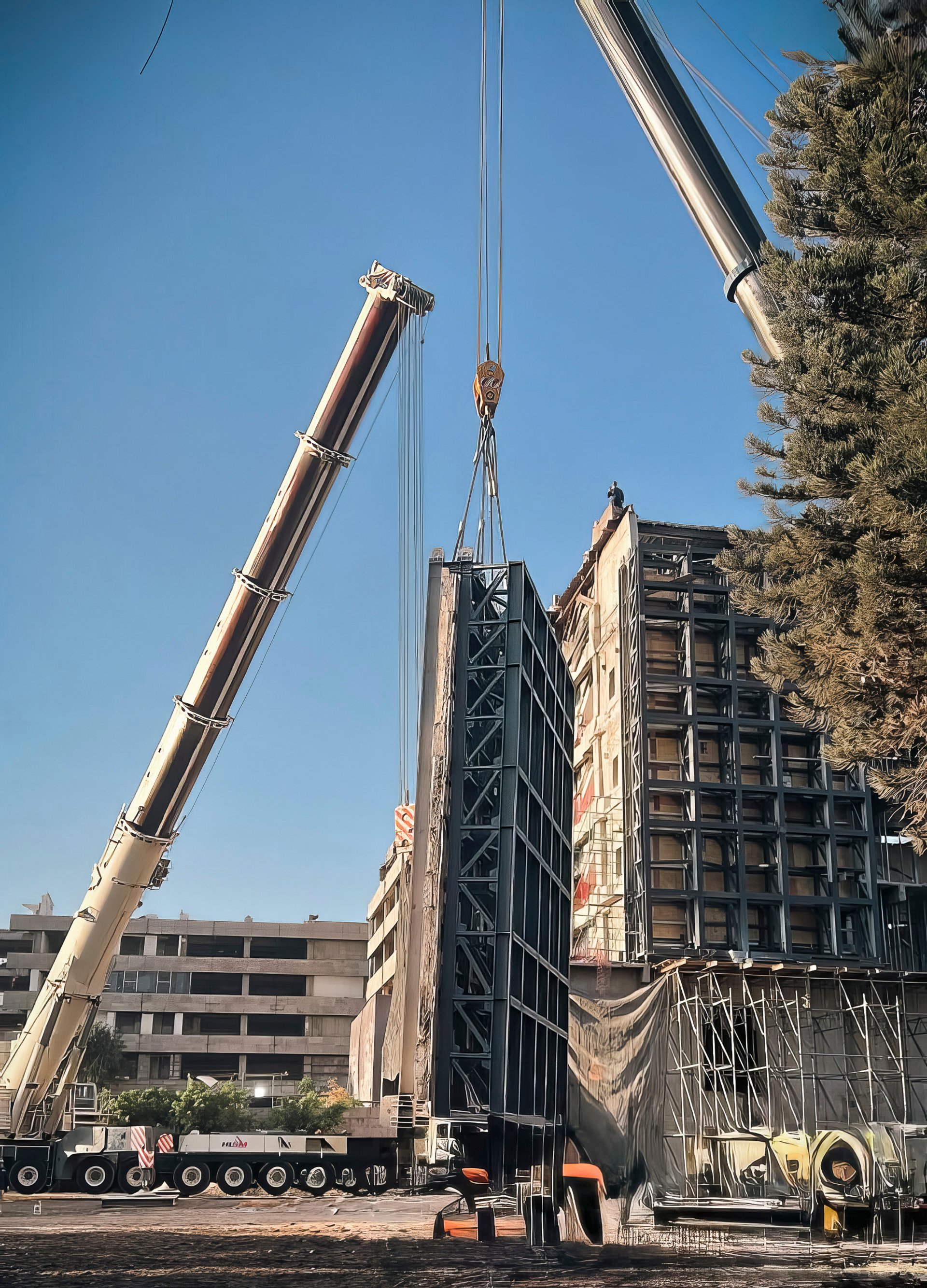
The Centro SCOP’s murals were carefully removed using a complex process Courtesy CAV Diseño e Ingeniería
It is unclear whether the Ignitia project, for which the federal government reportedly paid 36m pesos (almost $2m), will be integrated into the Mexican Muralism Utopia. City authorities, the Ministry of Infrastructure, Communications and Transport (formerly SCOP) and the Ministry of Culture did not respond to requests for comment.
Furthermore, the reinstallation of the murals would be extremely challenging. “This is a landmark of Mexican art and one of the most complex restoration endeavours in the country’s heritage,” González says. “The murals’ formal and symbolic order is vital—there may be no ideal solution, but it must rest on sound reasoning.”
Unfortunately, some of the panels appear to be kept in suboptimal conditions. “Some are placed horizontally,” Olvera says, which adds weight and vibrations that could cause further damage. “It is also crucial to determine whether restoration will prioritise material or image, as many stones have decayed over 70 years.”
Residents of the adjacent residential complex, which houses more than 500 families, are worried about the new construction’s sustainability. “There is uncertainty about the project, including how and who will maintain the facilities,” says Héctor Lozano, who has lived there for more than 25 years. He notes that insufficient infrastructure is also a concern.
Amid uncertainty, everyone The Art Newspaper spoke to concurs on the need for transparency and dialogue, which thus far appears to be lacking. As a site key to Mexico City’s memory remains in limbo and the murals wait patiently in storage, questions continue to linger. “Once reconstructed, the murals will stand on a new stage,” González says. “The question is—what kind of stage will that be?”