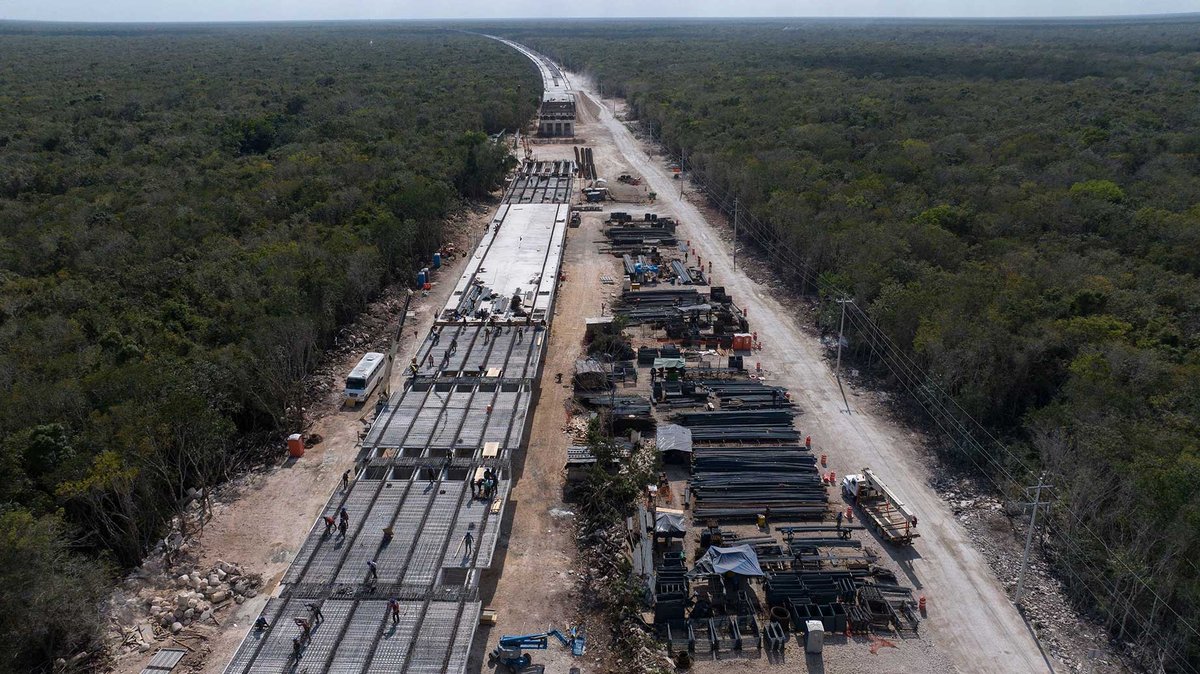
A giant banner Greenpeace activists unfurled on the 341ft-tall Estela de la Luz tower in Mexico City in late September read: “The Mayan jungle cries out!” It was one of the most high-profile actions to date denouncing ecological damage caused by the Maya Train and other industries in Mexico’s south east. The action followed years of protests over the train’s growing ecological impacts as it expands into freight and is expected to be extended into Guatemala and Belize.
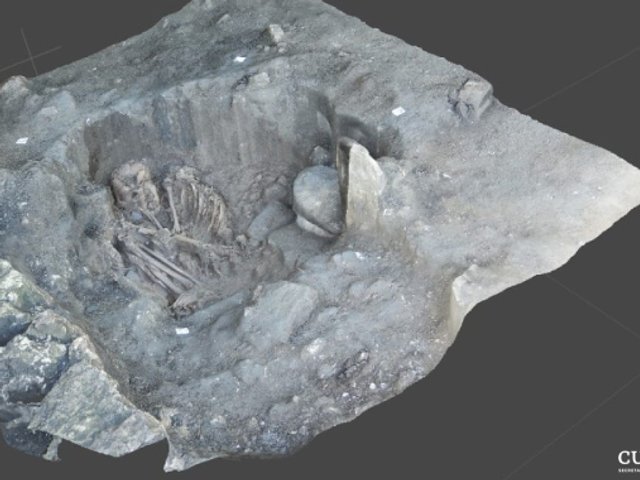
Criticisms of the project are both ecological and cultural; experts have long denounced archaeological destruction along the 1,554km of rails across the Yucatán Peninsula. Debates about the safekeeping of the region’s heritage reignited on 26 August, when Mexico’s Instituto Nacional de Antropología e Historia (INAH) announced that some of the archaeological structures affected are being relocated to two sites in the states of Quintana Roo and Campeche.
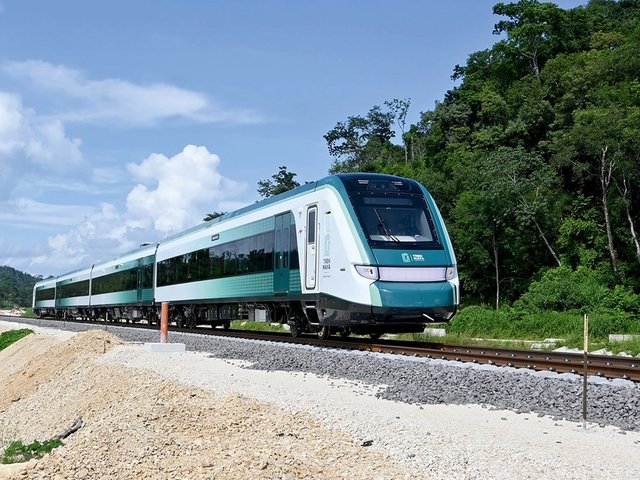
The Maya Train, a pet megaproject of the former Mexican president Andrés Manuel López Obrador that has been continued by his successor Claudia Sheinbaum, has long been polarising. Supporters have framed the project as a means of development for marginalised communities. Critics say it poses a threat to heritage sites and the environment. The first trains started ferrying visitors between cities and Maya archaeological sites in the region in December 2023.
In April, construction of the train’s freight service began and, on 15 August, the government revealed plans to extend the network into Guatemala and Belize. The same day, the new Great Mayan Jungle Biocultural Corridor—spanning Guatemala and Belize and intended to protect over 5.7 million hectares—was announced, alongside the institution of the Great Mayan Jungle Day.
The broad use of the term “Maya” is also part of what experts have dubbed “Mayanisation”. “It recognises Maya identity as a foundation for collective rights but is also a tool for heritage branding and tourist commercialisation,” says Marco Almeida Poot, a social anthropologist at the Universidad Autónoma de Yucatán in Mérida. “The train uses this imagery for political legitimisation anchored in the ethnonym’s commercial appeal.”
The train’s ecological impact extends to infrastructure, including new freight facilities affecting over 147 hectares of jungle. “Direct impacts—like deforestation and damage to mangroves and cenotes (natural sinkholes filled with groundwater)—are measurable, but indirect effects from expanding agriculture and infrastructure are broader and harder to mitigate,” says Luis Zambrano, an ecology expert at the Universidad Nacional Autónoma’s institute of biology who has long studied the project.
Endangered species like jaguars are affected by the train and related infrastructure; hundreds of wild animals are killed on Yucatán’s roads annually, according to Profepa, an agency of Mexico’s environmental ministry. Ironically, the Maya Train’s mascot is a toy jaguar named Temayín. The Mexican artists Eduardo Abaroa and Emilio Chapela, in collaboration with the anthropologist Sandra Rozental, pointed out the contradiction by including a ripped Temayín toy in a show at the Museo Amparo in Puebla focused on the Usumacinta River, which the train crosses in Tabasco.
“This is the continent’s second lung after the Amazon,” Carlos Samayoa, the leader of the Greenpeace campaign behind the 23 September banner unfurling, says of the Yucatán Peninsula’s jungles. The biocultural corridor agreement is positive, he adds, but its implementation is yet to be seen. “The problem involves other regions,” Samayoa says. “Often, insufficient budgets and a lack of real-life measures contravene government discourse.”
Zambrano warns about the effects over the next 25 years. “The train’s tourist and added freight use along its planned expansion significantly speeds up the deterioration of already fragile ecosystems,” he says. “Some damage, like to cenotes [natural sinkholes], is irreversible.”
‘Disneyfication’ of heritage
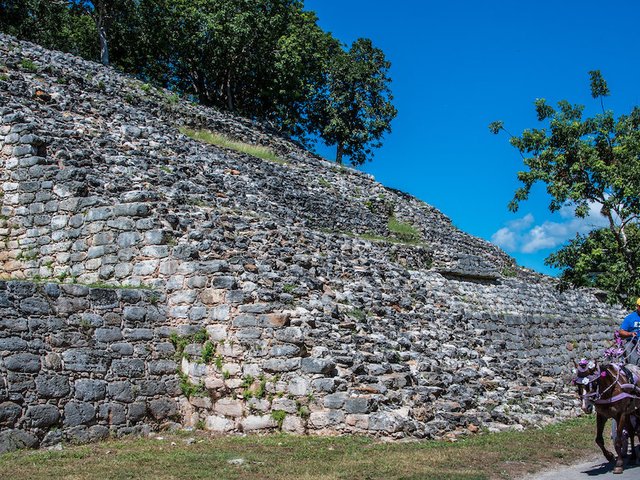
By year’s end, INAH plans to open two destinations showcasing buildings and other artefacts affected during construction and relocated. Balam Tun, in Chetumal, is to feature 36 reconstructed pyramidal bases, while K’awiil, in Campeche, will display 12 reconstructed structures near the Xpujil train station.
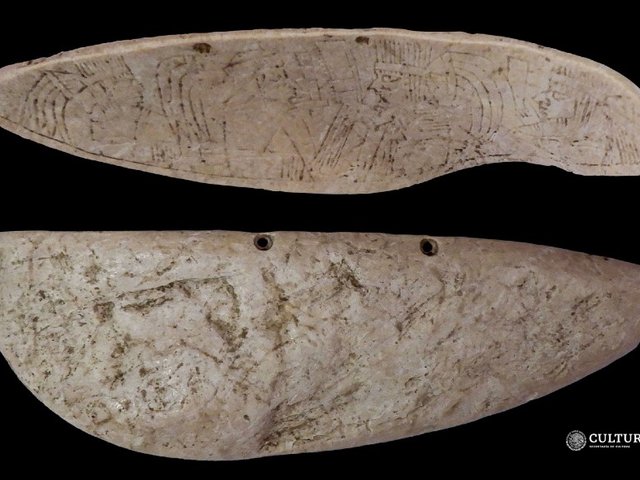
INAH has reported finding more than 870,000 archaeological pieces to date during Maya Train construction. In an announcement, the institute claimed that relocations were carried out with “millimetric precision” using advanced technology in accordance with international standards. But experts have raised concerns about the artefacts’ and structures’ decontextualisation, prompting an amendment to a lawsuit denouncing the project’s heritage impact that was filed in 2020—which is still unanswered.
“The Yucatán Peninsula is covered in archaeological vestiges. Still, preventive measures should have been taken,” says Juan Manuel Sandoval, a social anthropologist who has documented archaeological destruction during the military-led construction projects and is one of the plaintiffs in the lawsuit along with other experts. “The new parks falsify history: this is a Disneyfication and commercialisation of Mexican archaeological heritage.” He adds that pre-Hispanic heritage in Mexico is protected by a 1972 law that does not address relocation.
Manuel Pérez Rivas, the archaeological salvage co-ordinator for Maya Train, has stated that the relocation of monuments has been pursued only as a last resort to save them. “No complete structures were transferred as some were already damaged,” he told the Mexican newspaper Reforma. INAH did not respond to The Art Newspaper’s questions.
“These parks are the clearest example of the destruction we’ve long discussed and they’ve long denied,” says Fernando Cortés de Brasdefer, an INAH archaeologist who has denounced archaeological destruction during the project, the extent of which may never be known as not all findings were documented. “Those structures lost their historical value when they were disassembled and extracted from their archaeological, spatial and astronomical context and separated from their cosmological meaning.”
Concern is not limited to experts in the region. At the 47th session of the World Heritage Committee in Paris in July, Unesco acknowledged INAH’s Promeza programme—intended to improve heritage sites and institutions like Calakmul’s new museum, inaugurated in September 2024 and coinciding with the reopening of the Mayan site—but noted the absence of a strategic environmental assessment. A monitoring mission to the region is planned, though with no date announced. In September, the International Tribunal for the Rights of Nature also reiterated its stance, describing the project as “ecocide and ethnocide” and alleging violations of Mayan communities’ rights.
According to analysis by the non-profit México Evalúa, published by DW, the Maya Train relies heavily on federal subsidies; its revenue in 2024 amounted to just 10% of its operating costs, which totalled more than $141m. The project is also draining resources from INAH and other federal institutions. Officials argue that the freight service will improve the project’s viability, although Maya Train director Óscar Lozano has said that it may not break even until the end of the decade.
Reflecting on the Maya Train’s enormous economic, ecological and heritage costs, Cortés asks: “Was it more important to build the train over those ancient Maya towns and cities than to save them?”