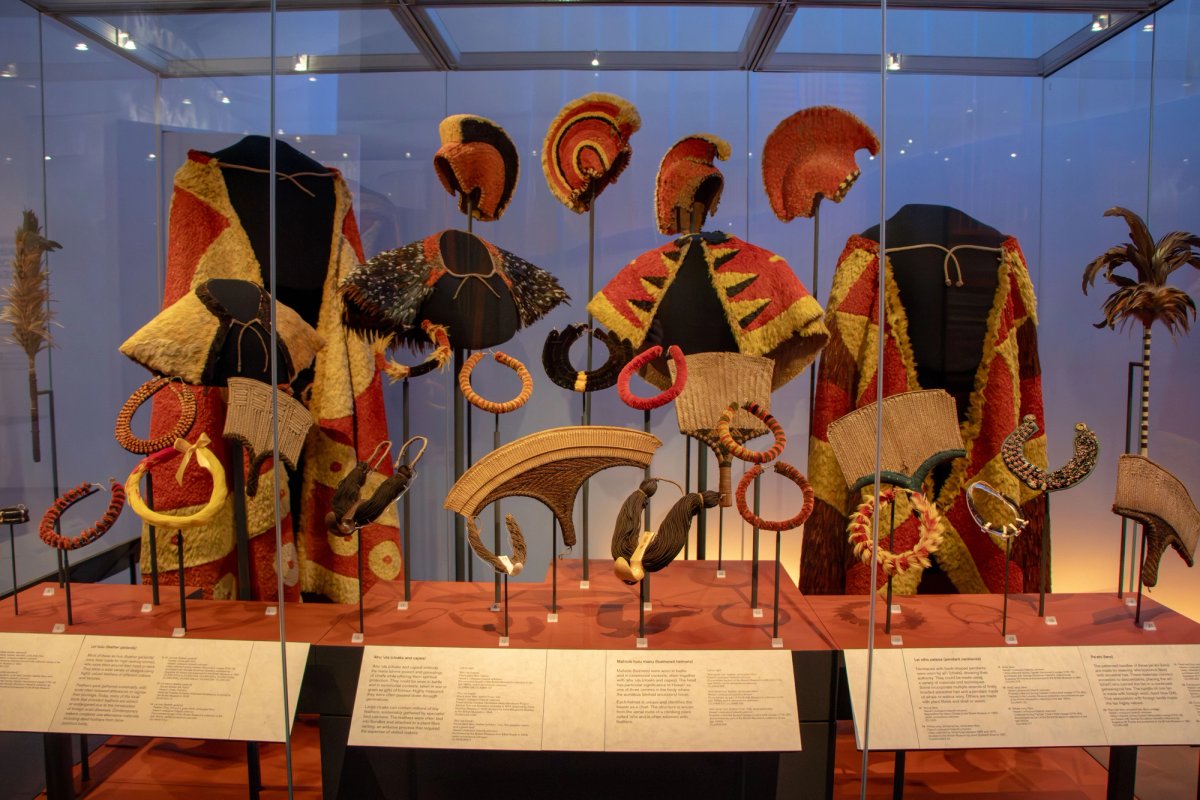
The British Museum in London shines a light on the ties that bind Hawaii and the UK in a new blockbuster show opening this month (15 January-25 May). The accompanying catalogue for Hawai‘i: a Kingdom Crossing Oceans features more than 150 works, from ancient Hawaiian treasures to important contemporary pieces, telling “a compelling story of movement, allyship and cultural exchange [between the UK and Hawaii]”. An inventory of the entire collection of Native Hawaiian works housed at the British Museum, the largest collection outside of Hawaii, is included in the catalogue. Below, Alice Christophe, the curator and head of Oceania at the British Museum, picks some of the top objects, explaining their significance in the catalogue and show.
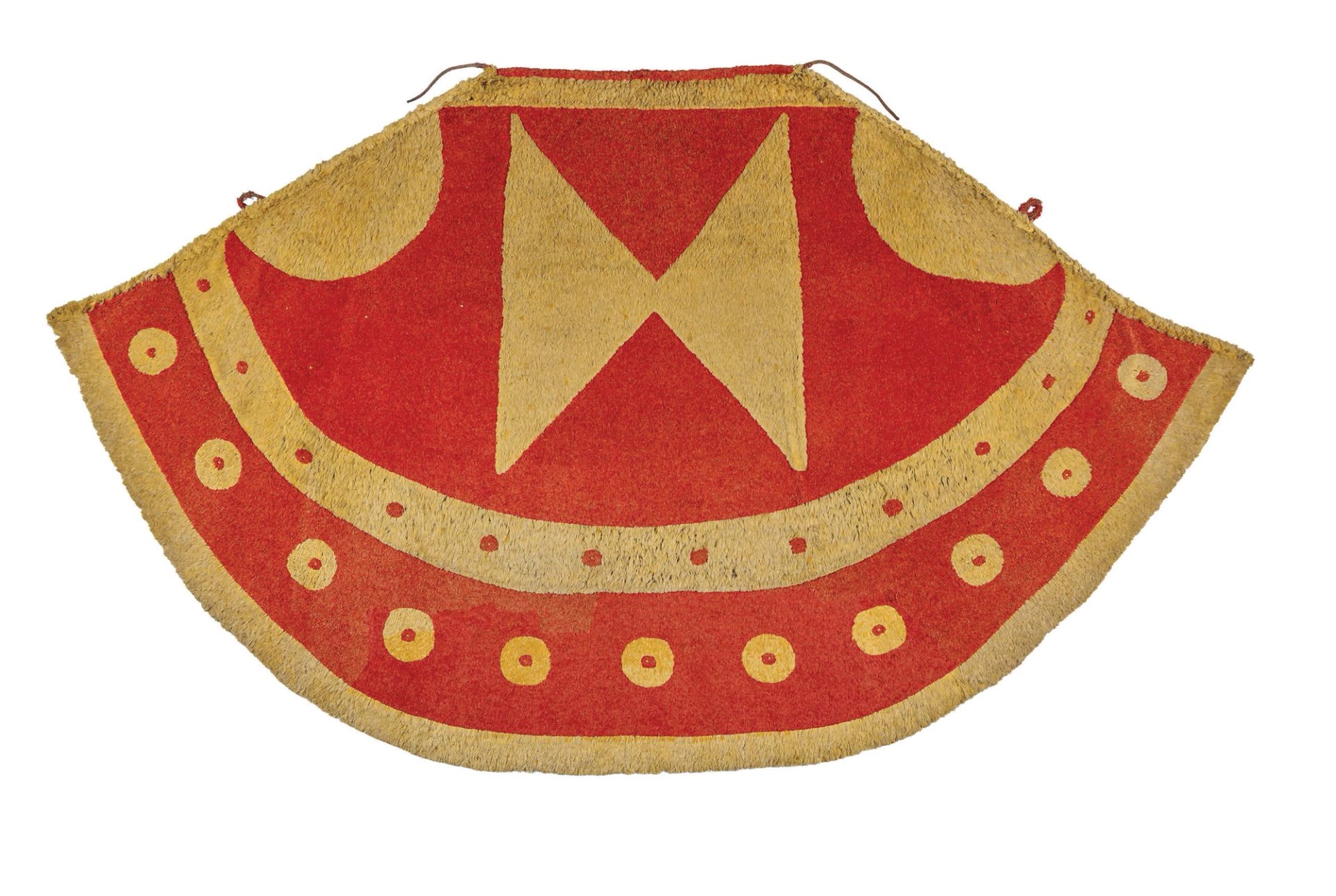
This ‘ahu ‘ula cloak, made of hundreds of thousands of tiny feathers, was created for a high-ranking chief © The Trustees of the British Museum
‘Ahu ‘ula (cloak), Maui, mid-late 18th century
The first section of the catalogue sheds light on the relationship between gods, chiefs and people, and their connection to the land. This relationship is epitomised by this large ‘ahu ‘ula, a cloak made of hundreds of thousands of tiny feathers, tied to a net backing. Created for a high-ranking chief, this exquisite garment would have mobilised multiple groups of experts; these include the bird catchers who collected feathers from upland forest birds before releasing them—allowing the feathers to grow back in time for the next harvest—and the workers who assembled the feathers into small bundles before affixing them onto a net made of olonā, a plant of the nettle family and endemic to Hawaii.
Research suggests that this ‘ahu ‘ula is likely one gifted by the High Chief Kahekili of Maui island to the British captain Charles Clerke when the two met off the coast of Maui on 26 November 1778, during the third voyage of Captain James Cook.
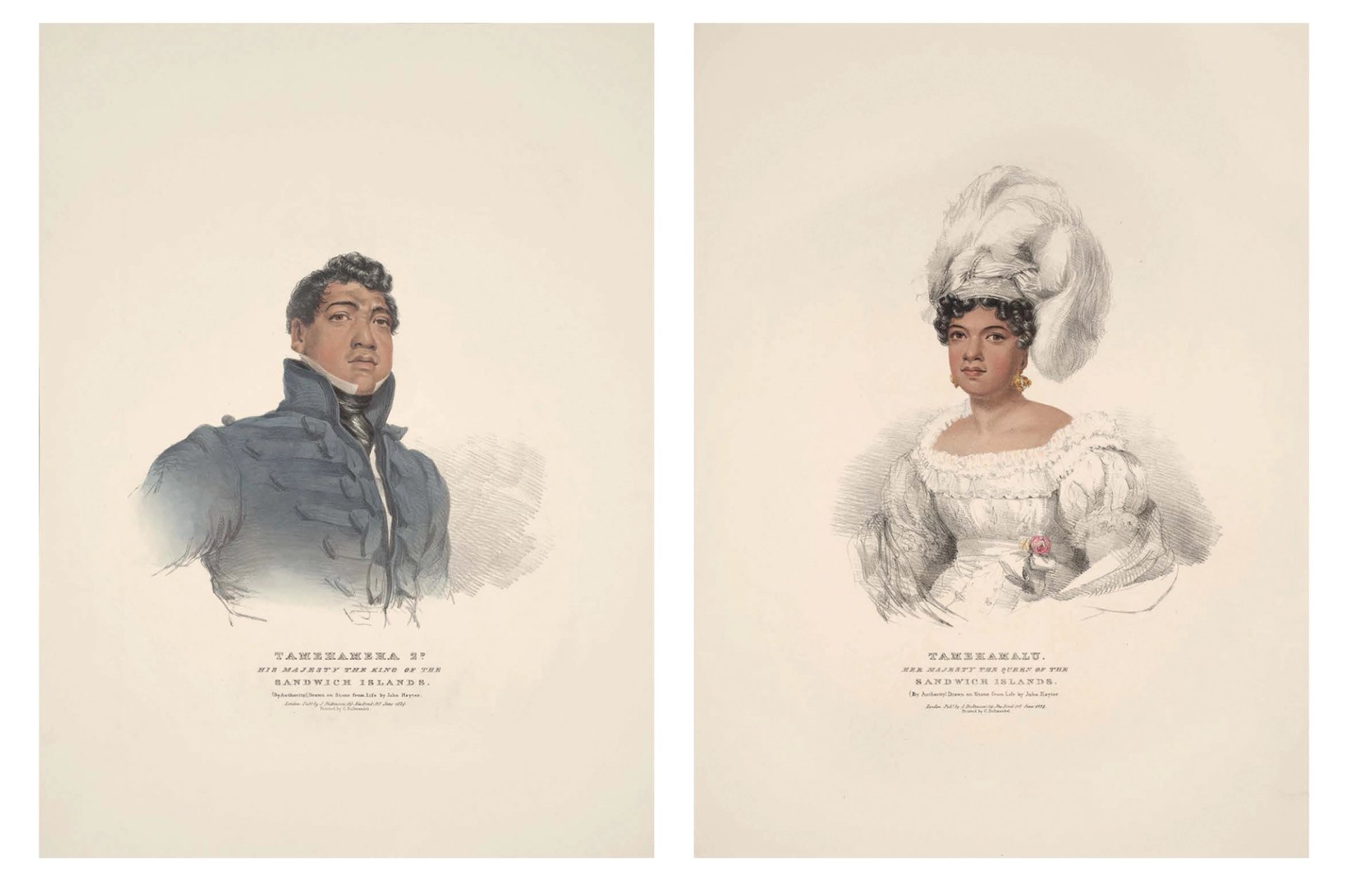
John Hayter’s portraits of Kamehameha II and Queen Kamāmalu, made when they visited London in 1824 © The Trustees of the British Museum
Kamehameha II, His Majesty the King of the Sandwich Islands and Tamehamalu Her Majesty the Queen of the Sandwich Islands (both 1824)
The late 18th and early 19th centuries brought tremendous change to Hawaii, a process driven both internally and externally. As the presence of foreign powers increased in the islands, Kamehameha I, a chief of Hawaii Island, progressively unified the entire archipelago under his rule and became the first king of Hawaii.
A remarkable strategic leader, he also nurtured relationships with foreign powers. After his passing, his son and successor, King Liholiho (Kamehameha II), followed the path charted by his father; in 1823, the young king embarked on a journey to London to seek alliance and protection from the British Crown, accompanied by a delegation of 11, including Queen Kamāmalu (also known as Tamehamalu). This was the first recorded journey of a Hawaiian royal delegation to the UK, a transformative sequence of events that is brought to light in the second section of the book and captured in these two lithographic portraits.
The portraits, “drawn on stone” by the British court artist John Hayter, depict the Hawaiian king and queen having reached London in May 1824 after five months at sea. Hawaiian royals, dignified and self-fashioned in western garments, present themselves not as subjects but as sovereign peers, projecting an image of Hawaii as a global nation. While their journey was marked by tragedy—the king and queen caught measles and passed away in London before having met the British king—their portraits and the message they carried were diffused across the country and well beyond British shores.
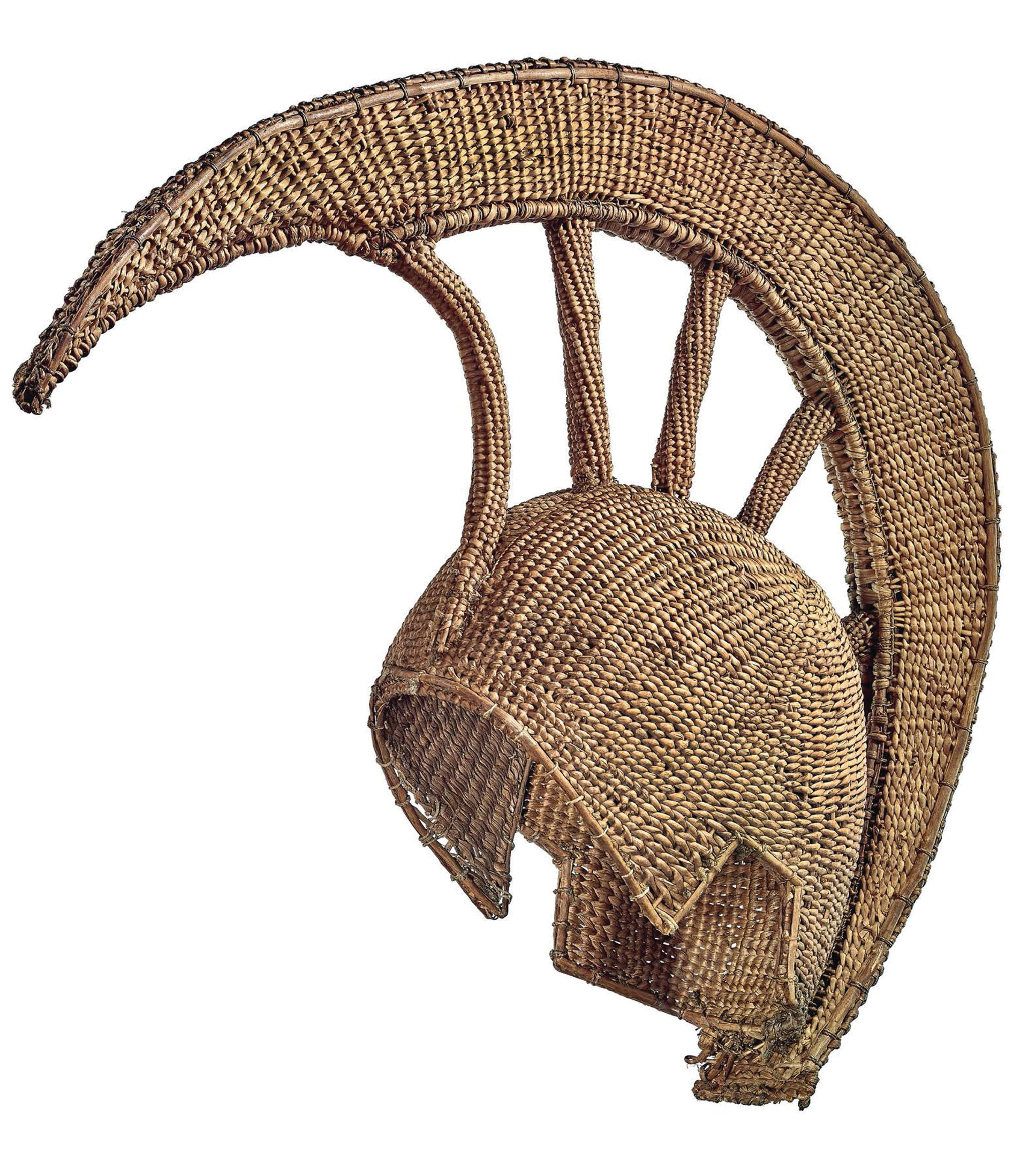
This mahiole was created using the long aerial roots of the woody climber ‘ie ‘ie plant © The Trustees of the British Museum
Mahiole (helmet), possibly 18th century
This tall, crested helmet is one of over 150 mea kupuna (ancestral works) featured in the book and the exhibition; the exact trajectory that carried it from Hawaii to London is only partially known. It may have been made for an unidentified Hawaiian chief and collected during the voyages of Captain George Vancouver to Hawaii in the late 18th century. Little was known about its making until the contemporary artists Kumulā’au Sing and Haunani Balino-Sing came to the British Museum in 2022.
They were part of a delegation travelling from Hawaii to engage in the stewardship of important ancestral works now at the British Museum, and to reflect on renewed means to bridge physical, cultural and spiritual care. The Sings, who specialise in weaving and twining, sat with this mahiole for a while, examining the long aerial roots that composed its cap and crest, those of the ‘ie ‘ie plant, a woody climber that is regarded in Hawaii as the sign of a healthy forest. Upon their return home to Hawaii, the Sings undertook to weave a piece inspired by the learnings gathered that day, also teaching a new generation of weavers along the way.
This thread of generational and generative movement, running throughout the book, is carried forward in a closing section: an imaged inventory of the entire collection of Native Hawaiian works under the physical care of the British Museum, the largest and most significant collection outside of Hawaii and an embodiment of the multifaceted relationship between Hawaii and the UK.
• Alice Christophe (ed), Hawai’i: a Kingdom Crossing Oceans, British Museum Press, 304pp, £30 (hb)