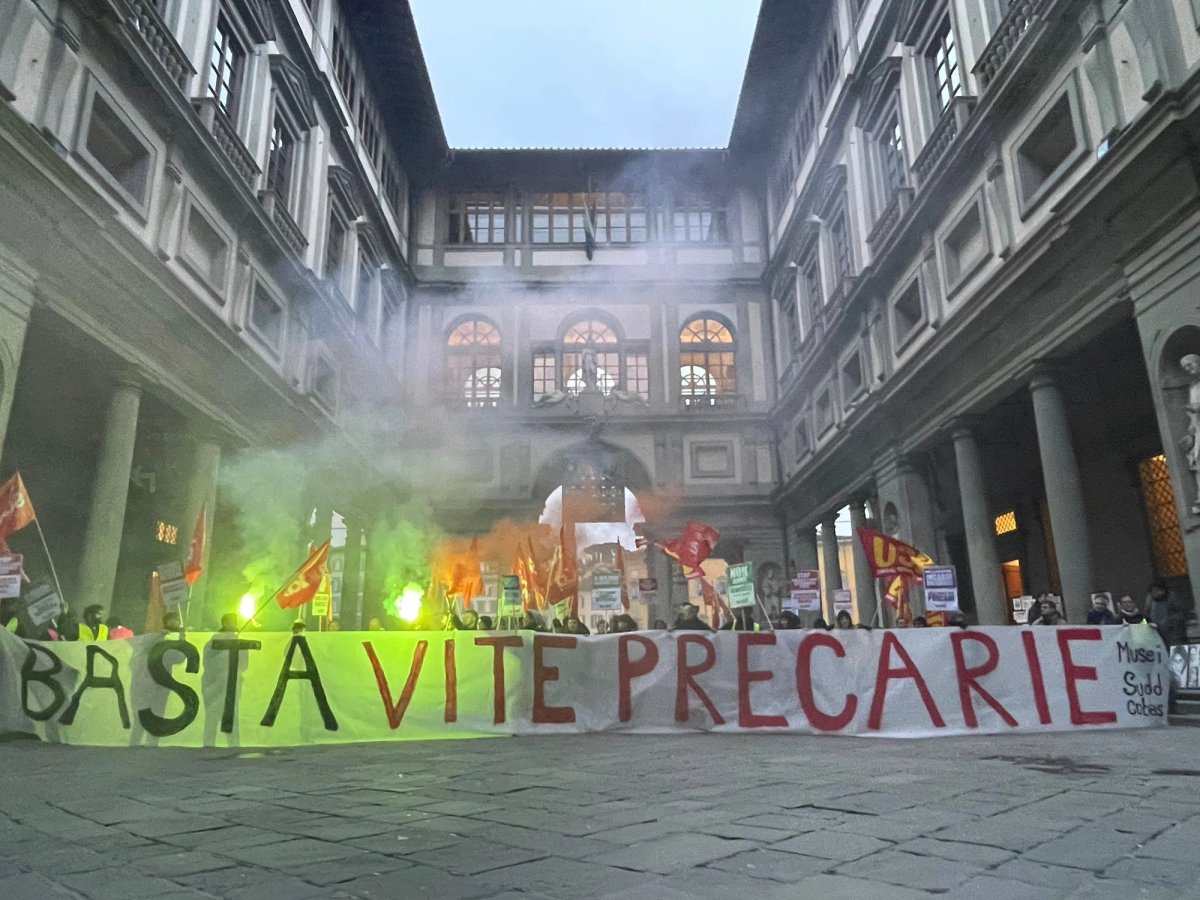
More than 100 workers protested at the Gallerie degli Uffizi in Florence on Sunday (4 January) after temporary staff working at the museum via an external contractor lost their positions.
Carrying placards, flags and flares, demonstrators gathered in Piazzale degli Uffizi—the museum’s long internal courtyard—behind a large banner reading “No more precarious lives”.
“New Year’s resolution: continue working together with the workers of the Uffizi Galleries,” the trade union Sudd Cobas, which organised the protest, wrote on Instagram. “What’s at stake is a different idea of work, of the city, of culture.”
The dispute centres on the fate of casual workers following a change in service providers at the museum. In September last year, Opera Laboratori Fiorentini—the company that had managed ticketing, surveillance and hospitality services at the Uffizi since 2006—was replaced by competitor CoopCulture. While employees on permanent contracts retained their positions, some temporary workers assigned to security, reception, ticketing, the bookshop and the cloakroom were not rehired.
According to Sudd Cobas, former employees who were on nine-month seasonal contracts have been replaced by new staff hired on more flexible, on-call contracts. The union says some of those affected had worked at the Uffizi on temporary contracts for more than a decade. Workers at other Florence museums now served by CoopCulture—including the regional directorate of museums of Tuscany and the art restoration institution Opificio delle pietre dure—have also been affected.
“Florence’s tourism economy cannot continue to rely on low-paid and precarious work,” the union said in a statement. “It’s time that all temporary workers are given permanent contracts.”
In a written statement, CoopCulture told The Art Newspaper it had updated employment arrangements “in full compliance with the provisions of the tender notice, which included a list of workers for whom continuity of employment had to be guaranteed”. The company added that workers on fixed-term contracts with the previous concessionaire “were not included in the procedure and are therefore not linked to the new concession”.
A delegation of union representatives and workers is expected to meet with Dario Danti, Florence’s deputy mayor for labour, in the coming days. The union has also appealed to the Tuscany regional government for support and called on Simone Verde, the director of the Uffizi Galleries, to take a “strong stance” on the issue.
Responding to The Art Newspaper, an Uffizi spokesperson said that as a state-run institution, the museum cannot directly employ staff and must rely on culture ministry tenders. “For seasonal or temporary workers not retained by the new concessionaire, the museum can only exert moral suasion,” he said.
The spokesperson added that Verde “has always been committed at the negotiating table to ensuring that as many people as possible keep their jobs”.
Rosanna Carrieri, the president of the culture-sector workers’ association MiRiconosci, told The Art Newspaper that temporary staff had “become pillars of the Uffizi.” She added: “There cannot be A-, B- or C-grade workers in Italian public museums—least of all at the Uffizi, which has effectively become a ticket-selling, revenue-generating machine.”
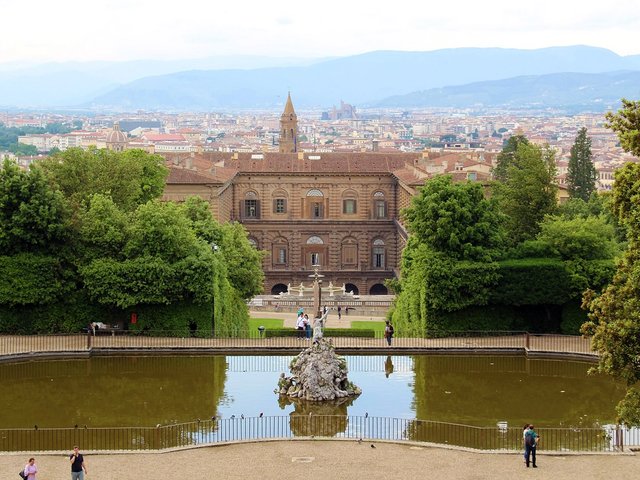
The Uffizi Galleries, which encompass three main institutions—the Gallerie degli Uffizi, the Palazzo Pitti and the Giardano di Boboli—received more than five million visitors in 2024, and based on its most recent reports, generate roughly €60m in annual revenue.