A team of UK archaeologists have discovered a rare war trumpet dating from the first century AD which was used by Celtic tribes to intimidate their enemies in battle.
The ancient artefact was part of a hoard of Iron Age objects found last summer during excavations in west Norfolk. Mark Hinman, the chief executive of the archaeological services firm Pre-Construct Archaeology, which made the discovery, tells The Art Newspaper that the hoard is “a once-in-a lifetime” find.
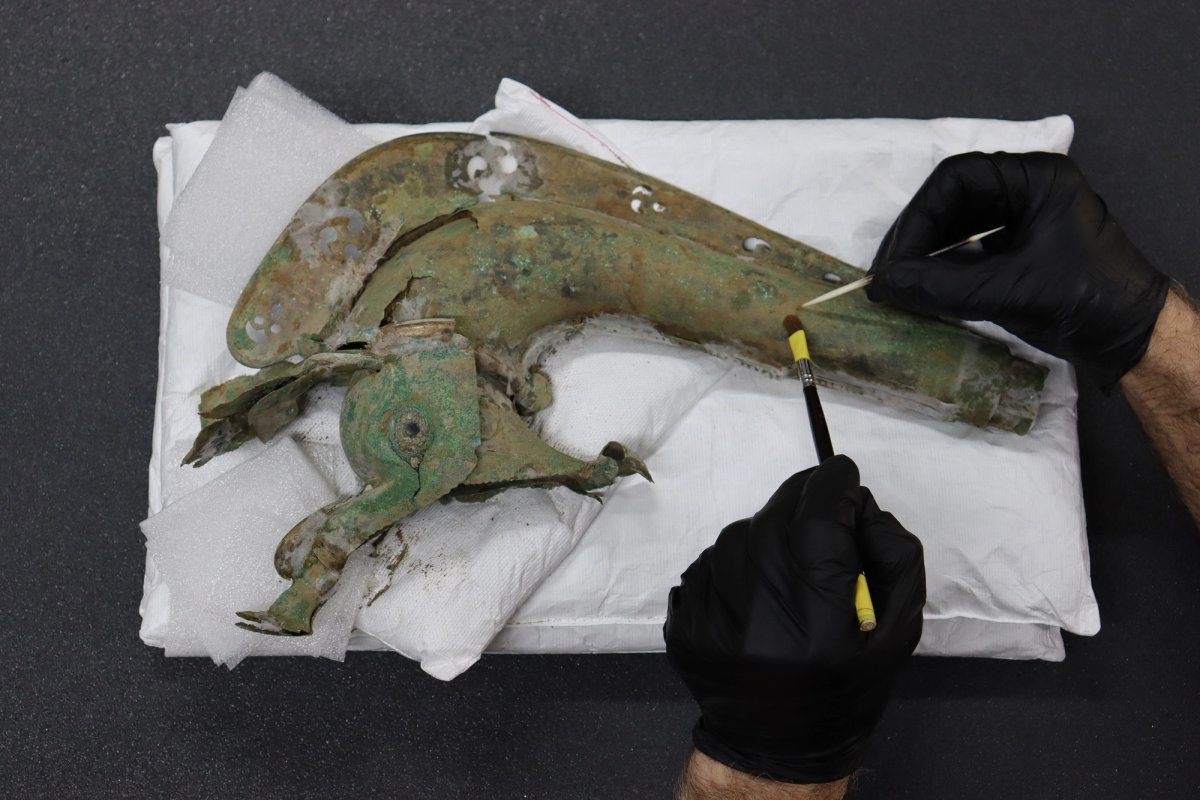
A carnyx is a type of bronze trumpet with an S-shaped head that is held in the air vertically. The carnyx discovered, which is shaped like a wild animal, would have been played by soldiers on the battlefield.
Hinman says that the carnyx unearthed may be linked to the Iceni, the British tribe that staged a rebellion against the Roman army in 60AD, led by the warrior queen Boudicca.
John Kenny, a professor at London’s Guildhall School of Music and Drama, told CNN: “Immensely powerful when played at full volume, it is also possible to play [a carnyx] whisperingly quietly, and to combine it with delicate instruments like flute, harp, string quartet and the human voice.”
The hoard also included a sheet-bronze boar’s head, originally from a military standard, five shield bosses and an iron object of unknown origin. “The finds are rare, not only in a British context, but from across Europe,” says a statement from the heritage body Historic England.
Parts of another carnyx were also found in the haul. Fraser Hunter, the Iron Age and Roman curator at National Museums Scotland, says in a statement: “The carnyces and the boar-headed standard are styles well known on the continent and remind us that communities in Britain were well connected to a wider European world at this time.”
Historic England is working with Pre-Construct Archaeology, Norfolk Museums Service and the National Museum of Scotland on research and conservation efforts linked to the finds. The items are, however, in a very fragile condition and require extensive stabilisation work before detailed research can begin, added a Historic England spokesperson.
Asked whether the objects will be donated to a museum, Hinman says: “We hope the finds will stay in Norfolk.”
The discovery will be featured on the BBC Two series Digging for Britain (14 January).