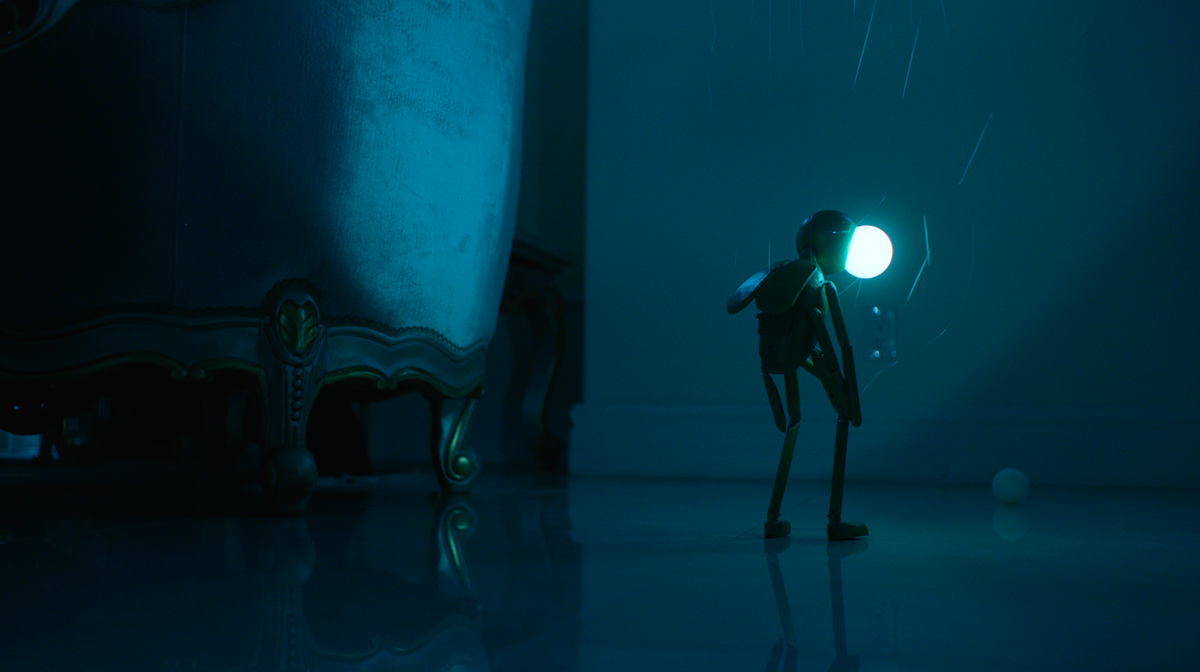
In Arash Nassiri’s new moving-image commission, an insect puppet drags itself across an empty marble floor, cast in eerie blue evening light. The scene is diffused through an enormous frosted-glass cubicle, refracting and distorting the images.
That sense of distortion pervades the Tehran-born, Berlin-based Nassiri’s first institutional solo exhibition, A Bug’s Life, which opened last weekend at London’s Chisenhale Gallery—and comprises a film set within a sculptural installation. The film follows its insect protagonist on a journey of discovery through a cavernous mansion in Los Angeles, its scenes filled with a sense of disorientation and ambiguity that mirrors the experience of those who are separated from their homeland.
The empty mansion is a “Persian Palace”—a unique mutation of Iranian and French Empire architectural styles that took off in Iran in the heady years of Iran’s oil wealth in the 1960s and 1970s. After the Iranian revolution in 1979, Iranians scattered around Europe and North America; Nassiri himself grew up in Switzerland. Some of the wealthier among them recreated the architectural styles of Tehran in Los Angeles, forming what Nassiri calls “a free-form collage of America and Roman and Greek antiquity”.
Existing in the “bubble” of the Iranian community, the builders of these houses in Los Angeles “were trying to belong to American culture, but they got cut off from it, in terms of culture and taste”, Nassiri says. By recreating their own taste, they opened up a contradiction between their history as Iranians, their lives as Americans, and their Western-influenced understanding of Modernity. Nassiri finds that contradiction “beautiful”, he says—and reminiscent of how Iran and the West have “mimicked but also rejected each other”.
Nassiri began to film the houses “as a way of archiving them, because when they are being pulled down to make new houses, these micro-styles will eventually disappear”, he says.
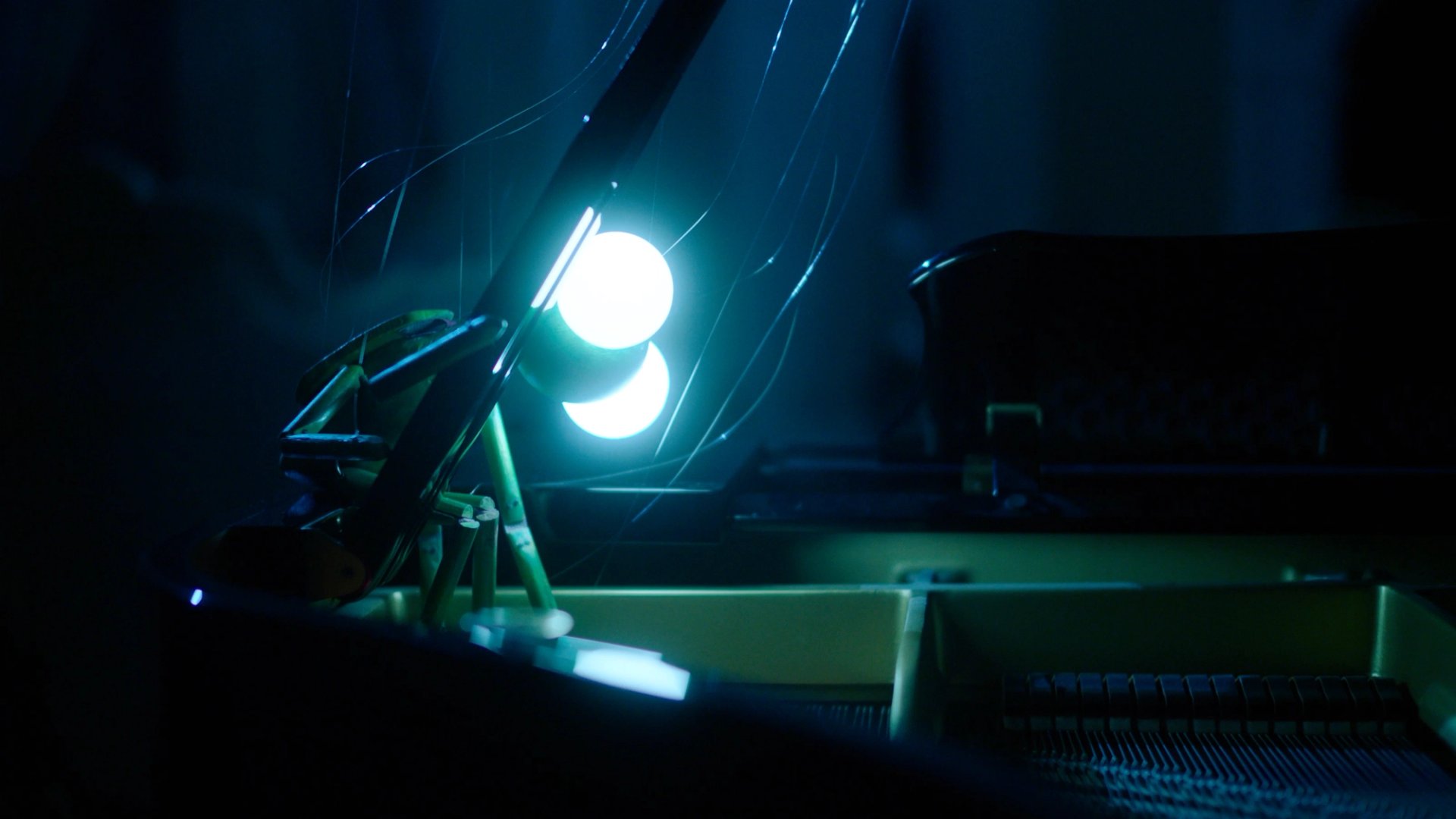
A Bug’s Life explores the architecture of Tehran that was transplanted to cities such as Los Angeles following the 1979 Iranian Revolution
Courtesy Arash Nassiri
In A Bug's Life, he creates a tension between the tiny, trepidatious bug-human and the alien, uncategorisable architecture—making a metaphorical point by doing so. The contrast highlights the ambiguous dual belonging of those who, once separated from their home countries, must contend with vast and unknown new circumstances. The inclusion of a phone call, in Farsi, underlines the feeling of being far from home in a domestic setting.
At a time of renewed horror and historic change for Iranians everywhere, Nassiri finds a niche, nuanced way into the vexed, historically contingent relationship between Iran and the West. He sees within this relationship “a friction that keeps recreating itself”, as each new generation of Iranians begins to seek opportunities outside Iran.
Having reflected on how previous generations have struggled to reconcile their passion for authentic Iranian traditions with their interest in Western culture and their experience of life in the diaspora, Nassiri says it is now "our turn” to address the question.
• A Bug’s Life, Chisenhale Gallery, London, until 22 March