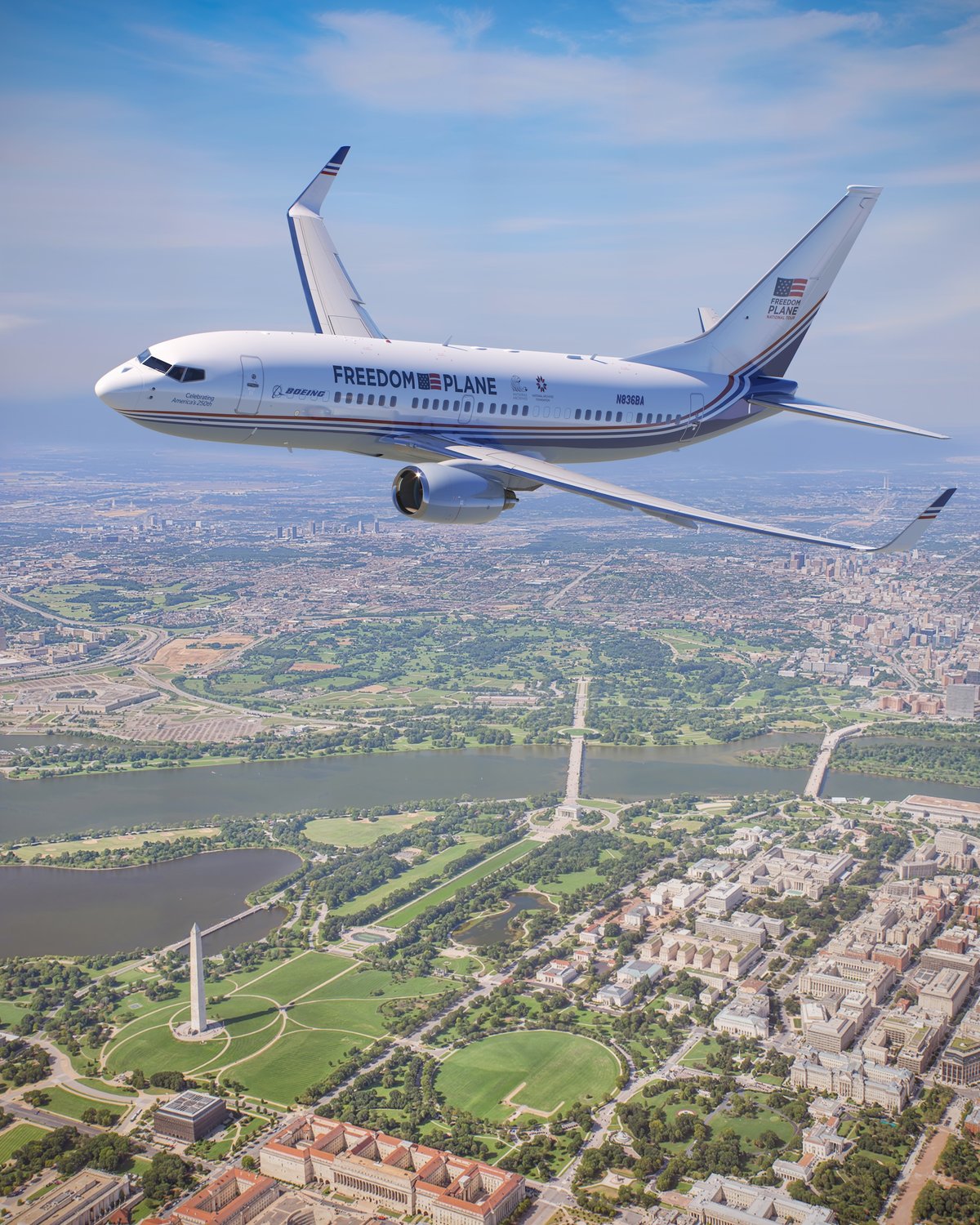
The US National Archives will send a group of historic documents on a national tour this spring and summer, as part of the cultural programming marking the 250th anniversary (or semiquincentennial) of the country’s founding. The initiative, inspired by a railroad-based “Freedom Train” exhibition on the occasion of the US bicentennial in 1976 that visited 138 cities and was seen by around 7 million people, has been dubbed the “Freedom Plane” and will touch down in eight cities from March to August.
While the Freedom Train invited visitors aboard the titular vehicle to view historic exhibits, the Freedom Plane—a customised Boeing 737 jet—will remain off-limits to the public. Instead, exhibitions of Freedom Plane National Tour: Documents That Forged a Nation will take place at museums in the eight selected cities. The tour will begin at the National WWI Museum and Memorial in Kansas City, Missouri (6-22 March), followed by stops at the Atlanta History Center (27 March-12 April), the Fisher Museum of Art at the University of Southern California in Los Angeles (17 April-3 May), the Houston Museum of Natural Science (8 May-25 May), the History Colorado Center in Denver (28 May-14 June), the HistoryMiami Museum (20 June-5 July), the Henry Ford Museum of American Innovation in Dearborn, Michigan (9-26 July) and the Museum of History and Industry in Seattle (30 July-16 August). Admission to the exhibition will be free at all eight venues.
The documents set to crisscross the country include the Articles of Association of 1774, signed by all 53 delegates to the Continental Congress, urging colonists to boycott British goods; and the oaths of allegiance to the Continental Army that George Washington, Alexander Hamilton and Aaron Burr signed during the Revolutionary War. Also taking to the skies is the Treaty of Paris, the 1783 treaty signed by John Adams, Benjamin Franklin and John Jay, whereby Great Britain officially recognised the United States as an independent and sovereign nation.
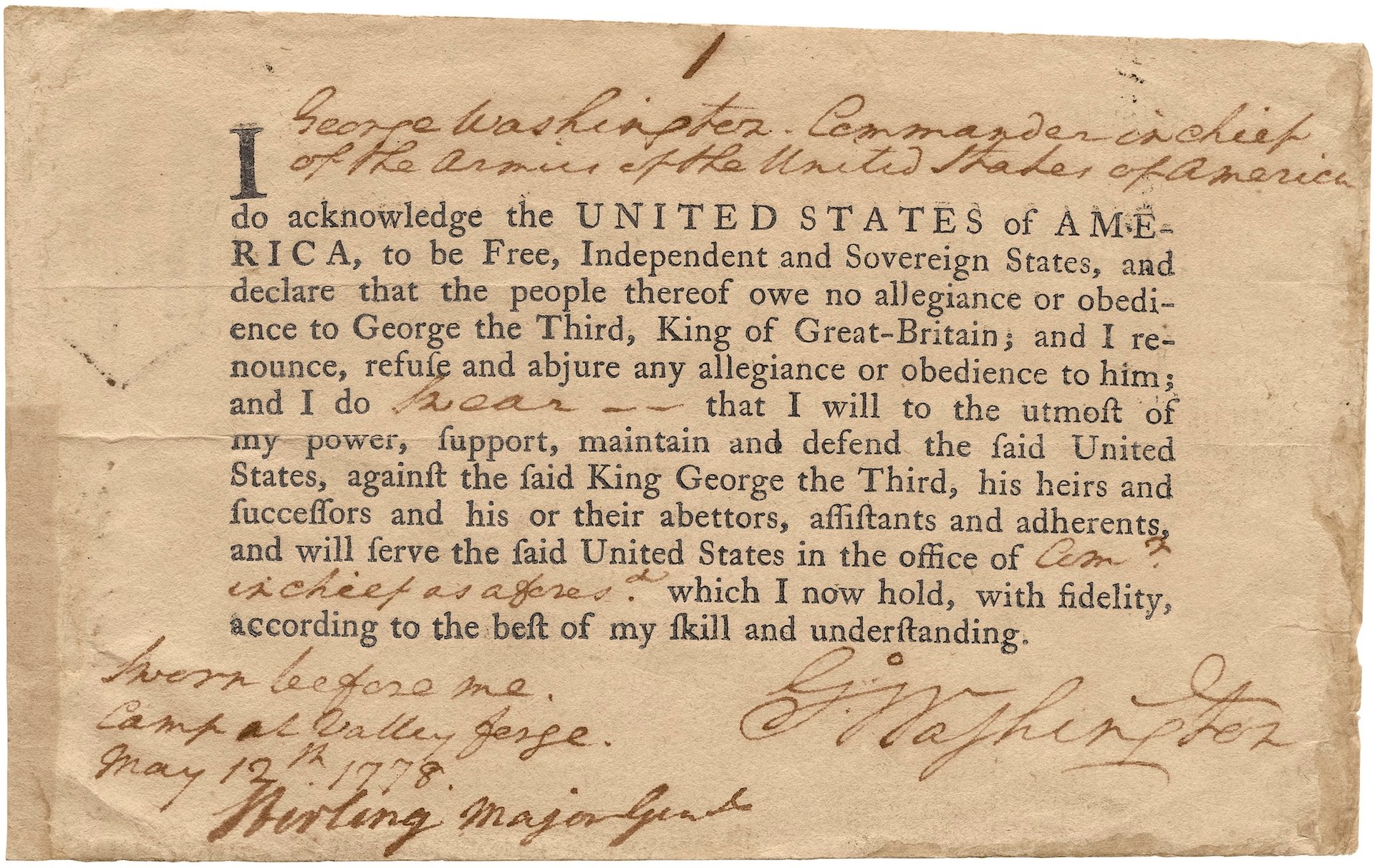
Oath of allegiance and fidelity signed by General George Washington while encamped and in command of the Continental Army at Valley Forge, Pennsylvania, in 1778 Courtesy the National Archives
“Americans across the country can bear witness to the people and principles that shaped our nation through the Freedom Plane National Tour,” Jim Byron, the senior adviser to the secretary of state and acting national archivist Marco Rubio (his predecessor was fired by president Donald Trump in opening weeks of his second term), said in a statement. “There is no more noteworthy an occasion than America’s 250th birthday to share this history, to inspire our fellow Americans to champion our nation’s founding ideals into the future.”
The exhibition received support from the National Archives Foundation, the private nonprofit that supports the National Archives, as well as Boeing, telecoms conglomerate Comcast, Microsoft and the consumer goods giant Procter & Gamble.
The National Archives’ star attractions will stay grounded in Washington, DC, including originals of the Declaration of Independence, the US constitution and the US bill of rights. However, a rare copy of the Declaration of Independence—one of only around 50 known engraved copies dating from 1823—will be along for the Freedom Plane ride. Rodney E. Slater, the chair and president of the board of the National Archives Foundation, added in a statement: “The Freedom Plane National Tour underscores that the rich history of our nation belongs to all of us, not just those Americans living in or visiting Washington, DC.”
Despite internal disarray at the United States Semiquincentennial Commission, including the firing of its executive director last September, plans for exhibitions and other programmes marking the 250th anniversary of the country’s founding are in full swing. The Trump administration is rumoured to be close to announcing a site for one of the president’s pet projects, a patriotic sculpture park that will include monuments to 250 “American heroes”—though its likely location in Washington, DC, and the lack of any known commissions mean it is unlikely to be completed or even begun in time for the main festivities on 4 July.
And though it does not have a Boeing jet with a custom paint job at its disposal, the National Gallery of Art is sending treasures from its collection—including works by Berthe Morisot, Georgia O’Keeffe, Mark Rothko, Alma Thomas and Winslow Homer—to regional museums from Alaska to Utah.