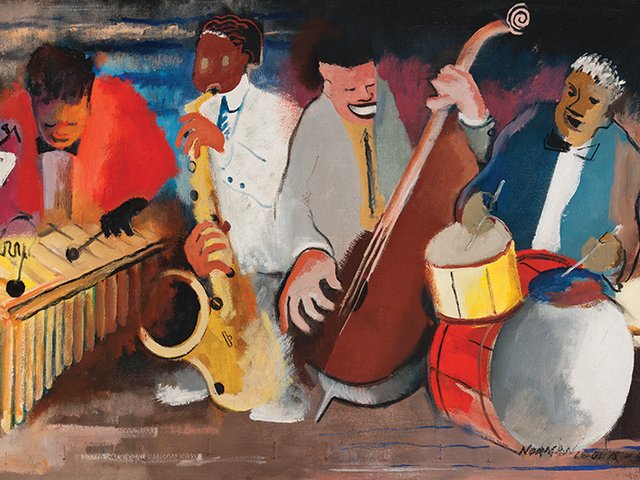
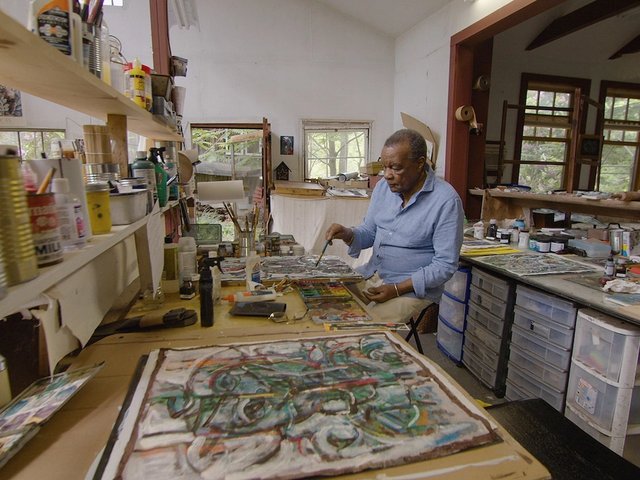
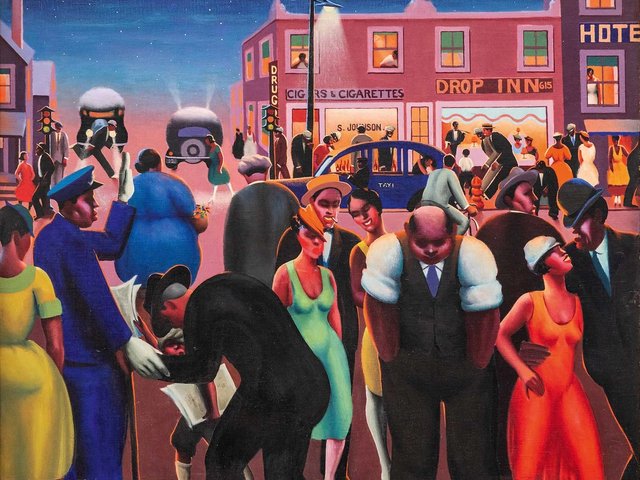
A film currently screening at Sundance Film Festival in Utah offers a unique look into the Harlem Renaissance. Once Upon a Time in Harlem gathers footage from a gathering at Duke Ellington’s home of some of the movement’s most important figures. Originally shot in 1972 by William Greaves (1926-2014), the film was recently completed by the late filmmaker’s son David—one of the original cameramen at Ellington’s home. Once Upon a Time in Harlem stands as a tribute to both the Harlem Renaissance and to the prolific Greaves.
Greaves produced more than 200 documentaries in his lifetime. Originally an actor, after attending the Actors Studio he grew frustrated with the typecasting of Black men and moved to Canada to study at the National Film Board. Returning home to Harlem in the 1960s to participate in the Civil Rights Movement, he made films about the boxer Muhammad Ali, the journalist Ida B. Wells, the diplomat Ralph Bunche and the abolitionist Frederick Douglass. He also produced Black Journal, a public-affairs television programme on Black issues that aired from 1968 to 1977.
In August 1972, Greaves brought together as many people as he could locate who had participated in the Harlem Renaissance at Ellington’s home in Harlem. With three cameras shooting 16mm film totaling 60,000 feet (around 28 hours of footage), he documented the gathering and conducted follow-up interviews afterwards. Greaves thought this was the most important footage he had ever shot, yet he struggled for decades to make a film.
“I saw myself as part of a process in which Harlem and the artists of the Renaissance were at the forefront of our people's search for identity and recognition,” he wrote in 2007. “I now see that culture is what defines a people, and I see this film as an exploration and an appreciation of African American culture, and the role the artist plays in creating that culture and defining who we are as a people.”
The gathering at Ellington’s included creative people of all kinds. Among them were the photographer James Van Der Zee; the musician Eubie Blake; the activist Richard B. Moore; the writers Arna Bontemps, Gerri Major and George Schuyler; the artists Romare Bearden, Ernest Crichlow, Aaron Douglas and Richard Bruce Nugent; and Thomas W. Harvey, then-president of the Universal Negro Improvement Association.
In the film, Schuyler reflects on what they had lived through. “I don’t know that it was a Renaissance. It was an awakening,” he says. “They came there to Harlem, which was sort of a new Mecca. I have thought of the Harlem Renaissance as a sort of prism reflecting all of the Black experiences from the beginning to the present.”
This sentiment is echoed by Major. “For the first time, we were aware of so many creative people who were Black,” she says, adding that there was a “great surge of creative work”.
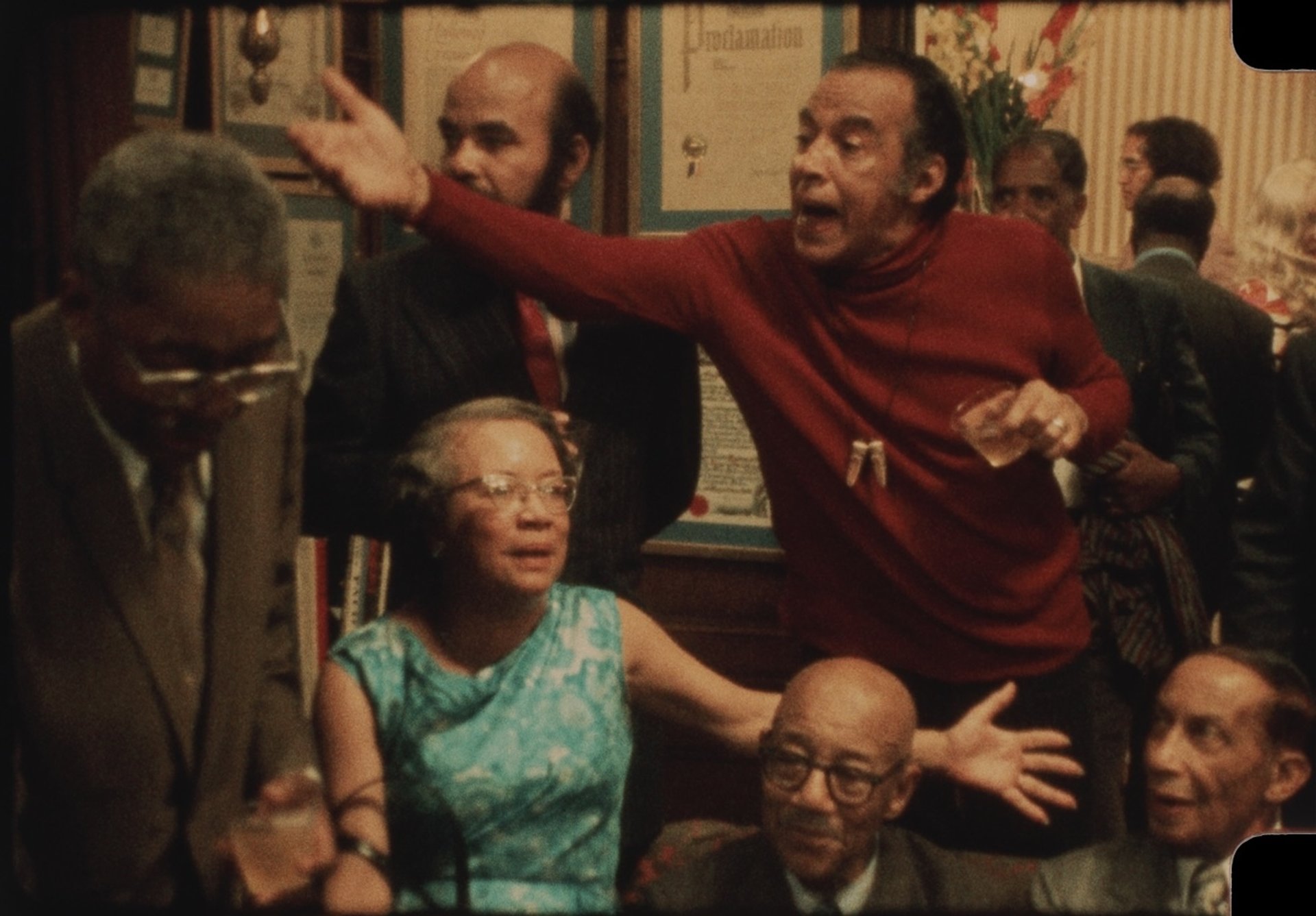
Still from Once Upon a Time in Harlem (2026) Courtesy Sundance Film Festival
“My interest was to spur and inject in the artists of America, Black artists of America, an interest in African art,” Douglas says.
Bearden thought that the 1971 book Harlem Renaissance, by Nathan Huggins (who was also in attendance), “didn't seem to understand the importance of artists like Aaron Douglas, Palmer Hayden and Archibald Motley, and what these men really contributed—some of the really great American painters”. He notes that the Lindy Hop dance is “a poem in motion, and it captures the symbolism of the Renaissance and what this whole period means. The audaciousness, the community coming together. We used to call Aaron ‘the Dean’ when we were little boys. You see, art comes out of a community and it comes out of audaciousness.”
In 1926, Schuyler wrote an article in The Nation titled "The Negro-Art Hokum", arguing that African American art was in essence American art, hence there was no need to create a separate category for it. Langston Hughes wrote a rebuttal in the same publication, "The Negro and the Racial Mountain", which embodies what Bontemps expressed later at the 1972 gathering.
“We young Negro artists who create now are not going to listen to one or the other—Black or white,” Bontemps says in the film. “We are going to be ourselves and not going to try to please white people or Black people. We’re just going to be us. It struck a very responsive chord. I think it became the slogan for the Harlem Renaissance.”
Bontemps continues by outlining the highlights of the fruitful period. “I think the Renaissance figured principally by a favourable conjunction of several favourable things occurring at once and that created a certain tension that ignited it,” she says. “1921—Langston’s first poem appears in The Crisis, ‘The Negro Speaks of Rivers’. Then in 1921 also, [the Jamaican activist Marcus] Garvey’s big convention was up in Harlem. Then another thing that happened in 1921 that just confirmed, that nailed it down, was Shuffle Along,” a musical composed by Blake. “From then on, every year was something dramatic,” Bontemps continues. “In 1922, the dramatic thing was Claude McKay’s Harlem Shadows. And in 1923, Jean Toomer’s Cane. Also in 1923 was Roland Hayes’s debut—the Renaissance had really exploded by then.”
“As a result of the economic development, and the political development, there was a ferment which finally brought us the artistic development,” Moore says.
Ida Mae Cullen, widow of the writer Countee Cullen, expresses her thanks to Greaves for bringing everyone together. “Today we have someone like Bill Greaves, to come here and to film this kind of historical works of our Black people—I could just weep,” she says. “I'm so happy. What Bill is doing today is one of the most tremendous things that has ever been done for us, Black people. You’re bringing the history, historical background. We’re bringing so many, many things. Bill, I'm so grateful to you.”
- Once Upon a Time in Harlem is screening at the 2026 Sundance Film Festival in Park City, Utah, until 1 February