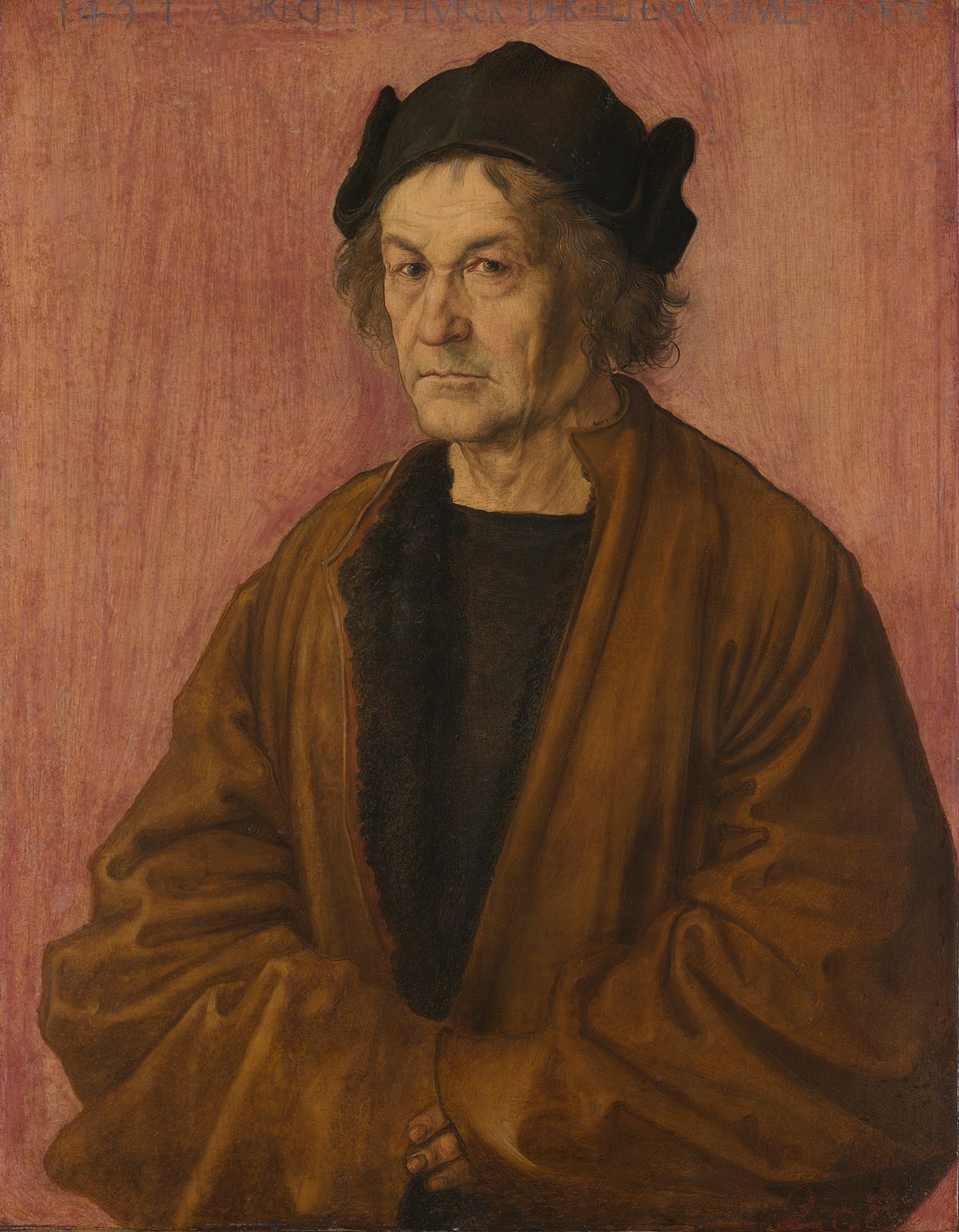
The portrait of Albrecht Dürer’s father at the National Gallery is authentic, according to a major publication by a German scholar—although this is rejected by the London institution. Christof Metzger, the lead author of Albrecht Dürer: The Complete Paintings, argues that The Painter’s Father is indeed by the master, dating from 1497.
However, the portrait has long been downgraded by the National Gallery, where it is regarded as a copy “after” Dürer by another hand. The museum’s curators believe it was copied from a now-lost original in the second half of the 16th century, decades after Dürer’s death in 1528.
The status of the portrait is particularly important because it is such a highly personal painting of the artist’s father, who shared the same first name. He is portrayed as a determined and perhaps stern individual, with a considerable amount of hair for a man of his age.
Albrecht the Elder, a talented goldsmith, was initially disappointed that his son failed to follow in his profession, instead setting out to become an artist. The young Dürer would have been aged 26 when his father sat for him, and perhaps by this time the successful portrait helped convince the elder Albrecht that his son had made the right career decision.
An inscription at the very top of the portrait (only just visible in reproductions) records that it depicts Albrecht the Elder in 1497 at the age of 70, which was very old for the time. The text is almost certainly correct, but a key question is whether the inscription on the National Gallery painting is from the artist’s own hand or was instead copied from a lost original.
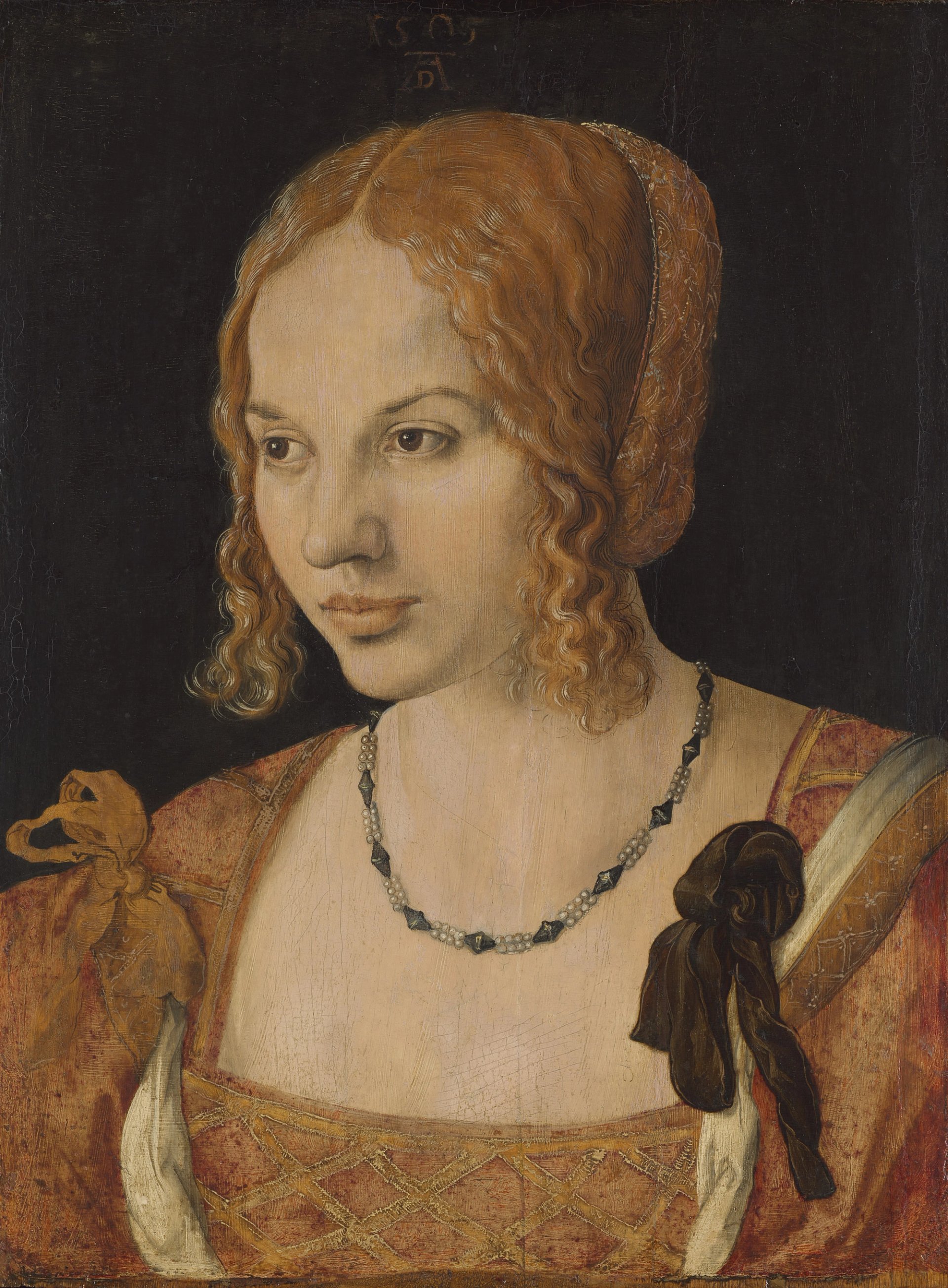
Metzger’s research suggests that the subject of Portrait of a Venetian Woman may in fact have been from Florence KHM-Museumsverband
Metzger, a Dürer specialist and curator of German art at Vienna’s Albertina Museum, is convinced of the authenticity of The Painter’s Father. His 800-page catalogue raisonné, just released by the Cologne-based publisher Taschen, states that although the picture’s condition is “hardly optimal”, the face is “preserved so well that the painting’s formerly outstanding quality is still perceptible”.
There are at least seven known early copies of the portrait, but Metzger tells The Art Newspaper that the London picture “stands out for its experienced brushwork and masterful glazing technique”. This shows “even the smallest details of the aged skin”.
Susan Foister, the National Gallery’s deputy director and curator of German paintings until her retirement two years ago, has a quite different view of The Painter’s Father. In her comprehensive 2024 catalogue of the gallery’s German pictures, she points out that the paint surface is severely disfigured by drying cracks, particularly in the remains of the faded pink background and the sitter’s coat (thanks to restoration, this damage is now disguised). Such cracking is not found in other works by Dürer, “whose technique generally produced a flawlessly smooth painted surface”.
Foister also stresses stylistic problems with the head. The hair “lacks Dürer’s usual fluency and delicacy” and “the flesh around the eyeball is drawn in minimal fashion”. In the eyes, the depiction of the pupil and iris is “not very coherent”. The form of the inscription is “uncharacteristic”.
She concludes that the National Gallery picture “cannot be the work of Dürer himself”. It is “likely to be a copy after a lost original by Dürer”, made around 1550-1600.
Unknown early provenance
The early provenance of the National Gallery painting remains untraced until it was recorded at the Nuremberg town hall as a Dürer in 1627, a century after the artist’s death. The Painter’s Father was brought to England in 1636-37, when it was presented by the city council to the Earl of Arundel, as a gift for Charles I.
After the king’s execution the painting was auctioned in 1651 and it may have gone to the Spanish royal collection, although the provenance is not entirely clear. The portrait was later in England, ending up with Lady Ashburton, who died in 1903. The following year it was bought by the National Gallery, which paid £10,000 for the assumed Dürer and a lesser Dutch picture.
The Painter’s Father is currently not on display, because of space constraints and the fact that it is regarded as a copy and has condition problems. But the work had been on show for a decade until the temporary closure of the gallery’s Sainsbury Wing for building work in 2023. The Art Newspaper understands that the gallery now has plans to bring the portrait back on view.
Metzger also produces another surprise in his book, about a fully accepted Dürer at Vienna’s Kunsthistorisches Museum. He argues that the painting labelled by the museum as Portrait of a Venetian Woman should be retitled Portrait of a Florentine Woman—and he has done so in his catalogue raisonné.
Although the museum dates the portrait to Dürer’s trip to Venice in 1505 (because of the painting’s Italian character), Metzger says it was done a decade earlier during an unrecorded visit to Florence. Dürer did indeed make an earlier visit to Venice in 1495, but until now there has been little suggestion that he then travelled further on to Florence, which lies 200km to the south.
Describing the female portrait as “one of Dürer’s most engaging works”, Metzger argues that stylistically it “does not seem related” to his 1505-07 Venetian works, but closer to paintings done earlier in his career. He cites problems with the portrait, such as “the anatomically undefined relationship” between the woman’s head and neck.
Although art historians often redate pictures, it is fundamental to do so by a whole decade. If the 1495 date becomes accepted by specialists, then the development of Dürer’s painting will need to be reconsidered.
Metzger also writes that the image is “probably not Venetian at all” and is “entirely Florentine in character”. He says the woman’s coiffeur and costume, including the rectangular décolleté, are modelled on Florentine fashions rather than those of Venice.
Did Dürer really visit Florence?
Although the painting is inscribed 1505, this date is believed to have been added after Dürer’s death, possibly because he made a well-documented visit to Venice that year—and the painting appears to be influenced by Italian art. Metzger instead cites parallels with the work of three Florentine artists: Sandro Botticelli, Filippo Lippi and Domenico Ghirlandaio.
Metzger admits that his catalogue raisonné will “initiate controversy and debate”, but that “must be a primary aim of any art-historical publication”. If Dürer is believed to have visited Florence, the birthplace of the Renaissance and Italy’s most important artistic centre at the time, then this again means that art historians will need to reconsider his development.
Guido Messling, the Kunsthistorisches Museum’s curator responsible for early German painting, rejects Metzger’s redating and argument that the woman is Florentine. He points out that stylistically the Vienna picture represents a step forward from four other portraits painted by Dürer in 1499. Messing says that although the Vienna painting’s sitter may not follow the Venetian fashions of 1495, her appearance would be quite compatible for a 1505 portrait.
Although Messling accepts that the 1505 date on the portrait of the young woman has been partially repainted, to him the numeral “0” beneath looks authentic. However, following our query, he has now asked for this to be examined by the museum’s conservators.
In conclusion, Messing wryly promises that the Kunsthistorisches Museum has no plans to “naturalise the Venetian woman as Florentine—and make her [ten years] older than she actually is”.