As Art Basel Qatar draws all eyes to the Gulf’s art market, Sotheby’s second sale in Saudi Arabia provides an early bellwether. Held on Saturday (31 January), the "Origins II" auction demonstrated a strong appetite for regional masters, but a lukewarm reception to more global offerings.
The results are an improvement on the house’s maiden Saudi auction, held one year ago. The 2025 sale came in just above its low estimate (all estimates calculated without fees), making $14.4m ($17.2m with fees) from 140 lots with a patchy 67% sell-through rate by lot. This year, by contrast, was a more concise offering, with 67 lots of fine art that landed a healthier sell-through rate of 89% and a hammer total of $15.4m ($19.5m with fees), near the pre-sale high estimate of $16.6m. Around one-third of the buyers came from Saudi Arabia, according to Sotheby’s, which is on par with last year.
Arab Modernists and name-brand postwar and contemporary Western artists continue to provide the bulk of this sale’s value. Last year’s slew of luxury lots was replaced by more blue-chip works, many of which carried popular references to the Arab world, such as an Alighiero Boetti canvas with Arabic script, or a Roy Lichtenstein painting with pyramids. They joined works by lesser known Middle Eastern names, plus a small selection of design and Indian art.
During the auction, three lots were passed: Refik Anadol’s generative video “painting” linked to an NFT (est $350,000-$450,000), a Joris Laarman biomimetic armchair (est $150,000-$200,000), and a 2013 bronze sculpture by the Persian market heavyweight Parviz Tanavoli (est $60,000-$80,000). In addition, four lots were withdrawn prior to the sale, including a Sahara landscape by Jean Dubuffet (est $800,000-$1.2m), a Basquiat oil drawing (est $400,000-$600,000), and the sale’s only pre-Modern work, an ancient alabaster figure from South Arabia (est $60,000-$90,000). Ashkan Baghestani, the head of sale, said that travel warnings to the region issued following Iran’s deadly crackdown on protestors did not factor in those withdrawals.
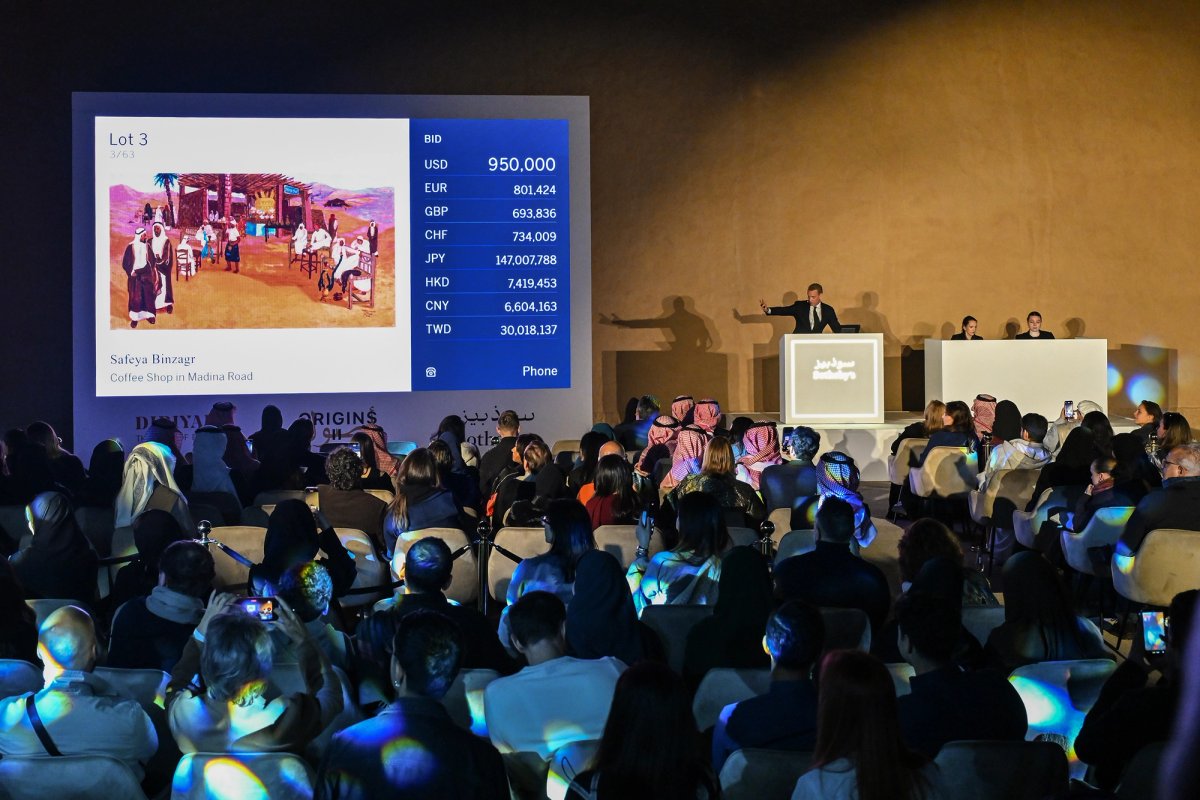
In attendance were around 200 guests, who gathered on the chilly evening within an amphitheatre at Bujaira Terrace, a recently developed luxury shopping and dining complex built as part of the $63bn Diriyah Gate tourism redevelopment project.
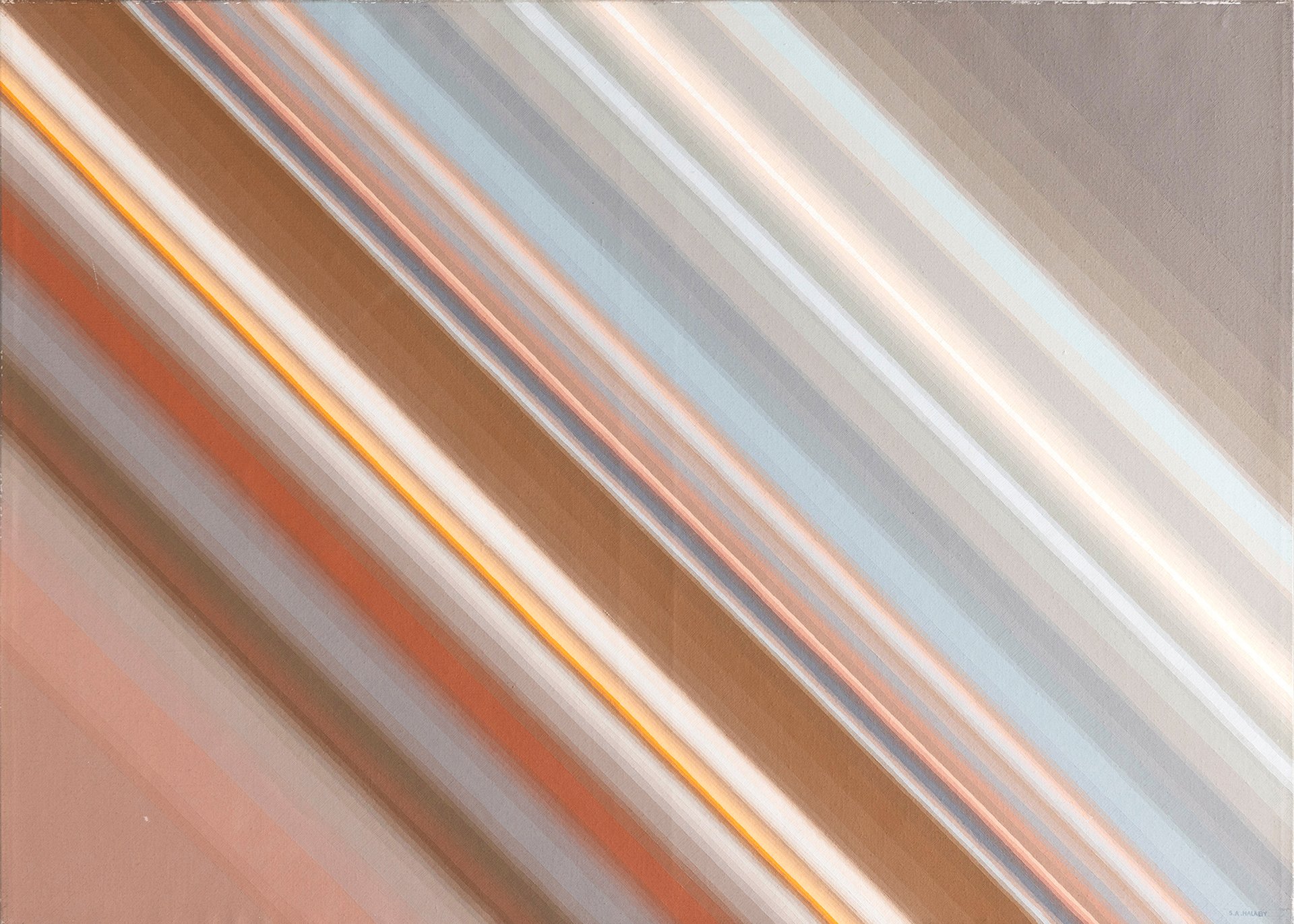
Copper (1976) by Samia Halaby Courtesy of Sotheby's
Under a waxing moon, Alex Branczik, the chairman and head of contemporary art, Europe, took to the rostrum, and made sure to pepper his auctioneering with the requisite “mabrouks” (congratulations) and “shukrans” (thank yous). The sale started flat—Mohamed Siam’s Futurist-inspired painting of a camel race hammered just above its $70,000 low estimate—but momentum quickly gathered for two women Arab artists.
The first, Copper (1976) by Samia Halaby, from her Diagonal Flight series of linear abstract paintings, made $260,000 ($315,000 with fees) against a $180,000 high estimate. Halaby, who is perhaps Palestine’s best-known living artist, is collected by leading museums and is presently on show at the Diriyah Biennale, which was taking place a short drive away. Her record was set by last year’s Sotheby’s sale for another Diagonal Flight work, Blue Trap (in a Railroad Station) (1977), which realised $384,000.
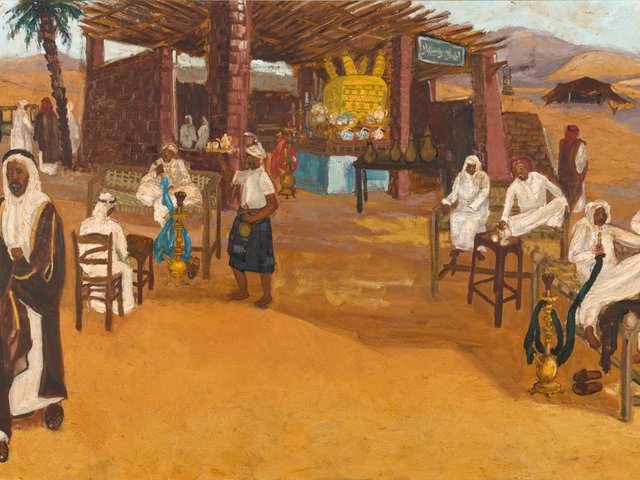
Next up was the night’s showstopper: a 1968 café scene by Safeya Binzagr, a pioneer of Saudi Arabia’s art scene, who died in 2024. Coffee Shop in Madina Road was consigned by a Spanish diplomat to Qatar who had bought the work from the artist. Only a handful of significant Binzagrs remain in private hands, with most of her works owned by the museum she opened in the early 2000s near Jeddah. Fewer than five of her paintings have come to auction in as many years, none of which have matched the scale of this work.
Sprinting past its reserve price, the lot climbed quickly to $500,000 and was then chased by two bidders—one of whom was a relative of the artist, bidding in the room—before hammering on the phone at $1.6m ($2.1m with fees), almost ten times its high estimate.
The sale broke the auction record for a Saudi artist—a notable achievement in a country where women's rights were restricted until 2017. It is also the third highest price for an Arab artist at auction.
All nine works by Saudi artists were sold for a combined $4.3m (with fees), eclipsing their high estimate of $1.1m. Several of these established names like Abdulhalim Radwi are featured in a recently opened exhibition about the birth of Saudi Modernism at the National Museum in Riyadh. "What’s particularly exciting is how this sale has introduced local and regional artists to a wider collector base expanding visibility and sparking deeper interest in the cultural and artistic expression of the region," Baghestani said. "This is very much a two‑way exchange."
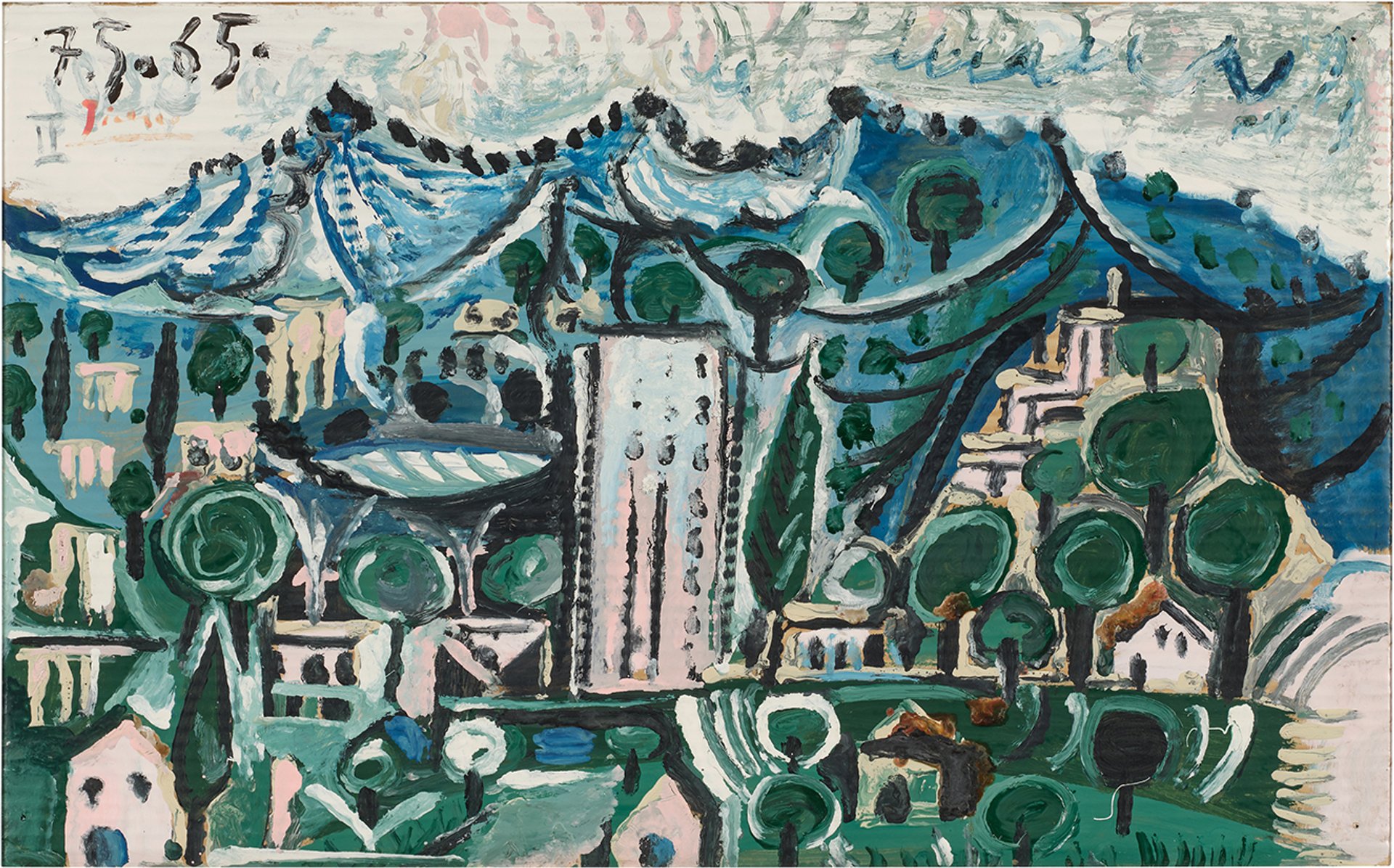
Picasso’s Paysage (1963) Courtesy of Sotheby's
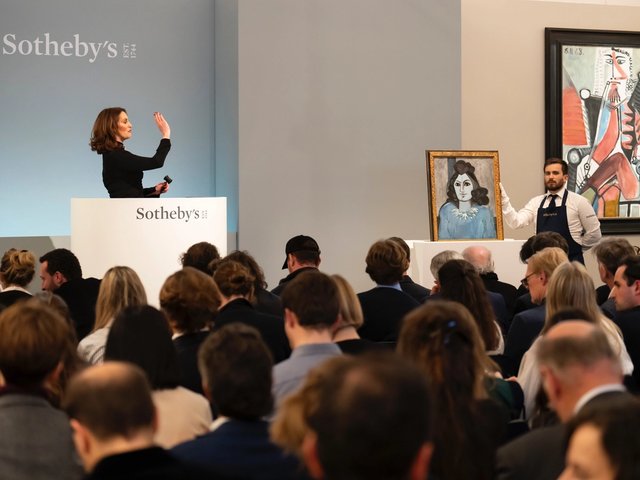
The energy drawn by Binzagr and other local artists proved a contrast to what some assumed would be the night’s top lot. Pablo Picasso’s Paysage (1963), a late-period landscape painting on cardboard, carried the sale’s highest estimate of $2m to $3m, but went to just a single bid on the phone to vice chairman Julian Dawes, hammering at $1.3m ($1.6m with fees). Speaking after the sale, Baghestani said that the price was “perhaps too bullish for a market not educated on this period”.
Similarly, several of the night’s other high-value Western works, many of which already carried noticeably lowered estimates and reserves, failed to stir excitement: two Andy Warhol silkscreen canvases hammered either below or just at their low estimates. Works by James Turrell and George Condo fared better however, with a light sculpture by the former making his third highest price at auction, at $630,000.
More successful was the introduction to this sale of works by two late Indian artists: two paintings by MF Husain, the Bombay Progressive whose museum recently opened in Doha, and four drawings by the South Asian Minimalist pioneer Zarina, to appeal to the region’s “growing population of diaspora South Asians”, Baghestani said. All works sold well above estimate, with Husain’s Untitled (Woman with Sitar) (1970s) making $250,000 ($310,000 with fees), considerably above its $90,000 estimate and similar examples on the private secondary market.
Sotheby's has recently expanded its foothold in the region with a new Riyadh office. However, whether its sales will remain in Diriyah—the historic town whose development is being spearheaded under the Vision 2030 project—in uncertain, with reports of Saudi Arabia scaling back spending on several of its Public Investment Fund projects.
While director of business strategy Fahad Malloh declines to comment as to whether Sotheby's is affected by these cutbacks, he tells The Art Newspaper: "We are always keeping an eye out to other sites and venues throughout the Kingdom as a future destination for our upcoming auctions."
Malloh emphasises how promising the region remains to Sotheby's overall strategy. "Saudi Arabia represents a very compelling long-term opportunity," he says. "With a population of around 35 million, the potential for new client engagement is significant, and we are seeing organic interest from a broad and diverse collector base."