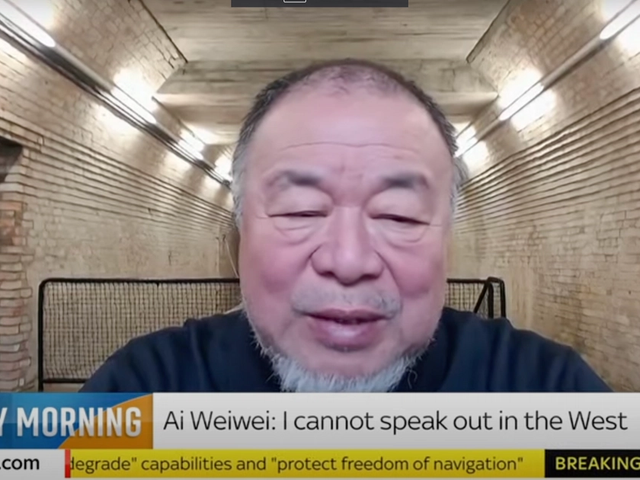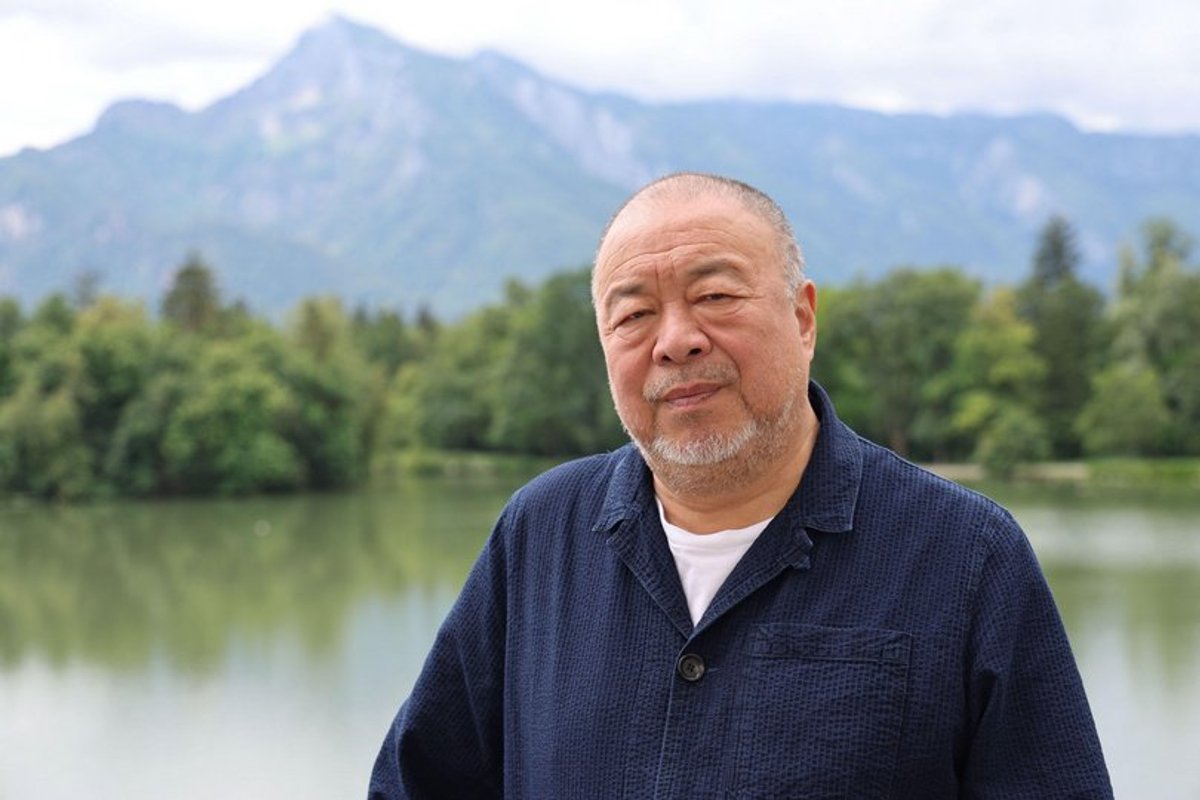
The Chinese artist and activist Ai Weiwei says he faced a vote of no confidence by the Academicians at the Royal Academy of Arts (RA) in London after posting a controversial tweet about the war in Palestine.
In late 2023 Ai posted a tweet relating to the Israel-Hamas conflict which he later deleted. Lisson Gallery in London, which represents the artist, subsequently postponed a show of the artist’s works. The tweet began: “The sense of guilt around the persecution of the Jewish people has been, at times, transferred to offset the Arab world.”
In 2011 the RA made Ai an international Royal Academician (the artists and architects who are responsible for the overall direction and governance of the institution). The Guardian reports however that following the controversy over the tweet, a vote was held at the RA to determine whether his membership should be revoked because of accusations that the post was antisemitic. The RA subsequently voted to retain his membership. Ai also claims that an article he wrote for the RA Magazine was withdrawn.
A spokesperson for the Royal Academy says: “In 2023, [Ai] posted a message on social media—subsequently deleted—which caused offence. The Royal Academy’s Council and General Assembly, comprising all Academicians, discussed the matter and the General Assembly decided to take no further action. This decision was communicated to Ai at the time.”
The spokesperson adds: “Ai Weiwei was contacted via his publicist to write a piece for the spring 2026 issue of the RA Magazine about his current book. Shortly after the commission, before the piece was received, a decision was made, and communicated to Ai Weiwei’s publicist, to reduce the book review section in the magazine. Ai Weiwei’s publicist subsequently sent the piece to the RA, but, as previously advised, there was no space in the spring issue to include the piece.
“The Royal Academy supports freedom of expression, which is of fundamental importance to artists and the RA. Plurality of voices, tolerance and free thinking are at the core of what we stand for and seek to protect.”
Speaking to The Guardian about the tweet controversy, Ai said: “I don’t have the intention of an antisemite. My best friends, they’re all Jewish people... I tweeted millions of tweets on Twitter, but [how is it that] this tweet can cause such trouble?”
In an interview last year with The Art Newspaper, meanwhile, he said: “I did what I should. And that sacrifice is very little compared to all of the lives lost and compared to those children who cannot talk about the future. They don’t even exist. What I did is nothing. I feel I’m a little bit ahead of time. Everybody would say whatever I said was very conservative. It’s not controversial at all.”
Since Hamas’s attack on 7 October 2023, which killed more than 1,200 Israelis and in which more than 250 people were taken hostage, more than 72,000 Palestinians are estimated to have been killed in Gaza in total, many of the victims women and children, according to the local heath authority.
In his new publication, On Censorship (Thames & Hudson), Ai discusses issues around censorship, saying: “Every society—whether authoritarian or part of the so-called free West—employs different forms of indoctrination to guide behaviour, shaping people's cognition, capacity for action and modes of thinking.”
Born in Beijing in 1957, Ai grew up in labour camps in northwest China after the exile of his father, the poet Ai Qing. Though a longtime communist, Ai Qing became a target first of the official Anti-Rightist Campaign, in 1957, and then of the Cultural Revolution. As a result of this, Ai has long been an outspoken critic of the Chinese authorities and an advocate for human rights.
In 2011, the artist was arrested at Beijing Capital International Airport and detained for 81 days as part of the government’s crackdown on activists. In 2015 he left China and is now based in Lisbon, Portugal.
Ai also reveals that he visited China for the first time last year in over a decade, describing the experience as “a piece of jade broken that you can put back together because it matches very well. Everything’s so familiar: the light, the temperature, the people.”
A forthcoming exhibition at Aviva Studios in Manchester, UK, entitled Ai Weiwei: Button Up! (2 July-6 September) will include a new work by the artist made from 30 tonnes of buttons acquired in 2019 from a defunct factory in south London. According to The Times, the buttons will be sewn into “netting” to create eight flags