The British Museum has successfully raised the £3.5m it required to acquire the Tudor Heart, an intricately decorated golden pendant with links to Henry VIII and his first wife, Katherine of Aragon. The purchase has been made possible after a four-month fundraising campaign, and thanks to donations including £1.75m from the National Heritage Memorial Fund as well as contributions from more than 45,000 members of the public.
The pendant was discovered by Charlie Clarke, an amateur metal detectorist, in 2019, in a field in Warwickshire, UK—and was reported under the Treasure Act 1996, which gives museums “first dibs” on potential treasures. The front is decorated with the white and red Tudor rose, intertwined with a pomegranate bush, symbols relating to the English king Henry and Katherine respectively. On the back are the letters “H” and “K”, bound together with white thread.
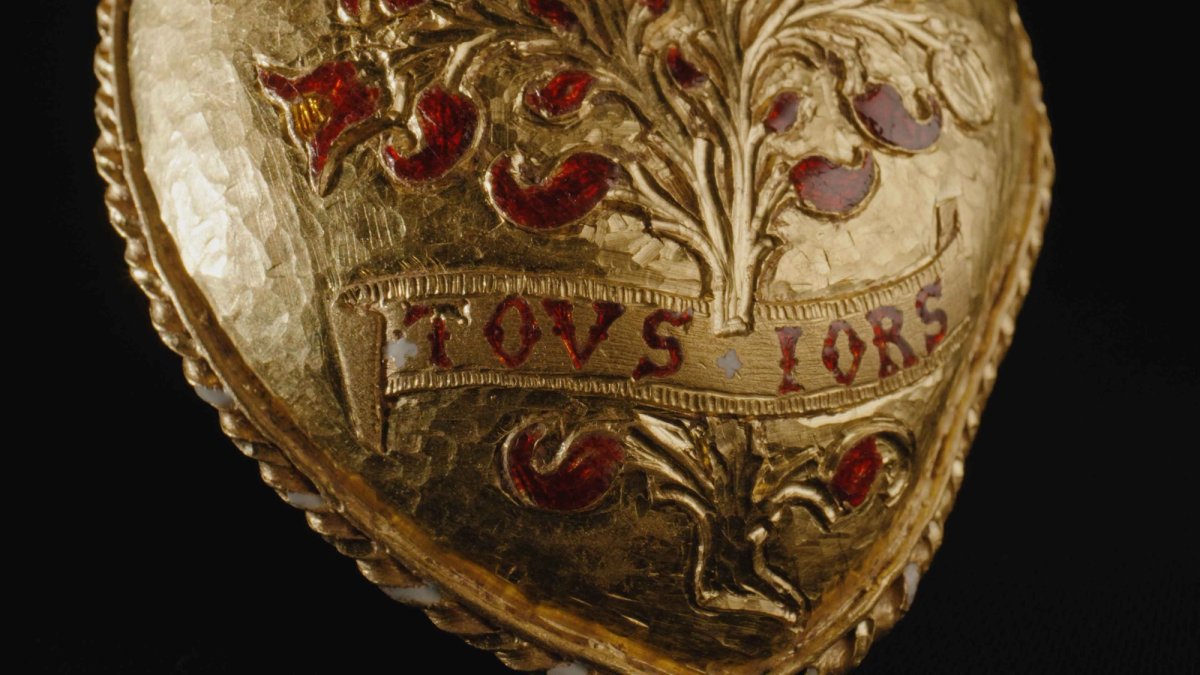
At the bottom of each face is a banner reading TOVS IORS (tousiors), the old French for “always’. Rachel King, the curator of Renaissance Europe and the Waddesdon Bequest at the museum, has suggested that this could also be a pun on the later, equivalent word “toujours”, with the spacing making it sound like “tous [all] yours” when spoken aloud. The pendant was found with a golden chain and clasp, which is carved in the shape of a fist.
Speaking to The Art Newspaper at the launch of the fundraising campaign last year, King explained that research undertaken by the British Museum suggests that the pendant may have been created for a tournament marking the marriage of Henry and Katherine’s daughter Mary to the French heir apparent in 1518. She also emphasised its artistic and archaeological value, explaining that “absolutely nothing [else] of this complexity or type” survives from Henry VIII's early reign.
King added that it was the kind of object that, until its discovery, was seen only in inventories and observations of paintings by artists such as Hans Holbein the Younger. “This is the first example of this type of chain that survives outside of a portrait,” she said. “You particularly see them in Holbein's portraits from the 1530s being worn by men.”
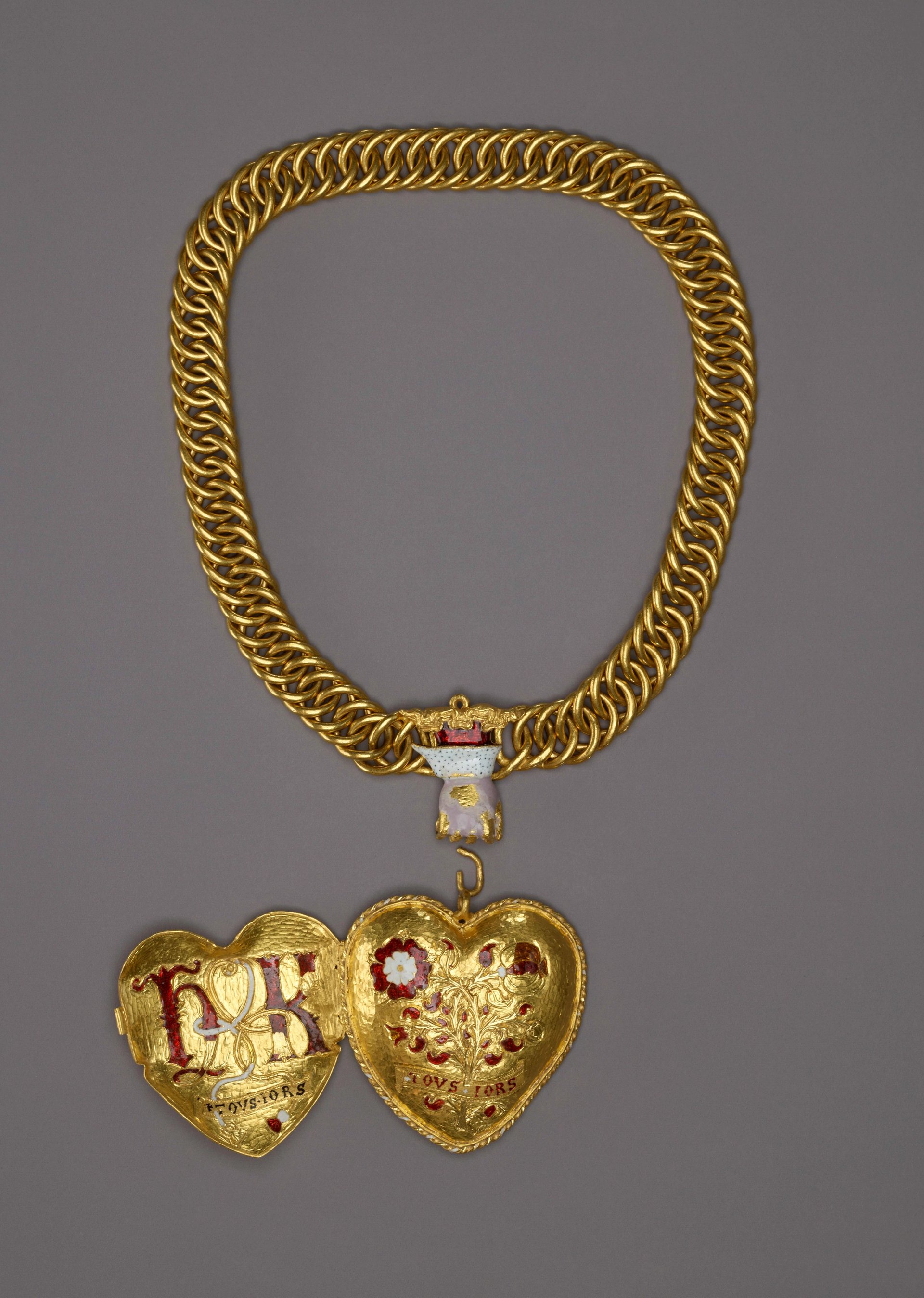
The curator Rachel King says that the chain found with the pendant is the first of its kind that survives outside of a portrait
© Trustees of the British Museum
It was the connection to Katherine and Mary, which King highlighted as the most exciting aspect of the find. “We have very little in Britain's museums that relate to those two figures and that's because of vilification through anti-Catholic bias over the past 400 to 500 years,” she says. “What we want to be able to draw out is Katherine as her own person, a queen in her own right,” she said.
The fundraising campaign, kicked off with speeches from the historian Mary Beard and the actor Damian Lewis, achieved success two months before its April deadline. The £1.75m award from the National Heritage Memorial Fund was made to mark the 45th anniversary of the organisation, which was established to “save some of the UK’s finest heritage at risk of loss”, according to a statement on its website. Other major contributions included £500,000 from the Julia Rausing Trust, one of the two leading donors for the National Gallery in London’s forthcoming extension, and the Art Fund, which gave £400,000.
The tens of thousands of donations from members of the public came to £380,000, just over 10% of the total sum.
Nicholas Cullinan, the director of the British Museum, said in a statement: “The success of the campaign shows the power of history to spark the imagination and why objects like the Tudor Heart should be in a museum. This beautiful survivor tells us about a piece of English history few of us knew, but in which we can all now share. I am looking forward to saying more soon on our plans for it to tour the UK in the future.”
Uncertainties about the pendant's history, such as how it came to be in Warwickshire, remain. A museum spokesperson tells The Art Newspaper that once the pendant is officially accessioned, further scientific study and research will be able to take place.