

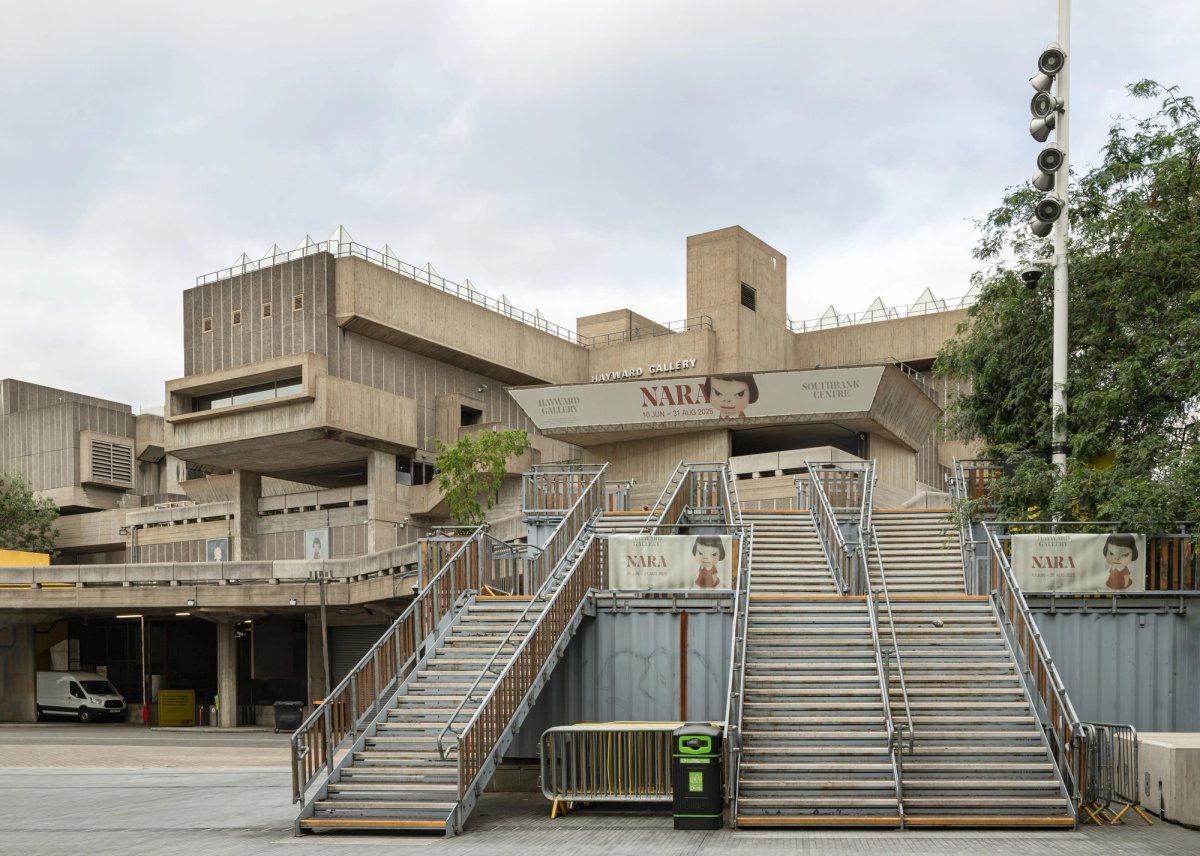
London’s Southbank Centre has been awarded Grade II listed status by the UK Department for Culture, Media and Sport, giving the controversial Brutalist landmark statutory heritage protection.
The vast venue—a symbol of post-war optimism initially built in 1951 under a Labour government—comprises a set of concrete buildings including the Royal Festival Hall, the Purcell Rooms and the Queen Elizabeth Hall, which opened in 1967, along with the Hayward Gallery which followed in 1968. The centre celebrates its 75th anniversary this year with a special programme of events including a major exhibition of works by Anish Kapoor at the Hayward Gallery (16 June-18 October).
The Grade II listing covers the Hayward Gallery, Purcell Room and Queen Elizabeth Hall—all designed by a team led by architect Norman Engleback as head of the Greater London Council's architecture department—as well as the skatepark undercroft, terraces, walkways and staircases around the complex. The Royal Festival Hall was previously listed as Grade I in 1988.
Historic England, which registers listed buildings, says that it is of historic importance given that “the Hayward Gallery was the first major building project undertaken in conjunction with the Arts Council, it is a key example of a purpose-built gallery for temporary and touring exhibitions, and one of the first in England to experiment with modern styling and planning”. It is also noted its architectural importance, stating that its designation was in part due to its "use of exposed concrete in which the building’s monumental scale is countered by the fine texture and tactility of its surface finishes, executed with exemplary technical skill".
A spokesperson for the Southbank Centre told the BBC: "The listing underlines the need for government investment in our buildings, all of which they own. We look forward to working with the government to ensure these buildings are able to thrive long into the future." The centre has asked the government for £30m to support improvements to its infrastructure.
A major renovation of the Southbank Centre, which began in 2005, created 35% more capacity in the Royal Festival Hall (the refurbishment was budgeted at £111m but the final cost was £117m). The Queen Elizabeth Hall, Purcell Room and Hayward Gallery all reopened in 2018 following a two-year refurbishment led by the architects Feilden Clegg Bradley Studios. The Centre has struggled financially in recent years, in part due to the debts accrued during the renovation.
Catherine Croft, the director of the Twentieth Century Society (C20S) which led the campaign for the centre to be listed, says in a statement that “the battle has been won and brutalism has finally come of age. This is a victory over those who derided so-called ‘concrete monstrosities’ and shows a mature recognition of a style where Britain led the way… The arts complex is a highly sophisticated, sculptural masterpiece, with enormous richness of form and detail inside and out.”
However, in response to the Centre's new heritage status, the journalist Simon Heffer wrote in The Telegraph that it was a “concrete monstrosity” adding that “in an ideal world, the Southbank Centre would be flattened and a competition held to build a handsome replacement that would adorn the banks of the Thames.”
