A string of high-profile gallery closures in Los Angeles recently set off alarm bells and sparked headlines about a potential cooling of the local market. But on the ground this week, dealers gathered at Frieze Los Angeles paint a more nuanced picture, especially for a new generation of younger galleries and collectors doubling down on local ties, experimentation and new approaches to conventional art-market wisdom.
Parts of Los Angeles are still rebuilding from the deadly wildfires a year ago that threatened to shut down the previous iteration of Frieze Los Angeles altogether, and the intense escalation of raids, arrests and deportations by federal law enforcement at the direction of the Trump administration have destabilised communities across the region. In the past year, Michael Werner Gallery, Sean Kelly, Tanya Bonakdar and Southern Guild have shuttered their West Coast outposts, while established local galleries like Blum and LA Louver closed their public commercial programming.
The dealer Hannah Hoffman says she doesn’t see the recent wave of closures as a referendum on the local art market. Since founding her gallery in 2013, she has been through several boom-and-bust cycles in Los Angeles, she says.
“I see it as a reflection of the fantasy people have about what this place is. [Los Angeles] holds a strong image in our imagination,” Hoffman says. “But the reality is that this is a place that’s a really tight-knit community—you need to be present. It’s hard for galleries, when this is their second or third or fourth space, to have those direct relationships.”
Hollywood looms large in narratives about Los Angeles, even for art dealers. The shrinkage of the entertainment industry has put pressure on Los Angeles’s economy as a whole. Entertainment contributes more than $115bn annually to the larger regional economy and supports more than 680,000 jobs, according to 2024 data from the Los Angeles Economic Development Corporation (LAEDC). According to Luminate, a Hollywood data company, Los Angeles saw a 24% drop in major scripted television and film productions in 2025 compared to the previous year.
Last year, California governor Gavin Newsom signed a $750m film and television tax credit to help keep entertainment projects in Hollywood. It more than doubled the tax credits California offers to productions shot in the state. But there is continued concern that growing consolidation in the entertainment industry will continue to push jobs and tax revenue out of Southern California. On the day of the VIP preview, Netflix announced it had backed out of its bid to acquire Warner Bros Discovery, paving the way for a Paramount Skydance takeover if approved by regulators.
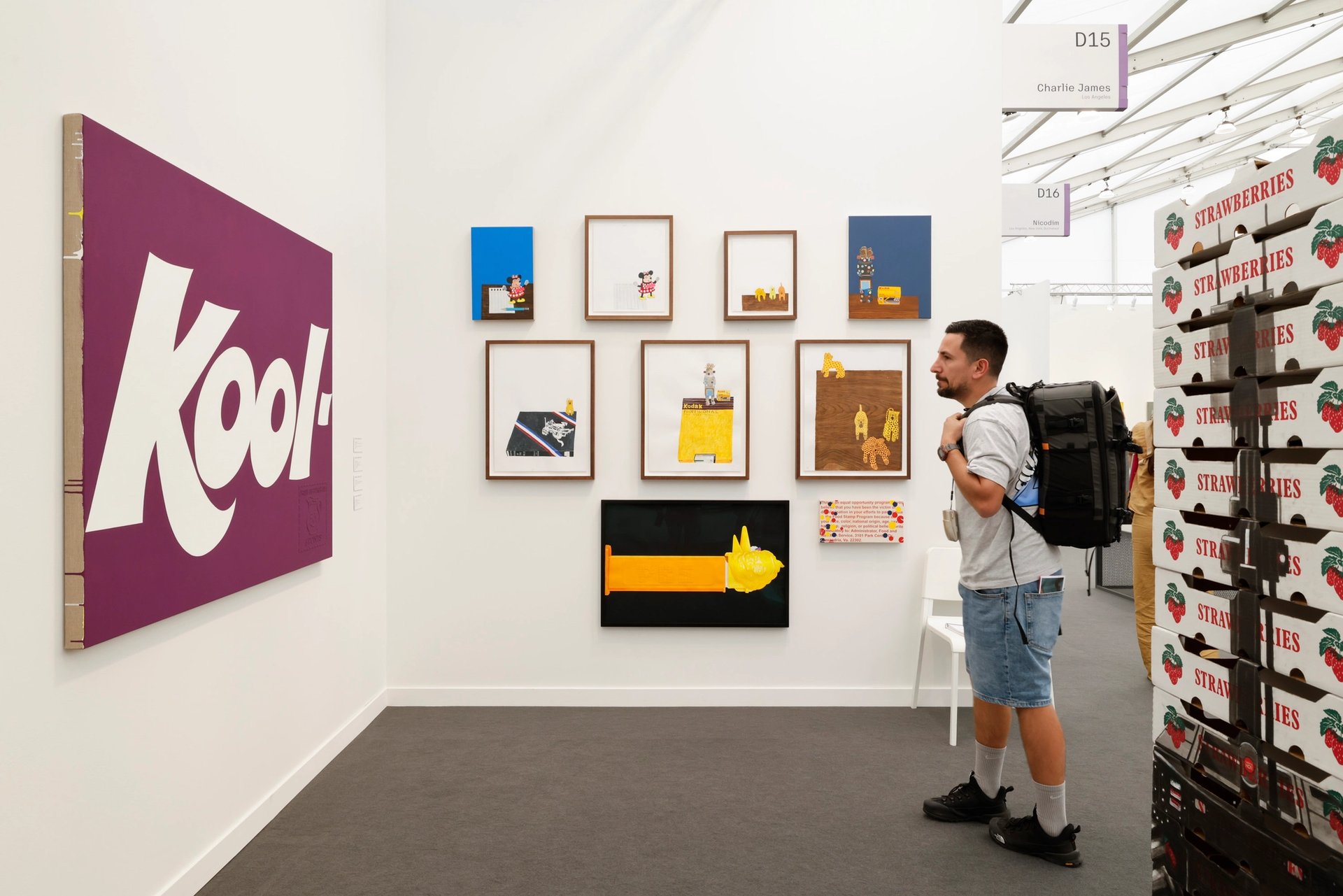
Works by Kristopher Raos, left, and Manuel López, centre, on Charlie James Gallery’s stand Carlin Stiehl
Adept galleries adapt
“There are things that are structurally an issue now in the entertainment business, which is core to the town’s identity and to the actual base of the city’s economics,” the Los Angeles dealer Charlie James says. “It’s been fundamentally altered by these takeovers by tech companies—some of our clients are in the creative community that’s involved in film and television, and that business is upside down.”
Still, LAEDC’s annual economic forecast report released this week indicates the overall regional economy continued to grow last year despite disastrous impacts from the wildfires, violent immigration crackdowns and supply-chain and trade issues caused by federal tariff policies. The gross Los Angeles County product—a local version of a gross domestic product, the total value of all goods and services produced—grew by 2.2% in 2025, up from the 1.1% growth rate in 2024 and the 1% growth rate in 2023.
“The chill in the market hit us late, but there was a concavity last year that took hold in late spring into early fall,” James says. “That was perceptible and weird, but things got right in December, and the year’s started well, thank goodness.”
Amid the changing landscape and recalibrating art market, Los Angeles galleries are making adjustments to keep their businesses dynamic. In September, Hoffman merged her eponymous Los Angeles gallery with the New York dealer Bridget Donahue to form a coast-to-coast enterprise. At this year’s Frieze, the first since the gallery’s merger, the Hoffman Donahue stand is front and centre at the fair entrance. Partnering has allowed for a more sustainable business, Hoffman says: “It became very apparent that we could do more together than we could do on our own.”
In the past few years, Los Angeles has been home to a rising group of young collectors who are institutionally minded and involved with museum boards and acquisition committees, Hoffman says. “These are collectors who maybe missed that Covid bubble in terms of their own arc as a collector, and instead have come into the conversation in the last year or two,” she says. “They’re not only each developing collections that feel deeply personal and different from one another, but they also have a shared value system that we are all collaborators.”
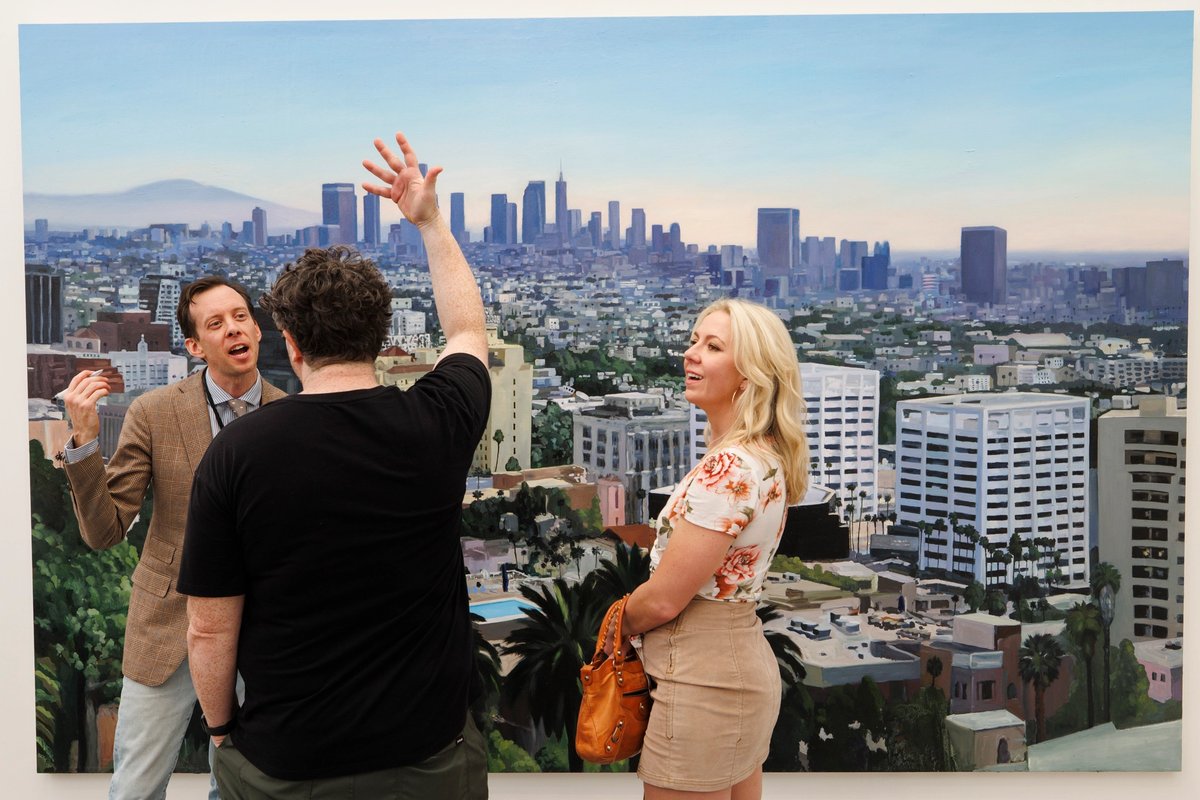
Emma Fernberger, who was previously a director at Bortolami in New York, founded her gallery in Los Angeles only two years ago and is showing at Frieze Los Angeles for the first time. The Fernberger stand in the Focus section is dedicated to Greta Waller, a Los Angeles-based artist who for a decade has also worked as a paramedic. The stand includes sprawling paintings of the Los Angeles skyline and ethereal renderings of ice. Fernberger says the mood among Los Angeles’s commercial galleries felt more “energised” in the lead-up to Frieze, which creates an important moment for the city’s galleries.
Fernberger, a self-described “eternal optimist, maybe to a fault”, adds that 2025 was “a real master class in being nimble” for local dealers. “Every artist I show, I’m a fan first, gallerist second,” she says. “I have to be really passionate about what I show. Otherwise, it just doesn’t work.”
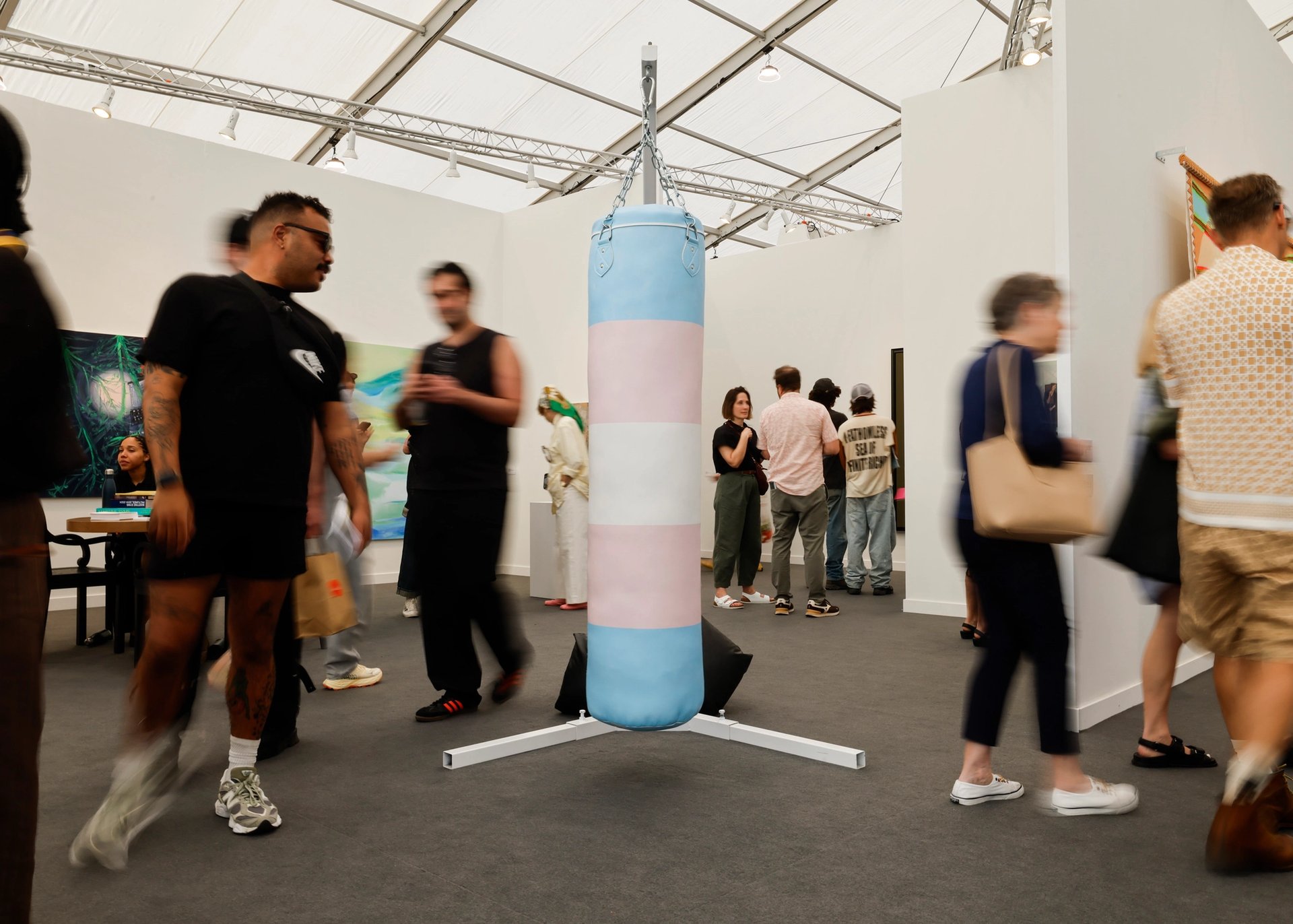
Puppies Puppies’s A metaphor for how I feel - my identity is being used - in 2026 (Punching Bag), on Hoffman Donahue’s stand, invokes the trans pride flag Carlin Stiehl
Gratitude for growing pains
Sara Lee Hantman’s gallery Sea View is also taking part in Frieze for the first time and showing in the Focus section. Its stand, dedicated to the work of Zenobia Lee—who has a concurrent solo show at the gallery’s home base in Hollywood (until 28 March)—is a hit with collectors, Hantman says. The stand sold out during the VIP preview, with works priced between $7,000 and $20,000.
“There is a new generation of dealers who are willing to take risks both structurally and programmatically, and function in different ways that might not have been successful or respected in previous generations of art galleries,” Hantman says. “But now there is a little bit more room for experimentation and for people to try something new.”
Young galleries are still beholden to Los Angeles’s infrastructural constraints, including its dependency on cars and the resulting traffic jams. Last year, Sea View relocated from a Modernist house designed by the Cuban American artist Jorge Pardo in East Los Angeles to a space in Hollywood near a cluster of established galleries including Jeffrey Deitch, Lisson Gallery and Regen Projects. As much as she loved the original space, Hantman says, the gallery can now receive more visitors in a single day than it did in an entire month at its previous location. The shift has been successful, she says, and adapting is crucial for galleries to survive.
“I am really excited about this new generation of galleries, and even the post-gallery pop ups,” Hantman says. “Growing pains is a really good way of putting it—we wouldn’t be trying these new models out if it wasn’t for a bumpy ride. This is an exciting time to be part of the Los Angeles art world, and I’m glad I didn’t wait for a better time.”