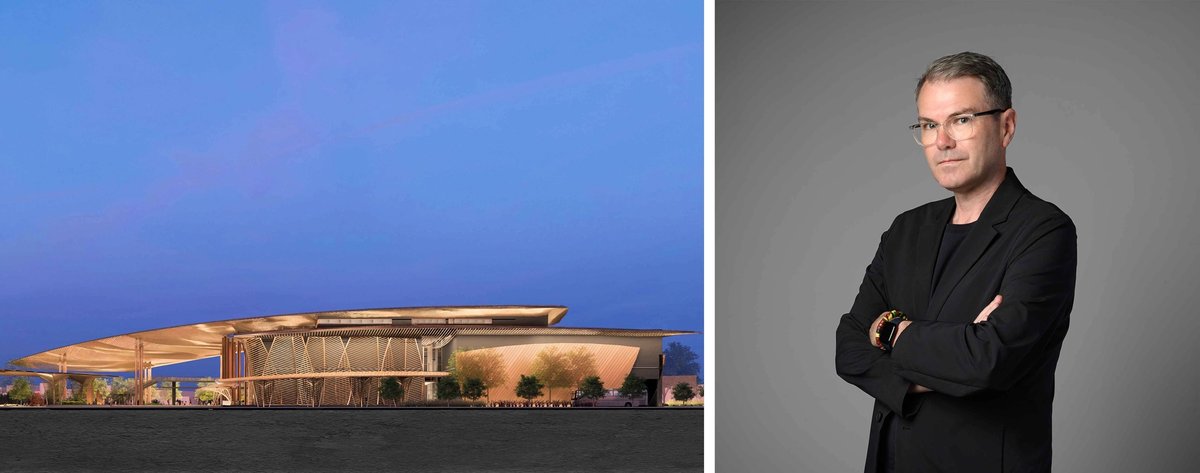
Last month, the Ayala Foundation named Reuben Keehan as the inaugural artistic director of Kontempo Center for Contemporary Art, which is currently under development in Manila. Construction began earlier this year, but no timeline for its completion or projected opening date has been made public.
The Ayala Foundation is the socioeconomic development arm of the Ayala Corporation, one of the Philippines’ oldest and largest conglomerates, with businesses spanning real estate, banking, telecommunications and infrastructure. The budget for Kontempo has not been publicly disclosed. The centre will focus “on exhibitions, commissions, research and public programming rather than building a large permanent collection”, according to a spokesperson.
Situated within a 2.5-hectare site, Kontempo will include three large gallery spaces measuring up to around 2,500 sq. m and surrounded by 15,000 sq. m of green space intended for public art installations and programming. Its location is beside the Pasig River, a vital city artery undergoing rehabilitation, and at the centre of Circuit Makati, a former horseracing track turned urban district where malls, residential neighbourhoods and pockets of nightlife collide.
Keehan and Kontempo’s architect Kulapat Yantrasast, the founder of Why Architecture, are embracing the site’s dichotomies. Yantrasast describes his design as “porous”. He uses the term both literally and metaphorically: referring to the building’s multiple points of entry and open sightlines, aimed at dissolving the boundary between interior and exterior, as well as an institution that resists enclosure.
Together with the Philippine firm Lor Calma & Partners, headed by Ed Calma, he wants to tap into Filipino heritage and materiality. Rather than replicate vernacular motifs, Kontempo draws from principals of tropical architecture, such as permeability and climatic responsiveness, and on traditions of communal gathering that are embedded in Filipino culture. “It doesn’t put walls around everything. It embraces the commercial aspect of Manila, embraces nature through the river and pays homage to the Santa Ana circuit energy—the free spirit of Manila from many years ago,” Yantrasast says.
His reference is to the site’s former life as the Santa Ana racetrack, once a leisure space that drew crowds from across social classes. “It’s not anti-institutional. It’s about integration and evolution,” Yantrasast says. “I’ve been very inspired by projects that ask the question: not who’s coming, and not even who’s not coming, but who can’t come? What are the barriers in the way of people actually participating in this form of cultural life?”
Keehan, the former curator of contemporary Asian art at the Queensland Art Gallery and Gallery of Modern Art (QAGOMA), echoes that message. “My role as artistic director, in formulating a curatorial ethos, is one that would operate very closely with Kulapat’s architecture and the propositions he has put forward, ultimately encouraging people to create a space of autonomy for themselves,” Keehan says.
Collaboration, regional exchange and sustained engagement have been longstanding priorities for Keehan, who for over a decade has been shaping QAGOMA’s Asia Pacific Triennial of Contemporary Art. He sees his appointment at Kontempo as an opportunity to continue that work. Central to Keehan’s decision to accept the role was what he describes as a shared “emotional investment” with the Ayala Foundation’s chairman Fernando Zobel de Ayala, who is adamant about being responsive to the local community.
“Like the architecture, it’s not an institution that’s putting up walls around itself, but an institution that’s making itself broadly accessible to a complex and deeply talented community,” Keehan says.
The name Kontempo is derived from the English word “contemporary”, and expressed through Filipino orthography. Adapting a global term and presenting it in Filipino phonetics, it signals a conscious assertion of local authorship within contemporary art discourse.
“One of the motivations behind using the terminology of a ‘centre for contemporary art’ rather than specifically calling it a gallery, speaks to that multitude of functions,” Keehan says. “Contemporary art is more than just objects placed in a space. A centre is more than just a gallery—it is a space for various modes of learning, knowledge production and the sharing of narratives, stories and techniques. So when we talk about a programme-led institution, we mean one that values the contributions of artists.”
Once Kontempo is up and running, Keehan says visitors should expect programmes that challenge the idea of institutional education. “I'm very inspired by the idea of education that's not simply a didactic one, where you produce a sequence of dates, events and information that the student memorises by rote; you give the students the tools to become producers themselves,” he says. This includes avoiding the colonial attitudes that are embedded in the identities and operations of many European and North American museums. “This is a really important goal for an art institution,” he says, “to enable people to see the possibilities for themselves creatively in their own lives in a way that’s genuinely transformative.”
Yantrasast concurs, reiterating that the centre is intended to create new connections and possibilities. “Every museum is a mirror,” he says, “an act of defining who you are, who you are as a people, who you are as a country. I grew up in Bangkok, where we once neglected our rivers. Now they’re central to city life again. I believe the same will happen in Manila. The museum will act as a bridge between the city and the river—connecting urban life with nature.”