Total star rating: ★★★★½
The works: ★★★★
The show: ★★★★★
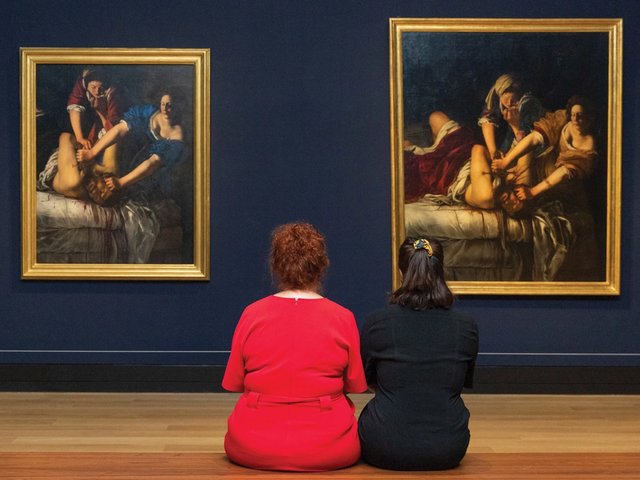
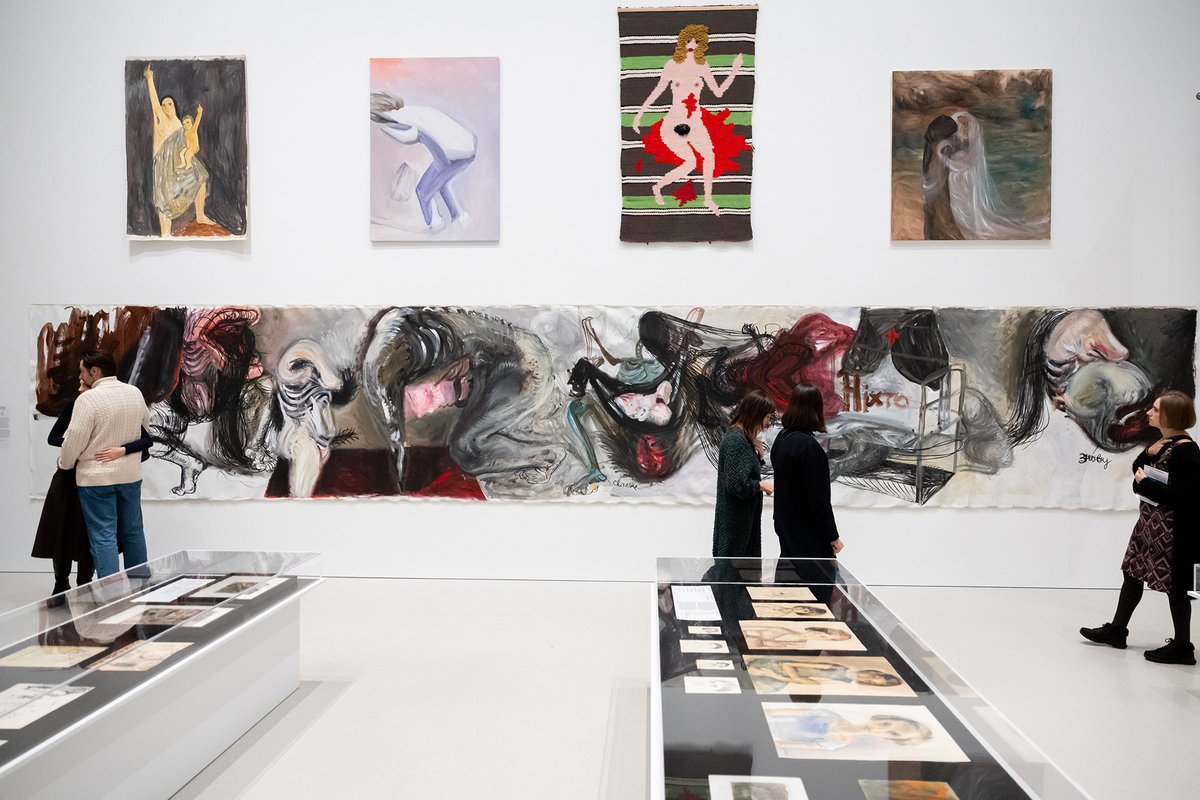
Before entering the main space of The Woman Question 1550-2025, two paintings immediately signal the collective mood and feminist ambition of the exhibition: Artemisia Gentileschi’s Susanna and the Elders (1610) and Miriam Cahn’s Must Strike Back (2024). Gentileschi portrays the biblical tale of Susanna being preyed on by lecherous elders as she bathes, her panic and discomfort emphasised by the drama of all the gesturing hands, the coldness of the stone bench under her nude flesh, and the dagger-like shadow under her right foot. Painted at the age of 17—shortly before she was raped by her art tutor Agostino Tassi and had to prove her innocence by undergoing torture by thumbscrew—it maps the personal and the political through allegory. Centuries later, the Swiss painter Cahn’s Must Strike Back also defies male aggression in an image of a naked woman—but now she has one hand in her vagina, the other in a fist, punching an erect male to her side.
That sense of women artists working to strike out against the male gaze and patriarchal society is reiterated with the looping of Gina Birch’s short film 3 Minute Scream (1977) over the entrance doors to the exhibition hall. Her punk, red-lipped screaming also powerfully reflects the curator Alison M. Gingeras’s exhibition concept and gathering of almost 200 works by some 140 women artists in a vast, powerfully unruly, survey spanning 500 years.
The exhibition title references “la querelle des femmes”, a phrase used by the Medieval court writer Christine de Pizan who authored The Book of the City of Ladies (1405) about an allegorical space that would protect and conserve the histories of important women.
The book called for “woman” as a new, prized category of citizen, and this show at the Museum of Modern Art in Warsaw calls for her rightful status as citizen artist. There is an old-school feminism about the exhibition and its banner-like thematic sections. Gingeras has taken inspiration from the pioneering exhibition Women Artists 1550-1950, organised by Linda Nochlin and Ann Sutherland Harris, which toured US museums in 1976-77. The show is also indebted to Nochlin’s (and Maura Reilly’s) exhibition Global Feminisms at the Brooklyn Museum in 2007. But this survey is more transhistorical and focused on figurative painting and sculpture, and, critically, at pains to show that hard-fought feminist victories are under constant threat.
The exhibition opens with the section “Femmes Fortes: Allegories of Agencies”, which includes Jane Graverol’s take on the biblical tale Judith and Holofernes (1949) and Lubaina Himid’s allegorical portrait of the sea goddess Amphitrite as a monumental black woman (2025), followed by a section on “Education and the Canon”, reflecting how women master their own image and insert themselves into the canon.
Wield a brush like a sword
A gallery themed “Palettes and Power” makes mastery literal through a focus on the palette as an object whose womb shape becomes a symbol of empowerment.
This is the most cohesive room in the show as across one painting after another women wield the brush like a sword. Star works such as Sofonisba Anguissola’s Self-Portrait at the Easel (1554-56) disprove the idea that women only entered the painting academy in the 19th century, while Marie-
Guillemine Benoist’s Neo-Classical Self-Portrait (1786) insists on beauty plus brains in combining a sensual bare shoulder with a firm grip on her brush. The inclusion of Felicja Curyło’s tempera Self-Portrait (1950-59), a local artist known for her folk “painted cottage” art, is a pointed curatorial decision—Gingeras rightly taking back women’s work typically marginalised in the folk or ethnographic museum. It was also a treat to find the young artist Somaya Critchlow’s X Studies the work of Pythagoras (2022) in the mix with its cheeky sensuality mocking the Greek philosopher’s reduction of the physical world to numbers.
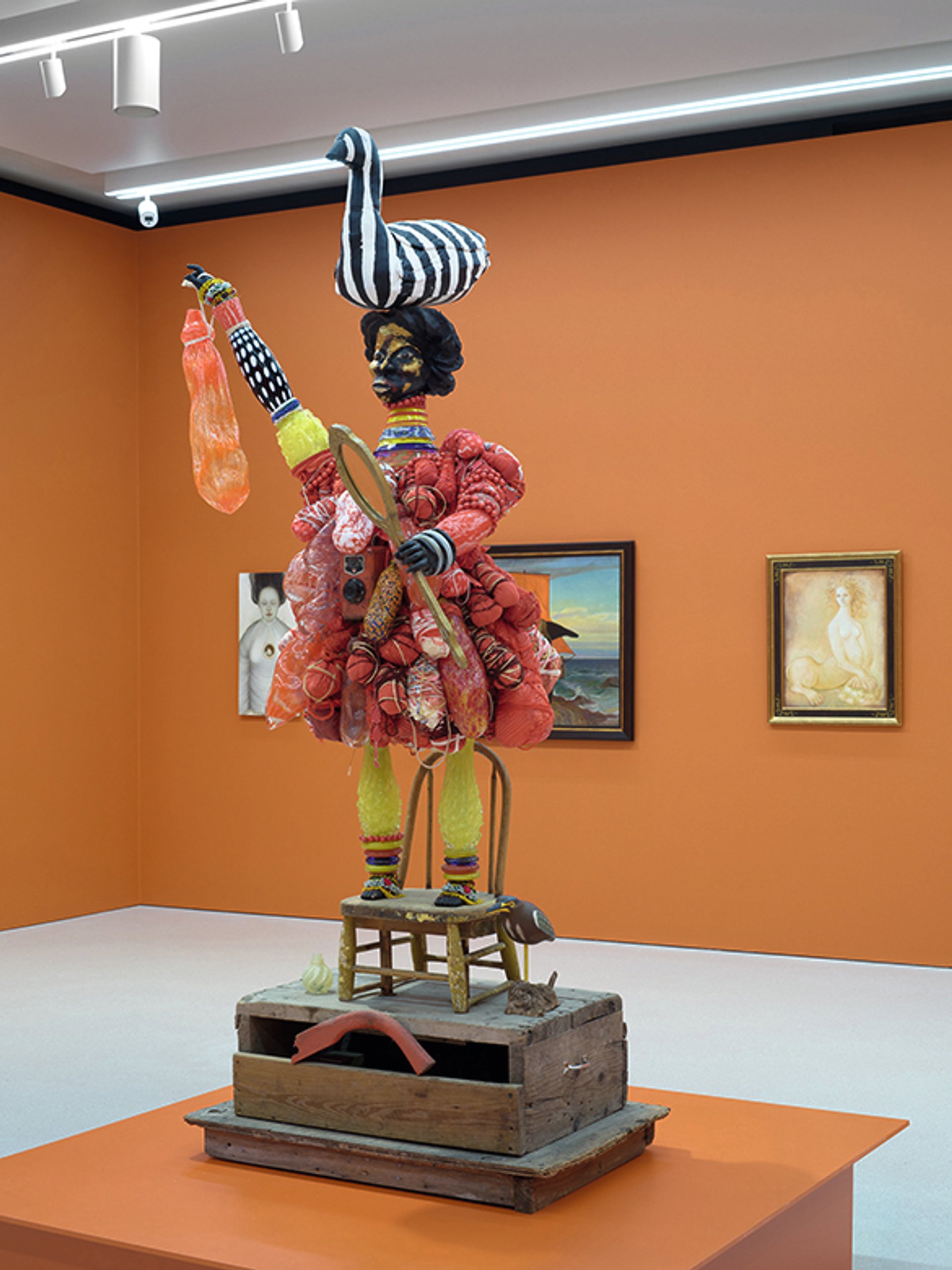
Vanessa German’s The Blood & The Animals, The Mirror & The Sky, an Ode to the Un-language-able Truth of Is-ness (2017) Robert Glowacki Photography
Women enjoying their own bodies takes a metaphysical turn
Women enjoying their own bodies takes a metaphysical turn in the “Surrealist Self” gallery with Anna Güntner’s enigmatic Shy Fiancé (1961) and Leonor Fini’s Sphinx (1973), both portraying bare-breasted women as totems of mystical powers, alongside Vanessa German’s figurative sculpture The Blood & The Animals, The Mirror & The Sky; An Ode to the Un-Language-Able Truth of Is-Ness (2017), constructed from found objects and, according to the artist, “the blood that binds us all together, light, light, light, glee, the glory of creativity, the deep truth that we are all here together”. This halfway mark in the show offered a necessary uplifting, poetic pause—though this critic does feel most at home in the surreal.
The theme of oppression then returns with a section called “No Gate, No Lock, No Bolt”, a quote from Virginia Woolf’s famous essay (and demand for) A Room of One’s Own. Many of the works are more about a boudoir of one’s own, with Tamara de Lempicka’s The Beautiful Rafaela in Green (around 1927), Teresa Tyszkiewicz’s vulvic “pin-painting” Red 1 (1986-87) and Jordan Casteel’s oil portrait of the black male nude Aaron (2013), all offering different renditions of full-frontal desire.
The last two rooms of the exhibition struck me as a kind of coda, summing up where woman is today. “Of Woman Born”, entered by an immersive mural by Karolina Jabłońska titled Weathering the Storm (2025)—where scraps of feminist quotes blow in a skyscape—uplifts the eye and soul with visceral imagery of goddesses and birthing by the likes of Monica Sjöö, Clarity Haynes and Frida Kahlo. And yet there is a reminder that rights won can be taken back, as a replica of Madame du Coudray’s 18th-century obstetrical mannequin for practicing mock births, and Ewa Kuryluk’s comic-strip like drawing Abortion on TV and Live (1974), speak to the medicalisation and pathologisation of women’s bodies, as well as the fact that there is still a near total ban on abortion in Poland.
Meanwhile, “Wartime Women” situates gender politics and feminist work within the collective memory of the horrors of the two world wars, including the Warsaw Uprising and the Holocaust, and more recently the war in Ukraine. Sharing the space are works by the likes of the 19th-century Russian aristocrat Marie Bashkirtseff; the Soviet Ukrainian artist Tetiana Yablonska; the Soviet dissident Alla Horska, an underground figurehead who was likely murdered by the KGB; and Sana Shahmuradova Tanska, who painted War Widow (2023) in Kyiv after the full invasion of Russia in February 2022.
At once about life and death, this finale feels urgent for the museum and its role in Warsaw at a time when the Women’s Strike movement rally cry for reproductive rights—“I think, I feel, I decide”—is so critical, and war and genocide so close to the country’s borders. Woman and her right to an equal and safe and celebrated place in the city remains the site of protest, in and outside the museum.
• The Woman Question 1550-2025, Museum of Modern Art in Warsaw, Until 3 May
• Curator: Alison M. Gingeras
• Tickets: 35zł (£7, concessions available)