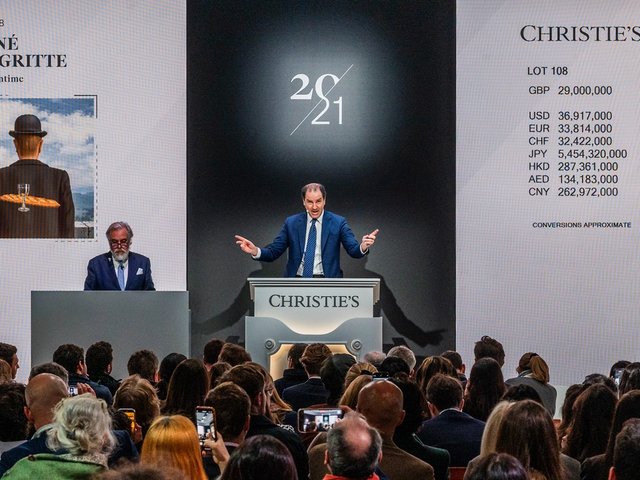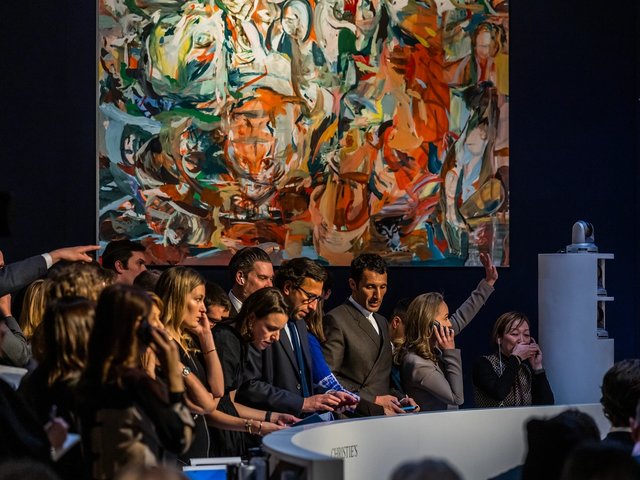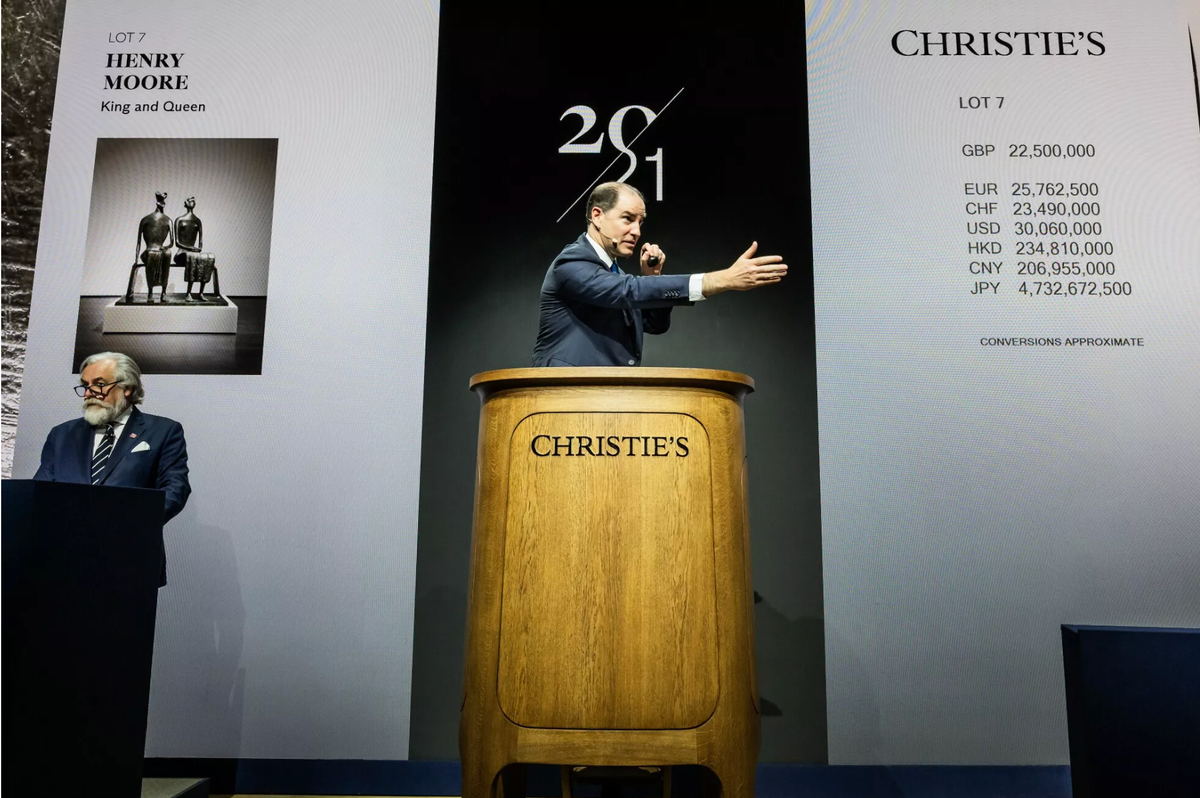
Christie’s London brought in £197.4m (with fees) across three evening sales on Thursday, marking a 52% increase year on year on the equivalent auctions last season. Bidding proved robust throughout the nearly four-hour marathon, with a 96% sell-through rate by lot and 98% by value. Artist records were achieved for Dorothea Tanning, Henry Moore and Toyen.
“The standout performers of the night were the works that were fresh to market. People are really pursuing quality,” Katharine Arnold, Christie’s vice chairman of 20th and 21st Century sales, told The Art Newspaper after the sale. “In a world that remains uncertain, quality is what prevails, and that's really the key ambition for us as we put together sales.”
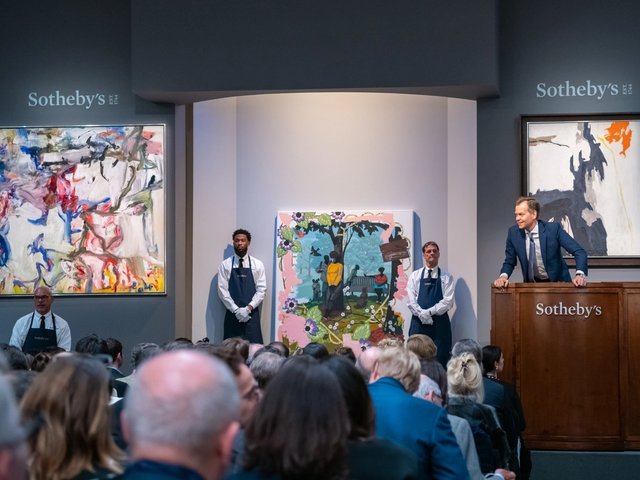
Following a respectable showing the previous evening at rival house Sotheby’s Modern and Contemporary evening sale, Christie’s triple bill began with the 20th and 21st Century evening sale.
Results were healthy but measured, with many works hammering around the low end of their estimates. Even so, there were moments of excitement. A prolonged bidding battle for Henry Moore’s King and Queen (1952-53) sculpture ended at £22.5m (£26.3m with fees), well above its £10m to £15m estimate, prompting an eruption of applause in the room. The sculpture is the last cast from the series still in private hands; the others reside in institutional collections including Tate. The result set a new auction record for the British sculptor and was the top lot of both the evening and the London season so far.
“The result that it achieved was the right result. It was a masterpiece, and we will not see another sculpture of that type for the foreseeable future—certainly not a King and Queen,” Arnold said.
Other strong results included Sonia Delaunay’s Rhythme couleur (1946), which sold for £1.45m (£1.8m with fees) against a £1m to £1.5m estimate, and Rose Wylie’s Tube Girl (2016), which fetched £120,000 (£152,400 with fees), nearly doubling the high end of its £50,000 to £70,000 estimate. The sale of the Wylie work coincides with the artist’s major exhibition at the Royal Academy of Arts in London.
“We very much position our sales within the London ecosystem and the art world, in terms of exhibitions and the broader art context,” said Keith Gill, vice chairman of 20th and 21st Century sales. “We are very careful to curate our sales to be resonating with today's audience.”
The lot carrying the highest estimate was Wassily Kandinsky’s Le rond rouge (1939), which hammered at the low end of its £10.5m to £15.5m estimate (£12.5m with fees). Three works near the end of the sale—by Georg Baselitz, Gerald Laing and Marc Chagall—failed to sell, and none returned for renewed bidding at the close.
Four works were withdrawn shortly before the auction began: a 1931 painting by Bridget Riley estimated at £3.5m to £5.5m; Cecily Brown’s Shadow Burn (2005–06) with a £3m to £5m estimate; Lucian Freud’s Pluto’s Grave (2003) estimated at £2m to £3m; and Frank Auerbach’s To The Studios IV (1985), also estimated at £2m to £3m. Together, the works carried a combined estimate of £10.5m to £16.5m.
The 20th and 21st Century evening sale totalled £93.7m (£114m with fees), comfortably within its pre-sale estimate range of £77.2m to £115.1m and achieving a 92% sell-through rate by lot.
Surrealism riding a high
Next came the Art of the Surreal Evening Sale, marking the 25th anniversary of Christie’s dedicated Surrealism auction in London. Long a market favourite, the category delivered £34.6m (nearly £43m with fees), at the high end of its £22.9m to £35.2m estimate.
The sale opened strongly when Joan Miró’s Peinture (1949) hammered at £3.9m, more than doubling the low estimate of £1.5m to £2.5m amid energetic bidding. Pablo Picasso’s Figure (1929) fetched £2.1m (£2.6m with fees) against a £600,000–£800,000 estimate. The most valuable lot was René Magritte’s Les grâces naturelles (around 1961), which hammered at £7m (£8.5m with fees).
Two artist records were set during the sale. The first came for Dorothea Tanning’s small but electrifying painting Children’s Games (1942), depicting two young girls ripping away wallpaper to reveal patches of flesh beneath. The work had remained in the same collection for more than four decades and had been on long-term loan to the Dallas Museum of Art since 2012. After nearly ten minutes of bidding, it hammered at £3.8m (£4.6m with fees), far exceeding its £1m to £2m estimate. Toyen’s Le devenir de la liberté (1946) also set a new record, selling for £3m (£3.7m with fees).
Only one lot was withdrawn from the sale: Magritte’s Le choeur des sphinges (1964), which had carried a £5m to £8m estimate.
Collections remain key
The evening concluded with a single-owner sale, Modern Visionaries: The Roger and Josette Vanthournout Collection. The Belgian couple spent six decades assembling the wide-ranging collection, which was displayed in their Flanders home. Roger Vanthournout, trained as an interior designer, manufactured furniture.
The collection brought in £32.3m (£40.3m with fees), within its £28m to £43m estimate.
The top lot was Pablo Picasso’s Nu debout et femmes assises (1939), which sold for £5.7m (£7m with fees) against a £3m to £5m estimate. Jacques Lipchitz’s Jeune fille à la tresse (1914) hammered at £1.6m (£2m with fees)—triple its high estimate including premium.
No lots were withdrawn from the collection sale, though one failed to sell: Magritte’s La plaine de l'air (1964) stalled at £2.1m. Max Ernst’s Seestuck (1921) initially passed at £900,000 against a £1.5m to £2.5m estimate, but when the auctioneer returned to the work at the end of the sale it eventually hammered at £1m (£1.2m with fees).
Afterwards, Gill said the Vanthournout collection had helped drive the sharp increase in totals compared with last year.
“Having a collection—which was very much the kind of cornerstone of the season—very much goes towards our totals,” Gill said. “The presence of the collection, then just really just strong performance across the board, across some of the leading artists of the 20th century.”