Three late paintings by Francis Bacon—Study from the Human Body — Figure in Movement (1982), Study from the Human Body (1986) and Man at a Washbasin (1989-1990) — are due to go on show at Gagosian in Paris next month, highlighting the artist's deep relationship with the French capital.
In 1971, Bacon was the subject of a landmark retrospective at the Grand Palais, which was tragically overshadowed by the death of his partner, George Dyer, on the eve of its opening. Bacon continued to frequently visit Paris between 1974 and 1987, notably staying at the legendary Hôtel La Louisiane in Saint-Germain-des-Prés. During this period, he also kept a studio in the city, at 14 Rue de Birague in the Marais, just off Place des Vosges.
Larry Gagosian tells The Art Newspaper: “I have had a number of important Francis Bacon exhibitions in New York and London over the past 20 years, and Paris feels like the perfect place to bring these late paintings together for the first time. It's a city that had a profound effect on the artist and his work. Our gallery off Place Vendôme is also an ideal venue—each of the three canvases will be framed by the historic street arcade and visible for all of Paris to see and enjoy.”
Study from the Human Body — Figure in Movement (1982), with its characteristic cadmium-orange background, reflects the painter’s fascination with cricket. The truncated, nude body appears on a pedestal, near a mirror. The painting was included in Bacon’s now-legendary exhibition at Galerie Maeght-Lelong in Paris in 1984, which drew such crowds that the police were forced to close the street, as Sebastian Smee recalls in his catalogue essay for the show. The work was last shown in Francis Bacon: Unsichtbare Räume at the Staatsgalerie in Stuttgart in 2016-17.
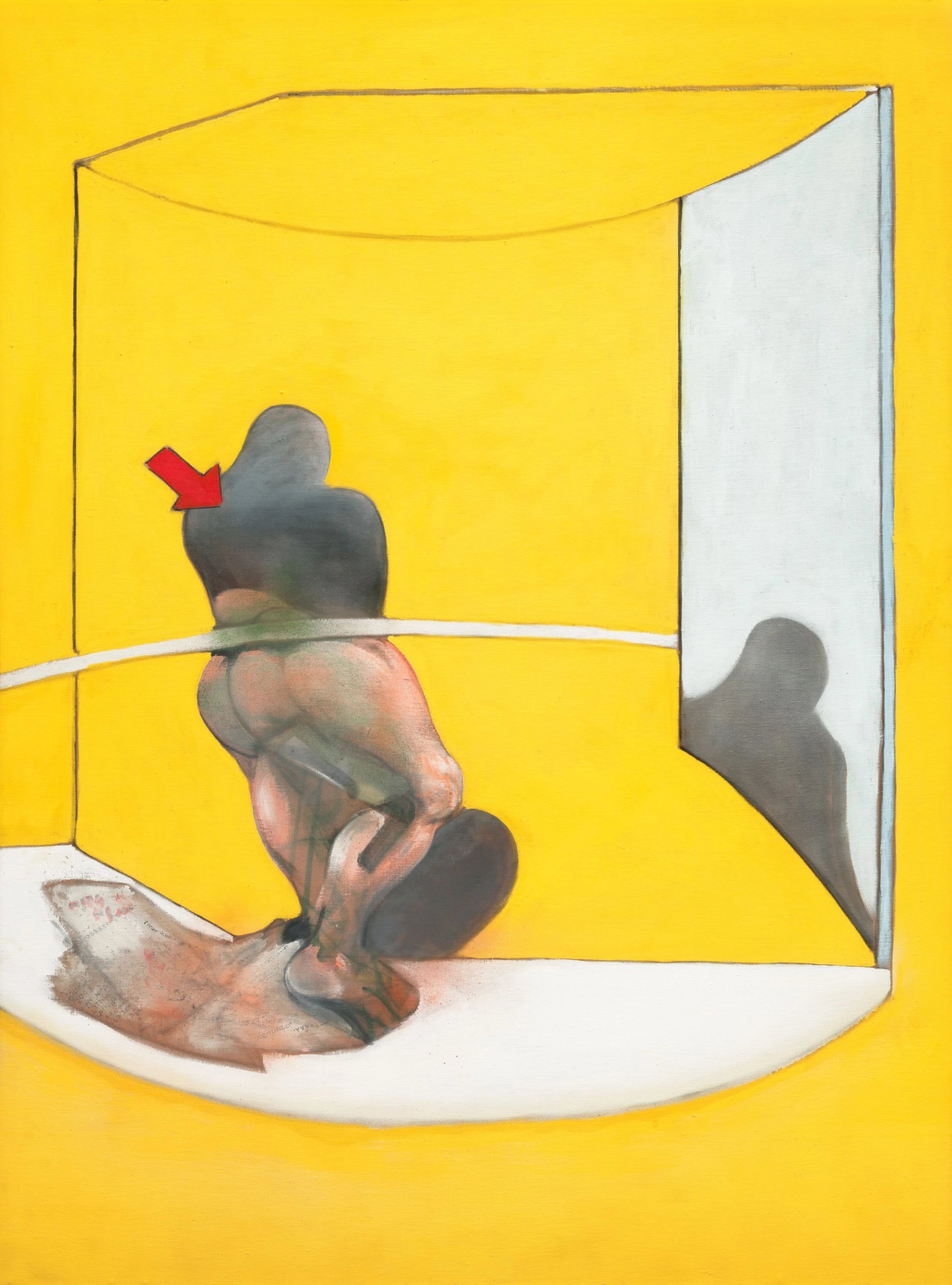
Francis Bacon, Study from the Human Body (1986) © The Estate of Francis Bacon. All rights reserved./DACS, London/ARS, NY 2026. Photo: Annik Wetter. Courtesy Gagosian
Study from the Human Body (1986) builds upon a closely related composition, with a mirror opening out to the right of a distorted figure seen in three-quarter view. Here, a vivid yellow background infuses the painting with sunlight. Rarely exhibited, the work featured in Bacon en toutes lettres at the Musée national d’Art moderne–Centre Pompidou in Paris in 2019–20.
Man at a Washbasin (1989–1990) was also included in that exhibition, as well as in Documenta IX in Kassel in 1992, which opened just weeks after the artist’s death in Madrid on 28 April of the same year. In this painting, Bacon returns to a motif first explored in 1954. Whereas in the earlier, darker work the figure leans forward to the left over the washbasin, here it has moved to the opposite side. The figure is also more colourful, with a pair of blue shorts still caught around the left foot. The work “derives from a photograph in Muybridge’s sequence of a man boxing—he’d used it several times before. The man’s position over the washbasin suggests he might be vomiting—an extreme, involuntary action, both physical and psychological, which inevitably recalls the death of George Dyer”, Smee writes.
“It is the privilege of the artist and the writer to give form to characters that are fully alive, fully real, whatever may separate them from everyday truth—because the artist’s role lies precisely in bringing something of themselves to the work, and in recreating the subject according to their own vision of reality,” Francis Bacon is quoted as saying in the book Francis Bacon, le réel mis à nu, by Majid Boustany and Eddy Batache (published by the Francis Bacon MB Art Foundation in March 2026). The three paintings on view at Gagosian on Rue de Castiglione eloquently bear this out.
• Francis Bacon, 11 April–30 May 2026, Gagosian, 9 Rue de Castiglione, 75001 Paris