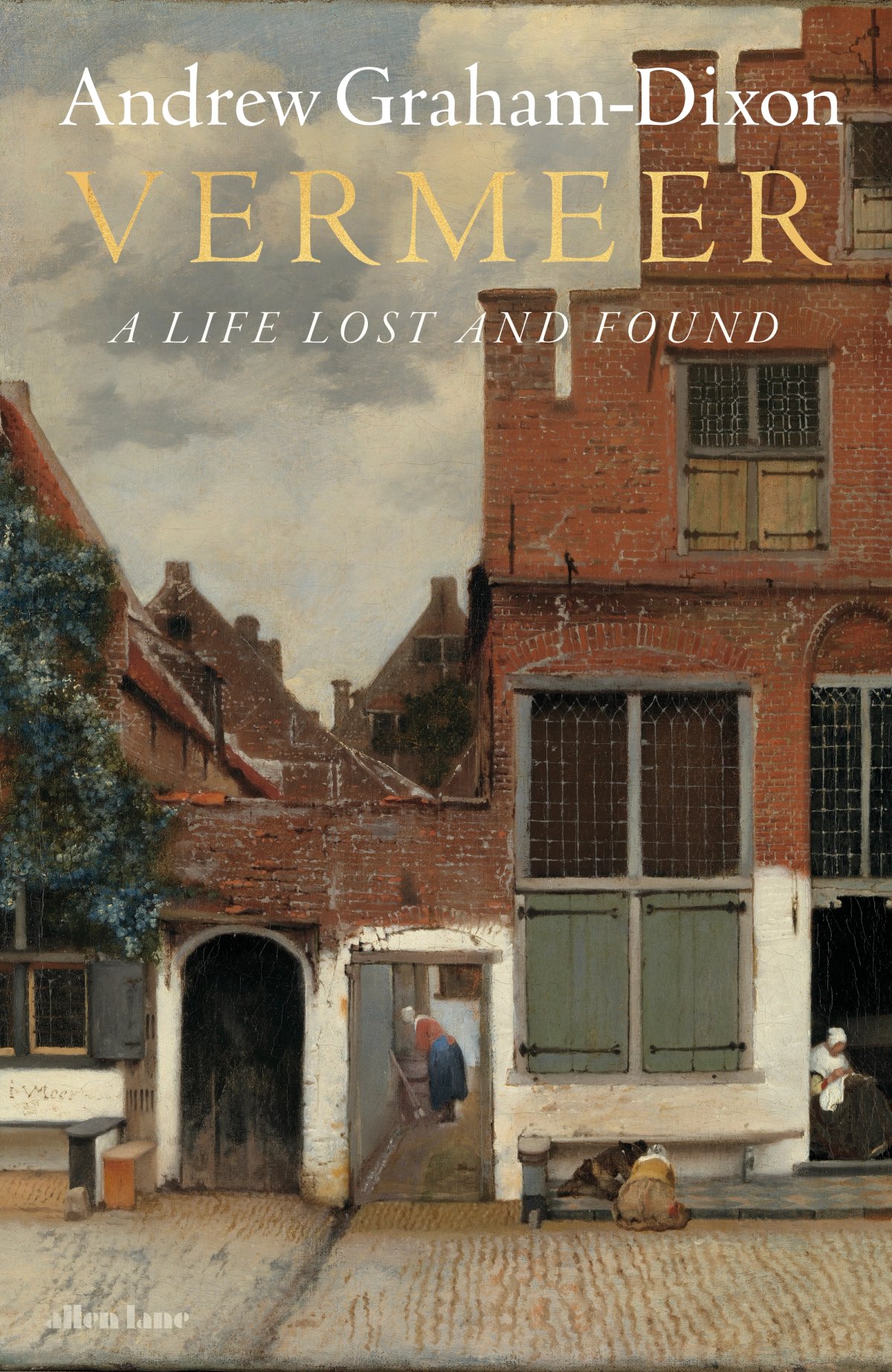
In his recently published biography of Johannes Vermeer, the UK art historian Andrew Graham-Dixon outlines how the patrons Maria de Knuijt and her husband Pieter Claesz van Ruijven commissioned most of the Dutch Old Master’s works. The couple’s daughter, Magdalena Pieters van Ruijven, died on 16 June 1682 in the house known as the Golden ABC that she had shared with her husband, a printer named Jacob Dissius, on the Great Market Square in Delft. A notary clerk visited the house in 1683 in order to list Magdalena’s personal possessions—and discovered a wealth of Vermeers.
Extract from Vermeer: A Life Lost and Found
Magdalena’s collection, now become Jacob’s, contained not only pictures by Vermeer: besides the 20 by his hand, 21 others are listed. But the notary’s clerk did not trouble to name the artists responsible for them, other than in one instance, that of the marine painting by Jan Porcellis, which was hung together with an anonymous landscape beside 11 Vermeers in the front room. No doubt the clerk took his lead from Magdalena’s widower, who must have been his guide through the house.
All this was not just out of the ordinary. It was unique. Many remarkable private art collections were formed in the Dutch Republic during the 17th century, but such collections were invariably larger and more eclectic than that housed within The Golden ABC. None was built around the work of a single painter. Magdalena’s parents had moreover owned most of Vermeer’s paintings. The 20 pictures in her death inventory amount to nearly two-thirds of his known production.
The collection was not only unique in its nature but unique in the way it was cherished and preserved. As long as it remained within the family of its original owners, it was never broken up or diminished by part sales. For reasons that remain unclear, following Magdalena’s death Jacob was obliged to share her estate with his father, Abraham: a ruling to that effect was made by the commissioners of the High Court of Holland on 18 July 1684. As a result six of Vermeer’s paintings became the property of Dissius the elder. It is not known whether Abraham Dissius ever took physical possession of those six pictures, or was merely content with nominal ownership of them. But Jacob got them back from his father, either by purchase or inheritance, and kept them at The Golden ABC together with the others, for the rest of his life. At the time of his death in 1695 he had ensured that the collection was still intact. Only then was it dispersed.
Documentary evidence shows that Vermeer began working for the Van Ruijven family in about 1657, when he was in his mid-20s. For the next 13 years he painted almost all his pictures for that family, and afterwards more or less gave up painting altogether. His relationship to his patrons was like none other that we know of in his time, just as his paintings are unlike any other Dutch pictures of the period. It is reasonable to assume that this is not a coincidence. There is another aspect to the mystery of Vermeer: namely his place in art history, or rather his lack of one until the mid-19th century. No other Old Master as highly regarded as he is today was ever forgotten for as long. This would surely never have been the case had he not painted nearly all of his pictures for one family, and had that family not kept them so close. For some 40 years, unless a person happened to know Pieter Claesz van Ruijven or Maria de Knuijt, Magdalena Pieters van Ruijven or Jacob Dissius, it would have been difficult to know much about the work of Johannes Vermeer.
So no wonder he was never as famous as Rembrandt, Frans Hals, Gerrit Dou, Frans van Mieris or Aelbert Cuyp; no wonder that his name was left out of the biographies of Dutch artists compiled in the 17th and 18th centuries; and no wonder that [the 19th-century art critic] Théophile Thoré, who rescued Vermeer from obscurity, described him as a man risen without trace. The pattern had been set early: for most of his life, and for two decades afterwards, his art had been kept out of public view, apparently with his willing cooperation.
• Andrew Graham-Dixon, Vermeer: A Life Lost and Found, Allen Lane, £30; published this month in the US with W.W Norton & Company, $45. © Andrew Graham-Dixon 2025