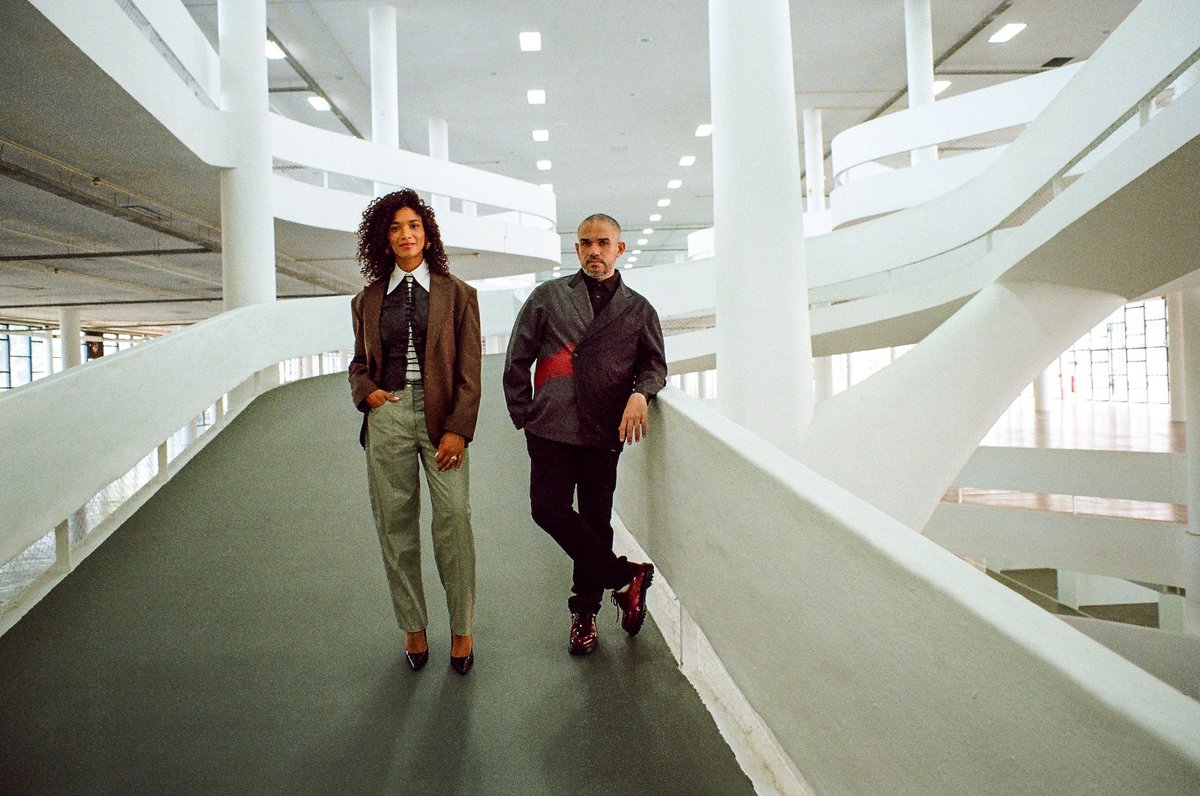
The Fundação Bienal de São Paulo has appointed the Brazilians Amanda Carneiro and Raphael Fonseca as the chief curators of the next edition of the Bienal de São Paulo, Latin America’s largest and longest-running visual arts event, scheduled to take place in 2027 at the Pavilhão Ciccillo Matarazzo in Ibirapuera Park. Further details, including the curatorial team, concept and exhibition dates, are expected in the coming months, according to the foundation.
Since 2018, Carneiro has been a curator at the Museu de Arte de São Paulo (MASP) and she was also the artistic organiser of the main exhibition at the Venice Biennale in 2024, Stranieri Ovunque - Foreigners Everywhere, curated by her MASP colleague Adriano Pedrosa, an edition that brought renewed and unprecedented visibility to art from Latin America on the international circuit. Before joining MASP, she worked at the Museu Afro Brasil Emanoel Araujo in São Paulo.
Born in Rio de Janeiro and based in Lisbon, Fonseca works at Culturgest, the Portuguese cultural institution with venues in Lisbon and Porto. He also serves as curator-at-large for Latin American modern and contemporary art at the Denver Art Museum and is curating the Taiwan Pavilion at the 61st Biennale di Venezia, which opens next month. He was the chief curator of the 14th Bienal do Mercosul in 2025 and previously worked at the Museu de Arte Contemporânea de Niterói from 2016 to 2020.
“For the second time, two Brazilian curators are taking on, together and on equal footing, the artistic leadership of an edition,” Andrea Pinheiro, the president of the Fundação Bienal de São Paulo, said in a statement. “It is a decision born of a careful collective selection process and a clear conviction: that there exists, in Brazil, a curatorial generation with the talent, experience and vision necessary to keep the Bienal de São Paulo at the centre of the artistic debate of our time.”
The selection also appears to reflect the impact of the biennial’s previous edition, held in 2025 and curated by the Cameroonian curator Bonaventure Soh Bejeng Ndikung under the title Not All Travellers Walk Roads - Of Humanity as Practice. That edition, with its focus on Africa and the multiple diasporas connected to it, featured a notably limited presence of Brazilian artists compared with previous editions, and of Latin American artists more broadly. Argentina, for example, had no artists included for the first time in the biennial’s history.
Over time, the Bienal de São Paulo has embraced different curatorial models, ranging from internationally appointed chief curators to collective structures without a defined hierarchy. This has produced a deliberate alternation between external perspectives and voices rooted in Brazil. In that context, the appointment of Carneiro and Fonseca signals a return to a distinctly Brazilian curatorial framework.
Carneiro said she was honoured by the appointment and described the biennial as “one of the most important platforms for contemporary art”: “I am excited to work with artists in São Paulo, which is also my city, to support the realisation of their projects and to collaborate with the Bienal team in building this edition.”
Fonseca recalled the first time he travelled from Rio de Janeiro to São Paulo was to attend the 27th edition of the Biennial, in 2006. “To be in the position of chief curator 20 years after that first encounter exceeds any of my expectations,” he said. “Also, being able to work on a project of this scale with Amanda Carneiro—someone with whom I’ve collaborated numerous times and who, more than just a co-curator, is my friend—makes me even more excited.”
Founded in 1951 and initially inspired by the Venice Biennale model of national pavilions, the Bienal de São Paulo gradually shifted toward curatorially driven exhibition formats.
The Fundação Bienal de São Paulo not only organises the marquee exhibition every two years, but also oversees the Ciccillo Matarazzo Pavilion, designed by Oscar Niemeyer and listed as a historical heritage site, and manages Brazil’s pavilion at the Venice Biennale, which this year will feature Rosana Paulino and Adriana Varejão.