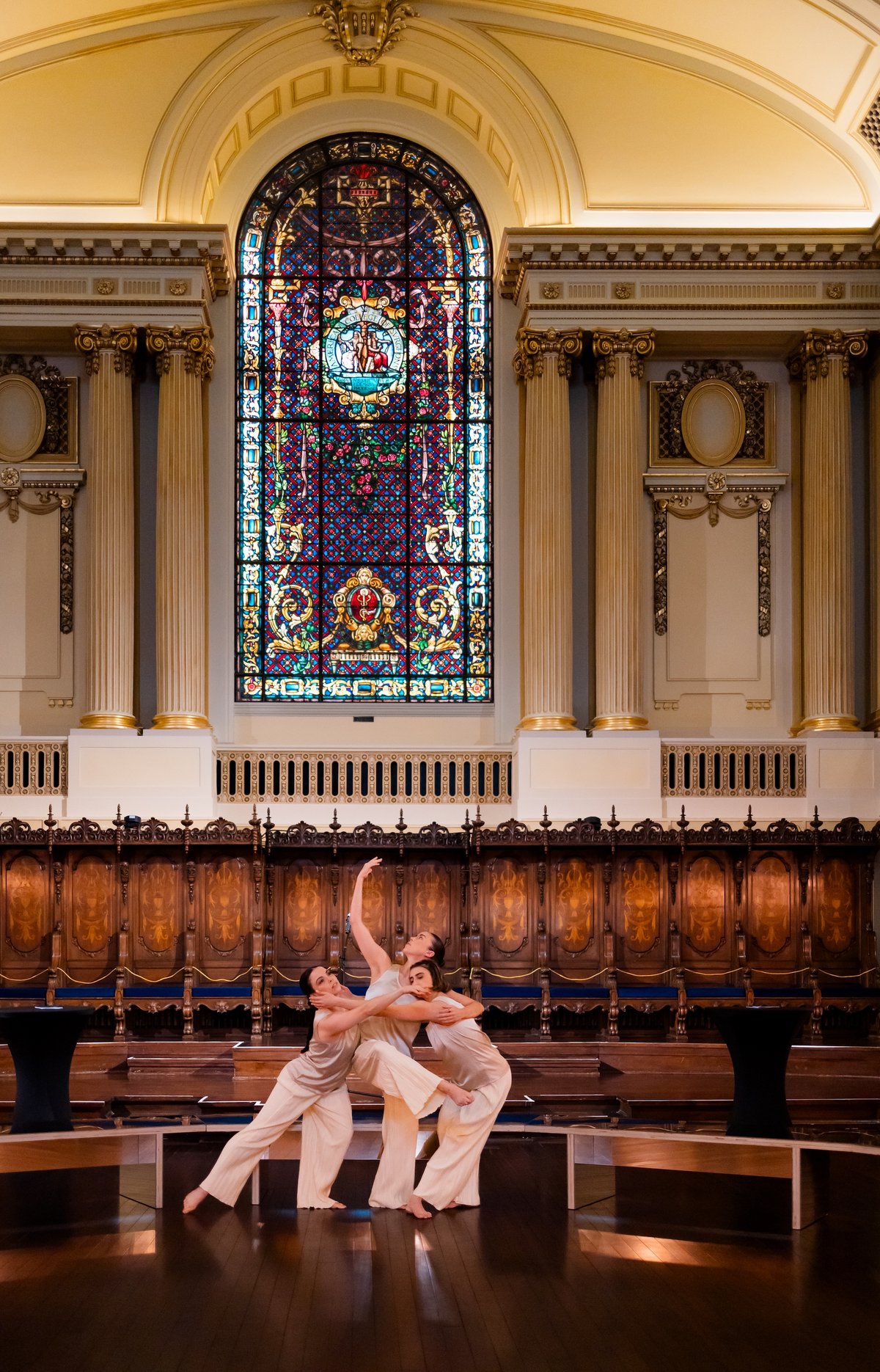
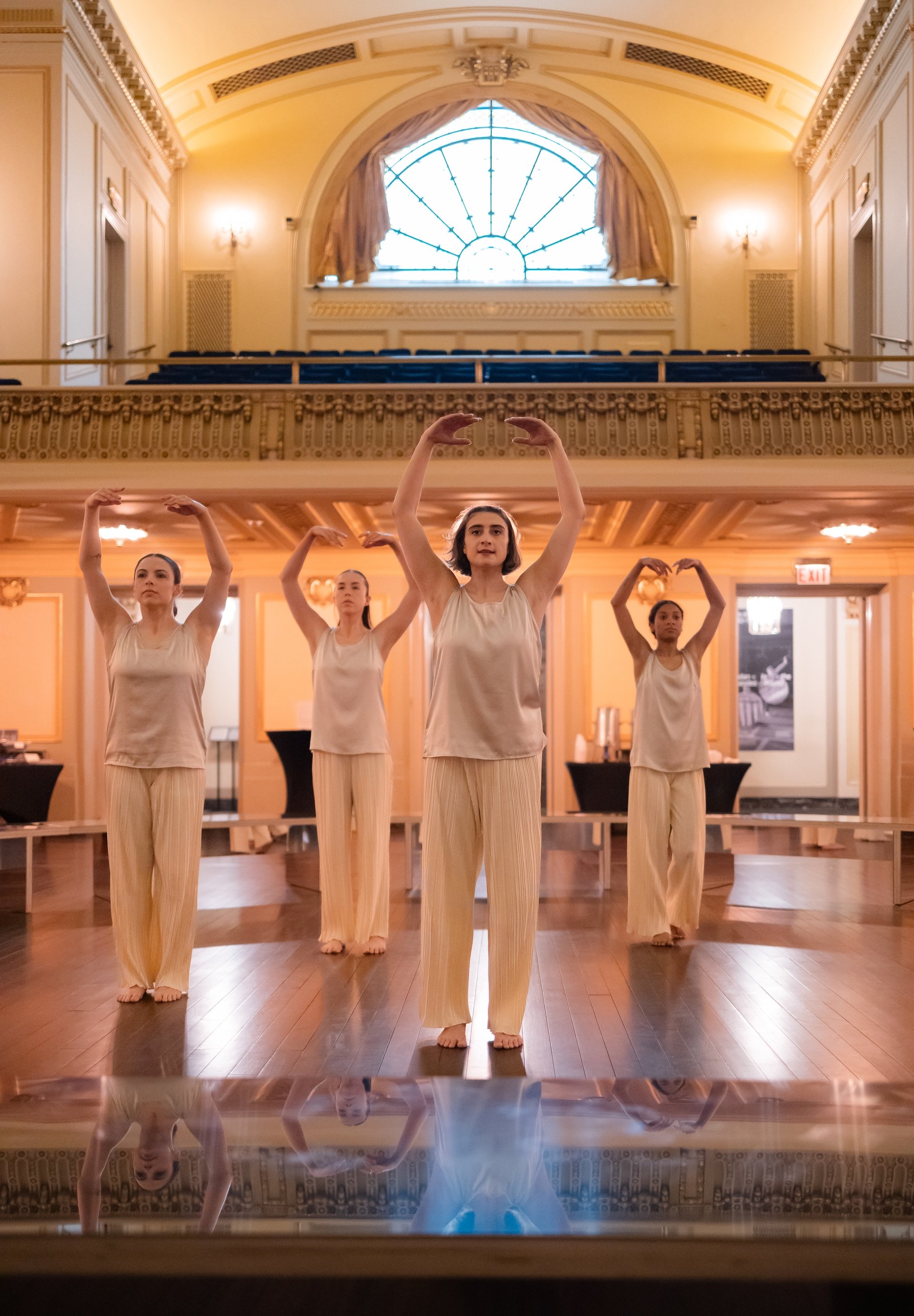
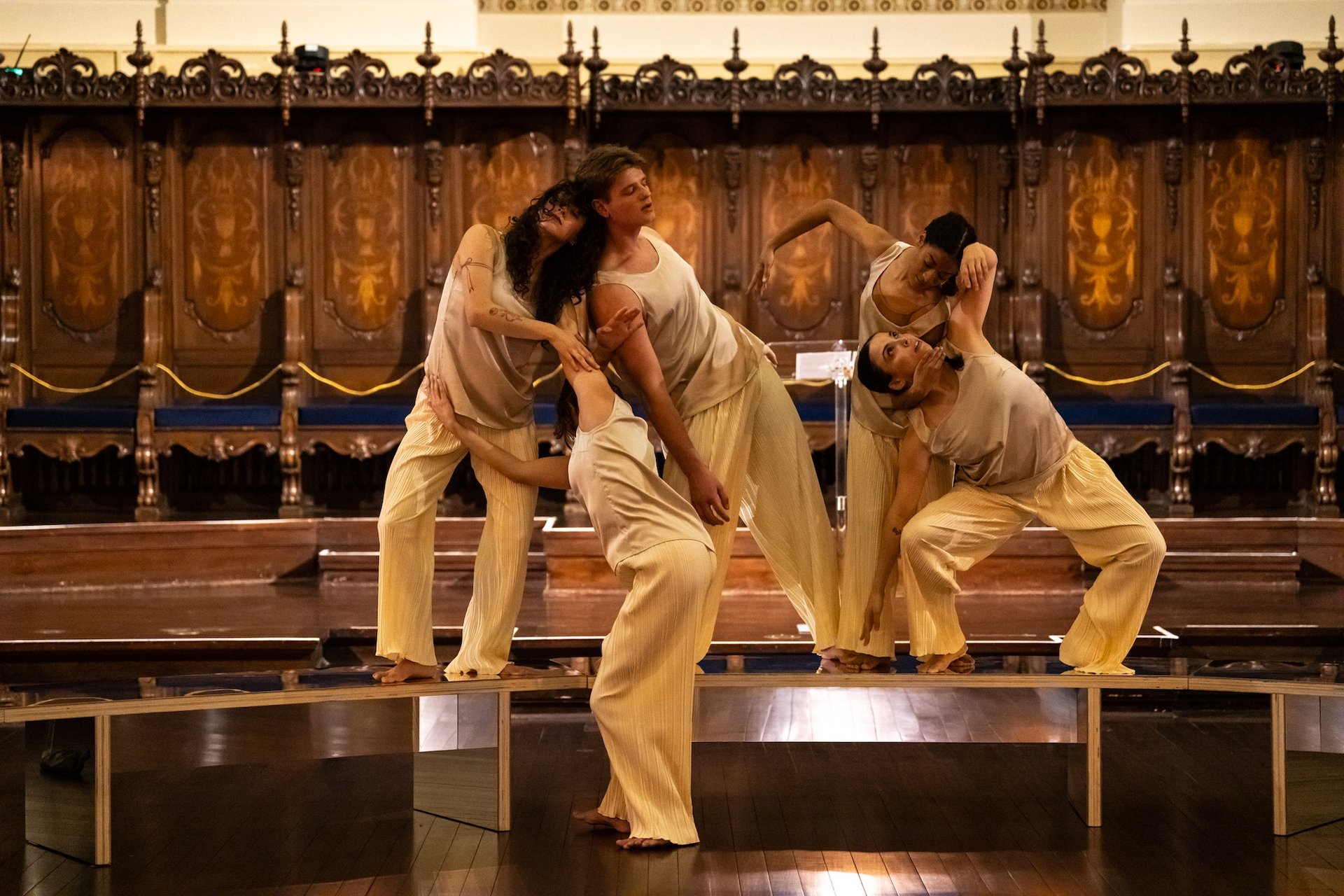
Seven dancers, dressed in flowing pants and tank tops in muted tones, are moving like a kind of 14-legged caterpillar, inching their way around a 12-sided mirrored bench at the centre of the stately Murphy Auditorium. The venue, which was built by the American College of Surgeons on Chicago’s Near North Side in 1926, features exquisite details like ornate cast-bronze doors by Tiffany Studios honouring famous doctors and stained-glass windows by the Willet Company. The precise elegance of the Gilded Age architecture contrasts sharply with enormous care and effort evident in the dancers’ gripping, reaching and pulling movements.
The Murphy Auditorium was acquired by the neighbouring Driehaus Museum in 2022, underwent a renovation starting in 2023 and was designated a Chicago landmark in 2024. It is now hosting the Driehaus’s first artist-in-resdience, the Chicago-based visual and performing artist Brendan Fernandes, who has developed the evolving, collaborative dance work Score for the Murphy Auditorium as part of his nearly year-long exhibition in the space, In the Round (until 14 November). True to the show's title, there is no fixed seating and visitors are encouraged to go around the dancers as they move within, atop, under and on the perimeter of the dodecagonal bench.
Brendan Fernandes’s Score for the Murphy Auditorium Photo by Bob
“We see this as a duet between Brendan and the Murphy auditorium, a chance to look at history in the round,” Stephanie Cristello, an independent curator working with Fernandes on the project, said during a preview last month.
“It’s about looking at the intersections of art, dance and architecture,” Fernandes said. “Dance is political. There is physical support in the piece, but it is also dance as a form of support—that way of dancing and moving in unison."
Between the passages when they come together to form a kind of self-supporting organism with many limbs, the dancers split into solos, duos and trios that move around the space in semi-improvisatory cycles. At intervals, they reconvene inside the benches and play a kind of game of mimicry, with each dancer in turn modeling a gesture that the others quickly learn and repeat in a synchronised rhythm, slowing or exaggerating the movement in response to a sequence of prompts from the instigator of the given gesture: “Bigger!” “Slower.” “Smaller.” After each dancer has modeled a gesture, the group splits apart again.
Brendan Fernandes’s Score for the Murphy Auditorium Photo: Michelle Reid
In addition to the mirrored bench by the Antwerp-, Chicago- and Shanghai-based firm AIM Architecture, the piece features textile works that Fernandes developed at the Fabric Workshop and Museum in Philadelphia and a sound installation by Alex Inglizian, a Chicago-based experimental musician. The score, like the dancers’ movements, shifts in gradual, cyclical patterns, with low, droning organ tones giving way to uptempo piano movements that then dissipate again.
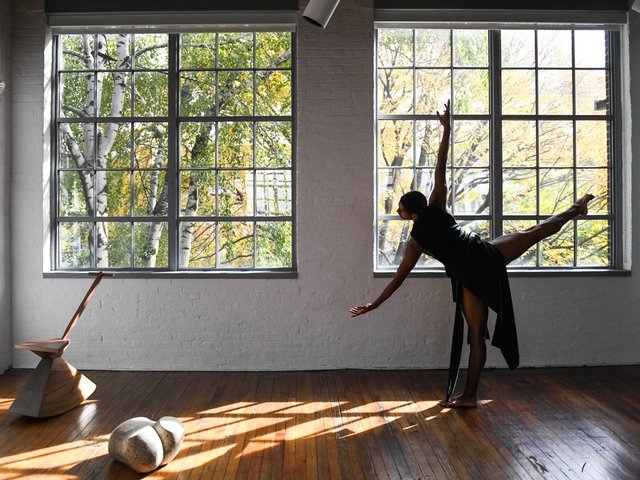
For Fernandes, the choreography’s openness and fluidity are essential features, as are certain prescribed gestures and passages. “I want to create new forms, so everything is developed in collaboration with the dancers,” he said. He drew inspiration from New York City’s pioneering Judson Dance Theater and the group of experimental dancers and artists that formed around it in the 1960s. In its spirit, Fernandes is inviting members of Chicago’s dance community to stage performances within In the Round throughout its run (including an open rehearsal on 8 May and a new performance on 9 May).
For the Driehaus Museum’s executive director, Lisa M. Key, Fernandes's exhibition is the perfect encapsulation of the institution's melding of expertly restored and preserved Gilded Age grandeur with contemporary art. “We are committed to pulling the past forward to today," she said, "and that is precisely what this project is doing.”
- Brendan Fernandes: In the Round, until 14 November (with scheduled programmes in May, September, October and November), Driehaus Museum, Chicago