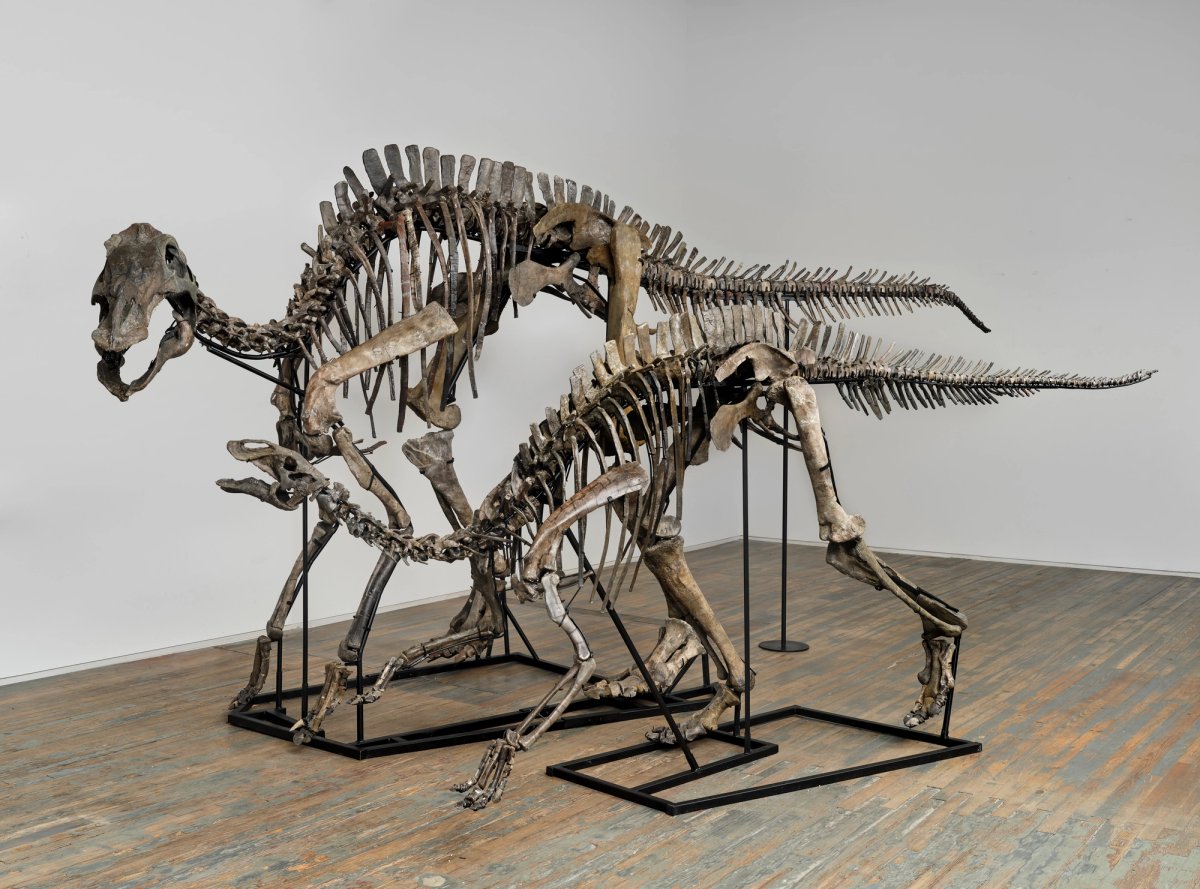
At the gallery Amanita’s Bowery location, a rare sculpture by John Chamberlain shares the floor with three even more infrequent companions: real, fossilised dinosaur skeletons.
The exhibition (until 9 August) pairs Chamberlain’s Gondola Marianne Moore (1982) with three Maiasaura specimens, a large herbivore from the Upper Cretaceous period more than 70 million years ago. Full, mounted Maiasaura fossils are exceedingly rare and have never been exhibited before in New York, much less in a downtown commercial art gallery, says Jacob Hyman, a partner at Amanita. The skeletons are also more complete than many museum-grade specimens, he says, each one being around 62% to 85% real bone.
“When we had the opportunity to show them, of course we understood the sort of unprecedented nature of showing fossils in a gallery space,” Hyman says. “But we wanted to make sure that this also wasn’t just a gimmick and a spectacle.”
The fossils are paired with Chamberlain’s sculpture from his series inspired by Venetian gondolas. Horizontal works assembled from crushed automobile parts, the forms are intended to lie on the floor. Chamberlain created only 14 examples of the gondolas, most of which are held by institutions including the Dia Art Foundation and the Chinati Foundation. Hyman sees parallels between Chamberlain’s twisted metal works and the organic system that leads to the preservation of fossils.
“I wanted to promote the sculpturality of them as objects that could potentially relate to other threads of sculpture,” Hyman says. “Specifically, American sculptors like John Chamberlain, who is this behemoth of American post-war sculpture—thinking of Chamberlain as someone who’s also dealt with these ideas of compression and time and articulation.”
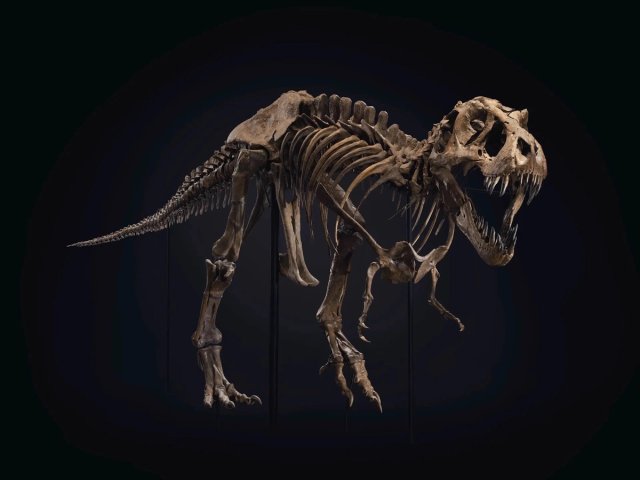
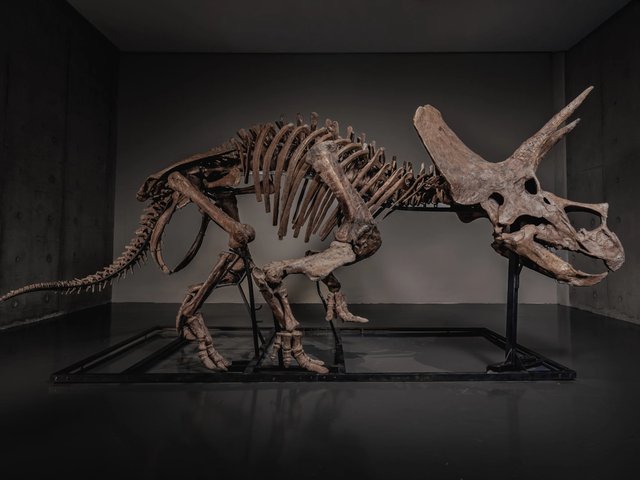
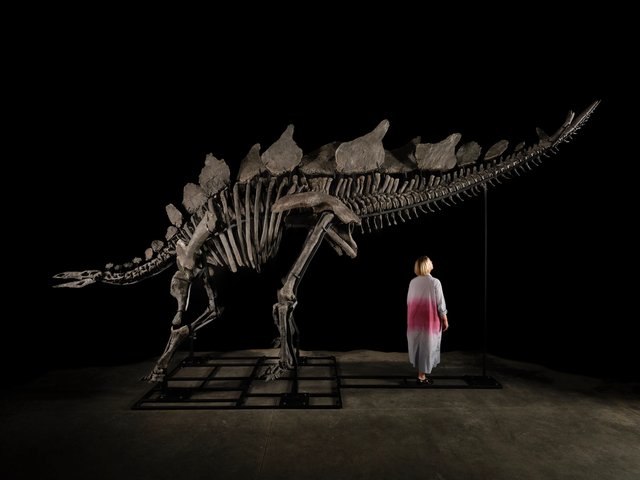
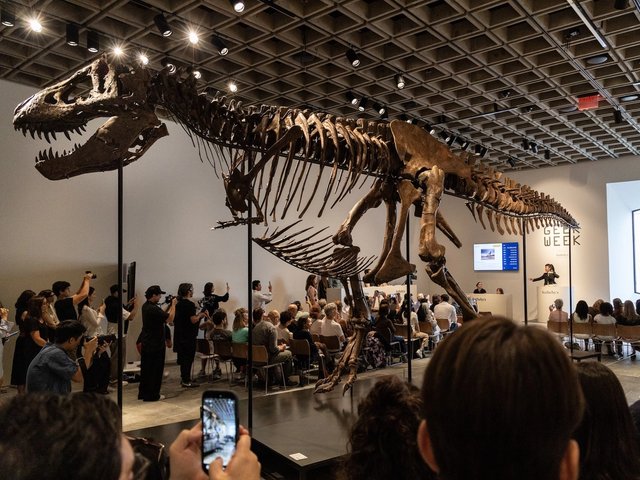
Since the onset of the Covid-19 pandemic, the market for dinosaur skeletons has skyrocketed and increasingly overlaps with traditional art collecting, largely at auction houses. A Stegosaurus fossil nicknamed Apex sold for a record-breaking $44.6m at Sotheby’s New York in July 2024, while more recently Phillips included a Triceratops skeleton in its contemporary art evening sale in New York last November. But the market for real fossils is not without controversy, and some experts have called for the private sale of dinosaur fossils to end.
“There’s an argument for these specimens to not be in private hands and to be in public spaces; actually, I would argue, that’s an even greater possibility when there is patronage from the private sector,” Hyman says. “For us, with placing these, the main motivation is to find those that will be good stewards for these works.”