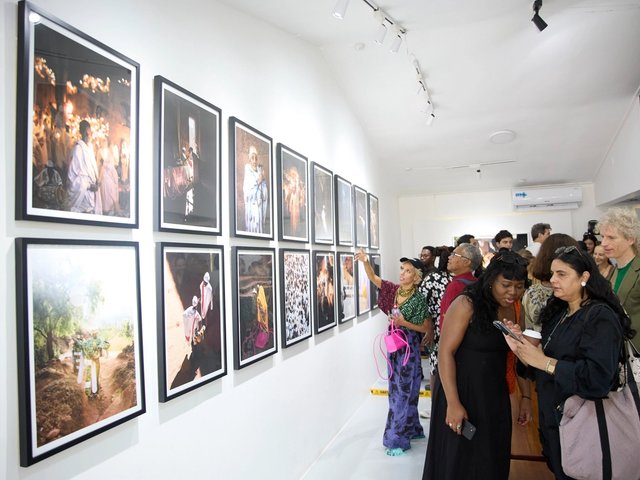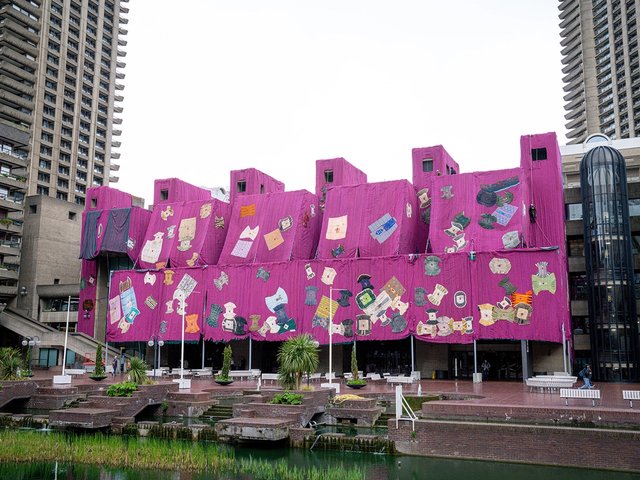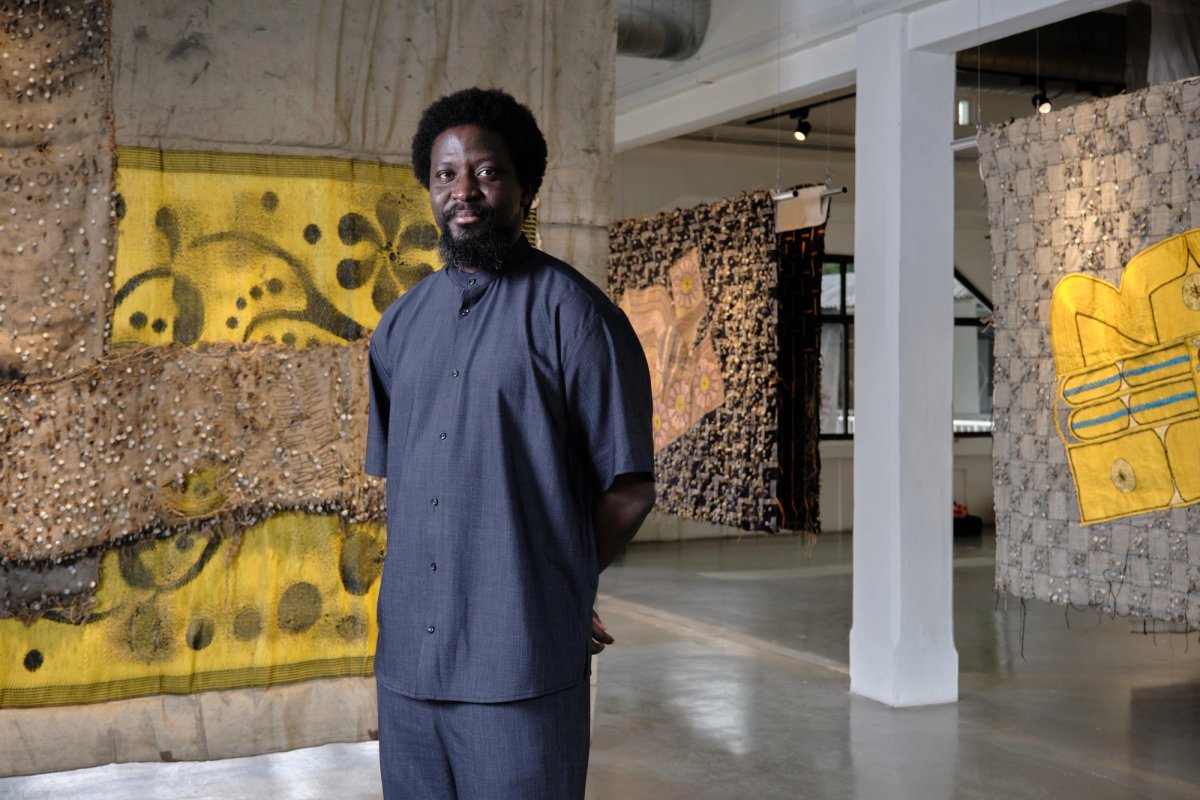
As the winner of the inaugural Art Basel Gold Awards, in the established artists category, Ibrahim Mahama unveils this week a new public commission on the Münsterplatz. The God of Small Things—in reference to Arundhati Roy’s novel—centres the Ghanaian artist’s exploratory mending practice via a series of large-scale textile pieces patchworked from batakari robes, rubber tyres and long-haul transport canvases.
This Art Basel win comes hot on the heels of Mahama being awarded another honour—the 2026 Arnold Bode Prize in Kassel—further compounding the prominence afforded by his placing first in the 2025 ArtReview Power 100. It also comes in the wake of a physical assault he suffered in March, allegedly at the hands of Ghanaian police. The attack was so brutal it brought the artist’s international travel and lecture schedule to a halt.
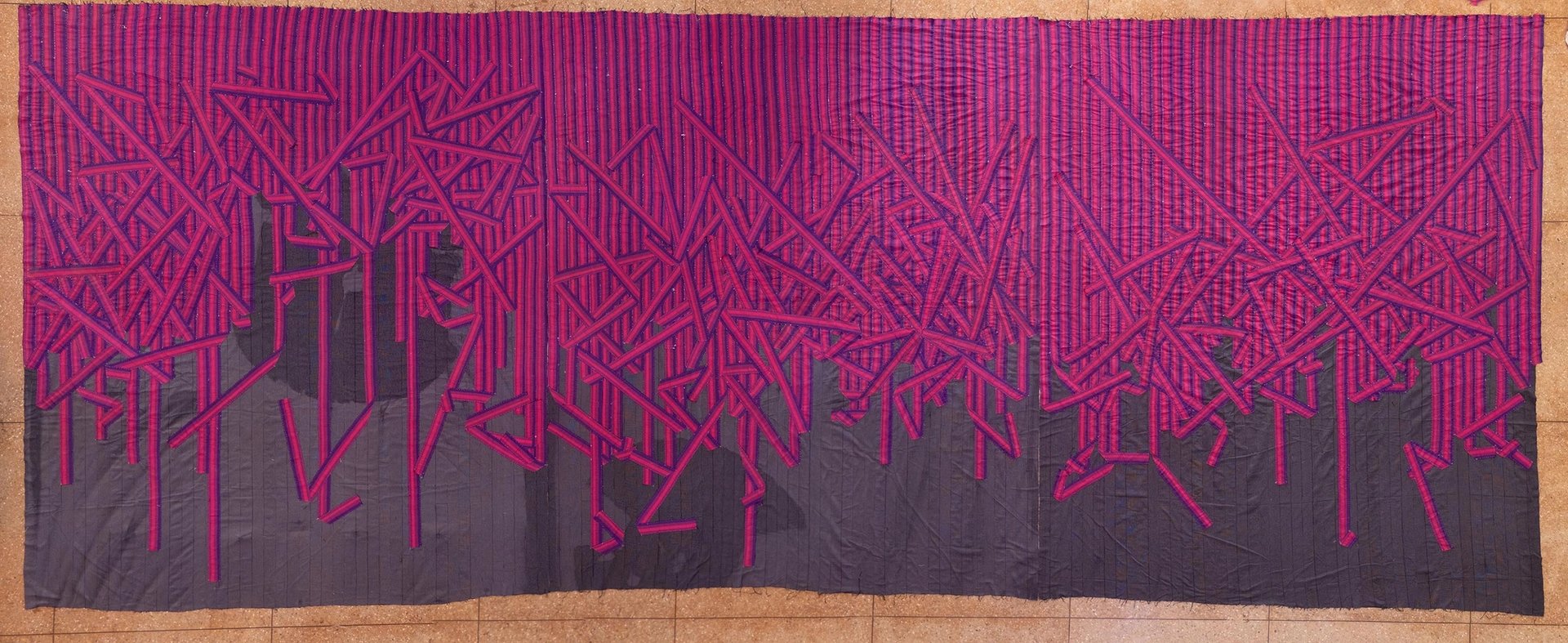
Mahama’s Münsterplatz commission involves patchworking batakari robes with rubber tyres and the canvases that cover long-haul trucks and end up in Ghana: “The piece is charged with this history of global circulation” Ibrahim Mahama; courtesy of the artist, APALAZZOGALLERY and White Cube
Mahama gathers things that have lived lives: shoemaker boxes, ambulance stretchers, jute sacks, sewing machines. Working with a collective of collaborators in the large studio he founded in Tamale, northern Ghana, he uses the objects to build structures and coverings that tell stories of colonial extraction and post-colonial dreaming. He speaks of materials carrying the memory of souls. But it is firmly to the present—and those alive now—that he directs his gaze.
The Art Newspaper: With both the Art Basel Gold Award and the Arnold Bode Prize, this has been a big year for you.
Ibrahim Mahama: I always think every year is a big year, and then the following year is a bigger year. I’ve just been very lucky with the people I’ve worked with and, generally, with a lot of the choices that I made in the beginning of my career. Instead of going purely down a commercial route, I have mostly gone down a practice route, working with my two galleries to ensure that the work, first and foremost, is critical, and is in direct dialogue and conversation with institutions, before any other thing.
It has also been a very difficult year for you following the attack in March. Have you recovered?
It’s been slow. The doctor said it would take a while for the pains in my body to go away completely. When it happened, three of my teeth got broken. I had to do two talks when I was in Venice recently and I felt very sensitive about showing my teeth, especially when laughing in public.
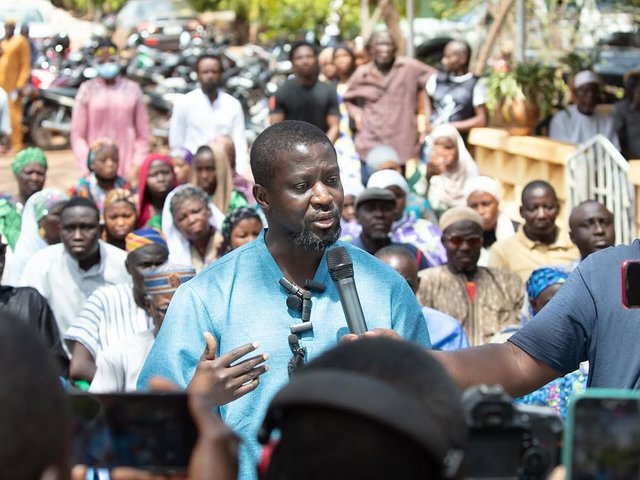
I had never felt that way in my life: I have always felt extremely confident. But for a moment I felt this sense of fragility, and I think it was important. When this assault happened, the number of people in the local communities who came out to support, to protest and to speak out against the issue, because of what they thought I represented for the community, was overwhelming. It made me realise that the work that I’m doing in Ghana is important after all to people.
Do you think community—and investing into one’s own landscape, if you will—is central to being an artist?
Sometimes when we make art, we think that by just making it, it is enough. But I’ve always thought that the question of redistribution is where the story of art begins. When I was studying art, my professors at the Kwame Nkrumah University of Science and Technology in Kumasi encouraged us to think not about technique but about purpose and form—and responsibility.
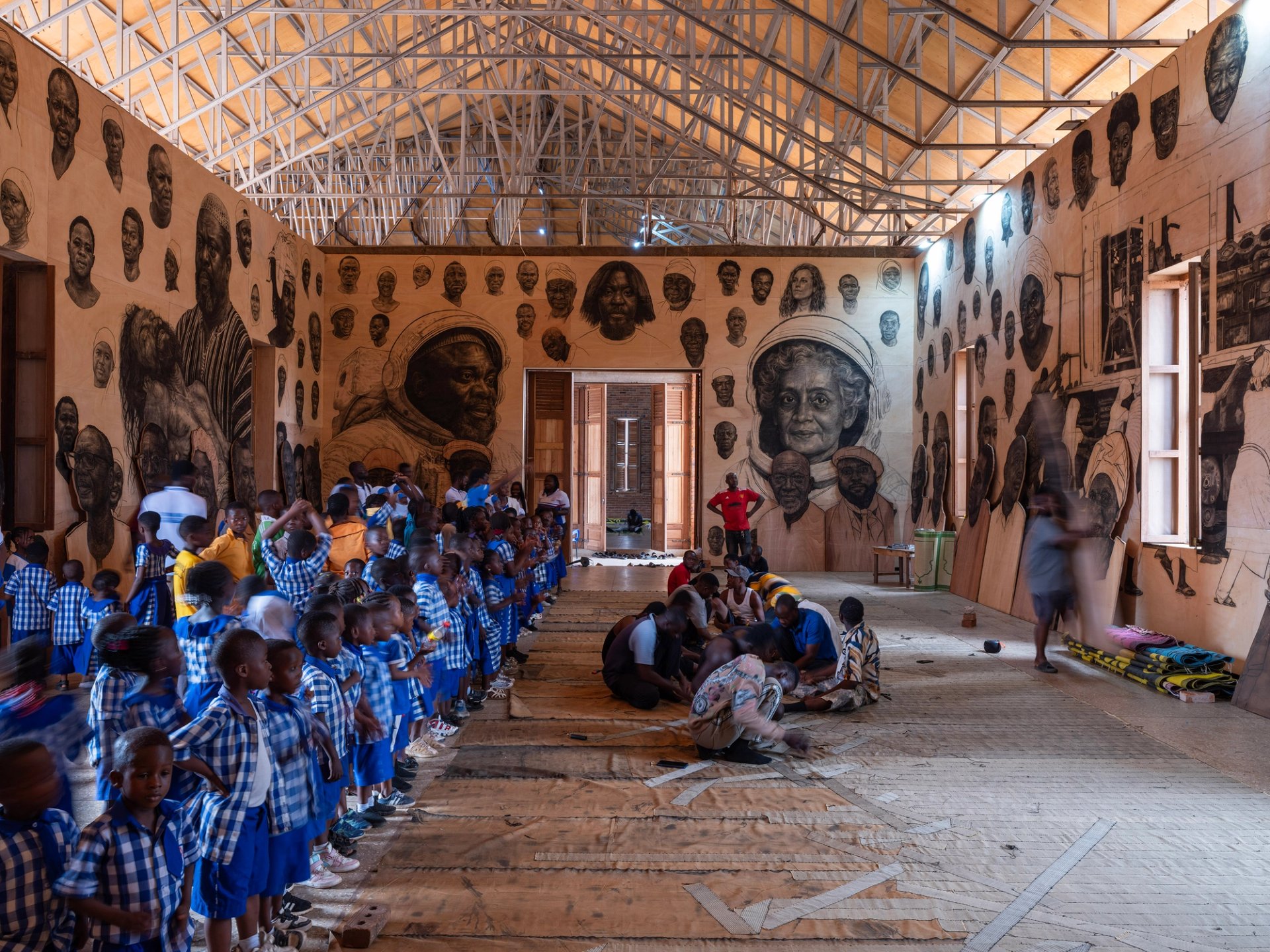
Mahama’s collective studio in Tamale, northern Ghana, regularly invites schoolchildren to watch the artists at work; the walls feature drawings of inspirational figures as well as the workers who have contributed to the space Ibrahim Mahama; courtesy of the artist, APALAZZOGALLERY and White Cube
From the studio in Tamale, we go around the country collecting materials: textiles, abandoned industrial and post-colonial residues. Recently, I collected an old metal bridge that was built between Elmina Castle—one of the first forts built by the British—and the nearby town. This bridge connected millions of people in the surrounding communities to the fort. But when it became dilapidated, rather than repair it and ensure people understand its historical significance, the authorities decided to destroy it. As an artist, I feel that it is our responsibility to step in. All these things are the stains; they are part of the story. We are interested in the memory, the souls, the history of the castle, in relation to the land. So we are taking the bridge to rebuild it as a monument.
What layers of memory have gone into the piece you are making for the Münsterplatz?
It is a very simple work made from handwoven batakari textiles, from northern Ghana; rubber tyres from a post-independence era company that was abandoned and sold as scrap after Kwame Nkrumah, our first president, was overthrown in 1966; and the canvases used to cover all these huge trucks that transport goods and services across Europe, which end up in Ghana. Here, they continue to be used to cover, let’s say, old engine blocks. The canvas ages and turns a different colour. So, the piece is charged with this history of global circulation. I would have liked to rebuild a part of the tyre factory in Basel, but there are limitations when you’re doing some of these projects abroad.
Photographs of this new work show groups of schoolchildren in uniform looking on as your team works. Can you describe your studio?
It’s not a very traditional studio, where the artist works in solitude. There are drawings on the walls of all the different people who helped build it (the carpenters, the masons, the cleaners, the curators); the artists we’ve worked with, like Theaster Gates, whose work has inspired me, as well people like Martin Luther King and Nina Simone, and writers from across the world. When the kids from the schools come, we open up the space to them so they witness the making of the work.
Other photographs of the work in progress show the studio assistants kneeling in prayer on the pieces on the ground. Do you think of the communal process that your work requires as a kind of prayer?
I think it is, because what is a prayer? A prayer is basically connected to the question of faith. As artists, we are already starting from the point of a certain collective faith by collecting what is dead, what we consider dead, what the world considers dead, and putting it back together again in order to give it new meaning.
Tamale is a predominantly Islamic society. It’s actually quite interesting to think about how, when we are making the work, we can actually use it. I never told my studio assistants that they can stand on the work to pray, but through their own logic, they stand on it to sew, so why not stand on it to pray?
• The God of Small Things, Münsterplatz, Basel