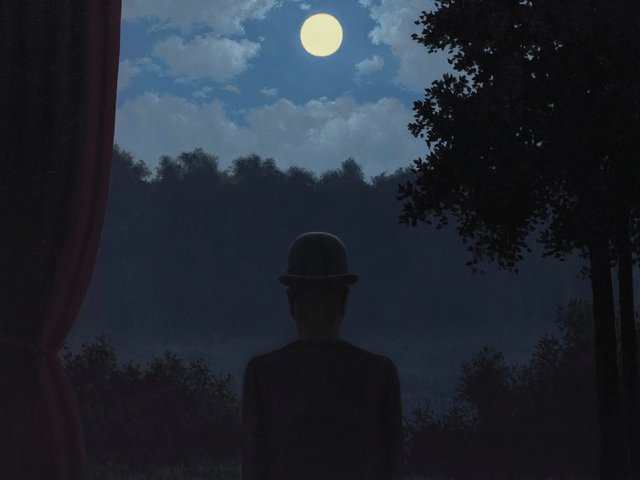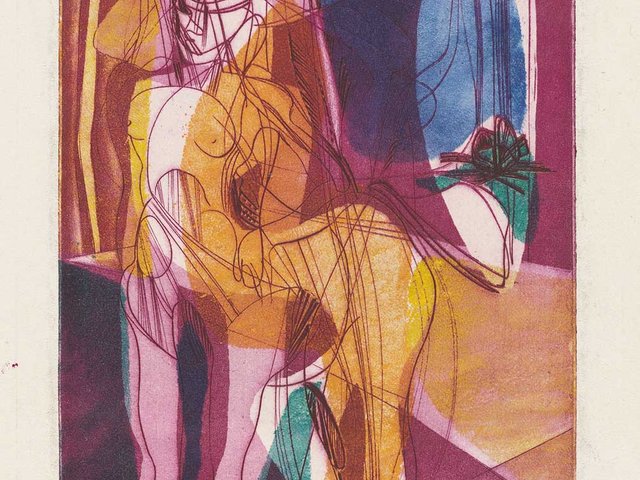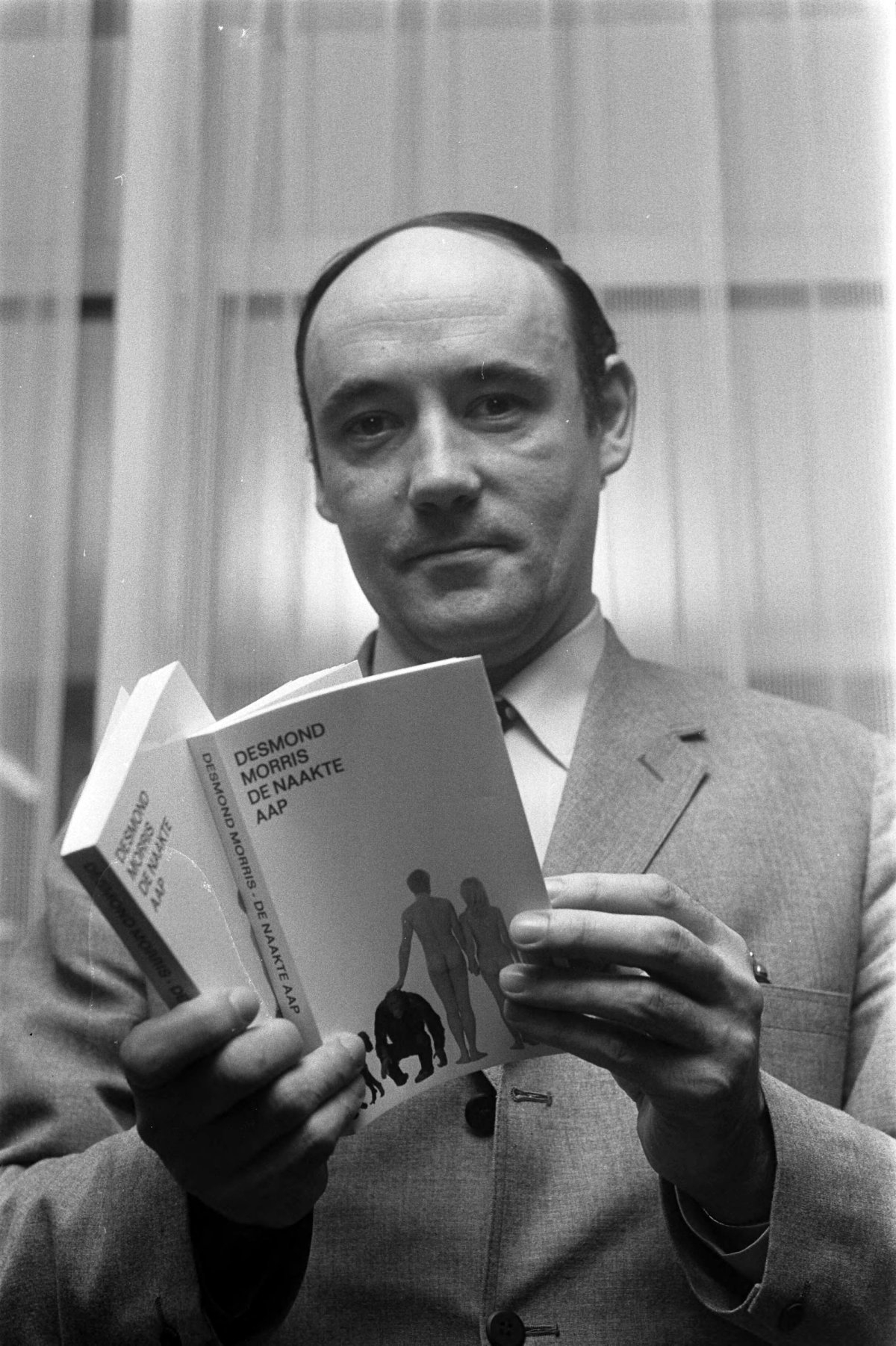
You could never have a short conversation with Desmond Morris, one of the last surviving Surrealists, who has died at the age of 98. During the past decade, we had an ongoing exchange about his student years (and pranks) in Birmingham, hanging a snake around Joan Miró’s neck, and getting “hooked” on collecting African masks, among many other things. These stories reflect his remarkable dual existence as both scientist and artist, which were interconnected from the start.
Born in Wiltshire on 24 January 1928 to Harry Morris, an author of children’s fiction, and Marjorie Morris, he found Surrealism by chance. “I was at boarding school and, one day in 1944, when I was 16, I went into the school library and found a book that contained essays about Surrealism,” he told me.
Understanding the Surrealist movement as “a rebellion against the slaughter of the First World War”, he wanted to join this revolt “against the lunacy of the adult world”. Inspired by the likes of Max Ernst, Yves Tanguy and Salvador Dalí, he made his first Surrealist sketches during that year and when the war was over “started painting in earnest”.
The subject for these compositions he discovered through the lens of his great-grandfather’s Victorian microscope. After rescuing this beautiful brass instrument from the family attic, he placed a saucer full of pond water beneath it and was not only amazed to observe shape-shifting patterns but moved to depict them.
After completing two years of army service in 1948, Morris went to the University of Birmingham to read zoology and continue what he had started. “It was my intention to spend most of my time doing drawings under the microscope—of biological organisms that fascinated me.”
While there, Morris joined the Birmingham Surrealists, who included Conroy Maddox, brothers John and Robert Melville, Emmy Bridgwater and Oscar Mellor. Meeting at Maddox’s house, he remembers, “there were endless arguments and debates—which was typical of all Surrealist meetings”.
But they were also unified by fierce opposition to London’s Surrealists. They believed that many of these artists, including Henry Moore, were involved in the movement just for exposure. “There was a popular preconception that just because Birmingham was the second city and London was the first, the art of the latter had to be more significant than the art of the former,” Morris explained. “Because of this illogical notion, we tried harder—we wanted to show not only that we too were Surrealists, but also that we were truer to the ideals of the movement.”
In 1949 Morris travelled to France in search of Surrealism’s founder, André Breton. “I had his address and phone number in my pocket but sadly he was away from Paris while I was there,” Morris said. “I did, however, meet some of the other Surrealists, including one who was working on a project that involved building a life-size pyramid underground in Wales. What else?”
Back in Birmingham, Morris staged his own stunt, which should be understood as an early example of installation art. Behind the zoology department, he spotted an elephant’s skull that had been discarded due to its poor condition. “As far as I was concerned, its eroded surfaces rendered it even more remarkable, as a piece of natural ‘sculpture’—what the Surrealists referred to as an objet trouvé,” he said. “I decided that such an object should inspire a sense of wonder and determined to bring it to people’s attention.” Taking it by tram into the city centre, Morris left this surreal object sitting in a shop doorway. The next day, “A dinosaur in Broad Street” was the headline in the local Birmingham newspaper.
Morris also bridged the worlds of art and nature through paintings such as The Jumping Three (1949), in which a trio of imaginary beings leap into the sandy-coloured sky, where bird-like creatures have gathered.
From the 1940s onwards, Morris sought to create “a private world of my own on canvas. It was influenced indirectly by my knowledge of biological shapes, but all my ‘biomorphs’ were invented beings.” Working directly from his subconscious, with the curiosity of both a scientist and artist, he developed a distinctive visual language.
His dreamlike landscapes also reflect the influence of Miró, whom he exhibited with at the London Gallery in 1950. That same year, while still a student, he wrote and directed two short black-and-white Surrealist films, The Butterfly and the Pin and Time Flower with his future wife Ramona Baulch, whom he married in 1952. With a history degree from Oxford, she went on to work
with Morris as a researcher on his books and television programmes.
While completing his doctorate and then post-doctoral research at Oxford’s Department of Zoology, Morris observed animal behaviour. In 1956, he first put a pencil into the hands of Congo the chimpanzee, analysing the ape’s interest in creating “art for art’s sake” through drawing and then painting.
As one of his art dealers James Mayor remembers, Morris was impressed by Congo’s aesthetic sensibilities: “Desmond said that Congo carefully thought out which brush and colours to use, deliberating over works, and knowing when he’d finished, which is the key thing for painters.”
These findings led Morris to write The Biology of Art, a study of picture-making by great apes and its relationship to human art. He also exhibited a selection of Congo’s paintings at London’s Institute of Contemporary Arts in 1957, with works from the show acquired by Pablo Picasso, Roland Penrose and the Duke of Edinburgh, among others.
Morris was a collector, too, and his Oxford house was a cabinet of curiosities, crammed full of books, curios and tribal artefacts. By the time I met him in 2019, he had decorated an entire wall with African masks. He also showed me a treasured letter from Miró, thanking him for the gift of a pre-Columbian figurine as a birthday present in 1975.
Another highlight of their friendship was in 1964 when Miró visited Morris, who was then curator of mammals at London Zoo, and the younger man welcomed his hero by hanging a large python round his neck.
Other encounters with wildlife were filmed, as Morris presented the popular TV programme Zoo Time weekly from 1956 to 1967. An engaging broadcaster, he starred alongside a giant tortoise, mating lions and a vampire bat, among other animals. It was not just broadcasting that propelled Morris to fame: in 1967, his controversial book The Naked Ape became an international bestseller.
Moving to Malta, he spent the next six years painting, writing and exploring the island, where his son Jason was born. The family returned to Oxford in 1974, where Morris continued to develop his paintings of biomorphs, often taking part in strange rituals, as seen in The Arena (1976), pointing to his interest in observing human and animal behaviour.
Morris felt “very lucky” to have a dual career that used both sides of his brain. However, his celebrity zoologist status undoubtedly cast a shadow over his artistic output. In 1987, he published a well-illustrated book of his work, titled The Secret Surrealist.
Over the course of 80 years, Morris made more than 3,000 paintings, as well as drawings and collages, often working until 4am. Just months before passing away, he told me: “Being able to work in my studio for four hours every night, making new paintings, is what is keeping me alive at the age of 97.”
His studio, towards the end of his life, was in County Kildare, Ireland; following Ramona’s death in 2018, he wanted to live nearer Jason and his family. In 2022, alongside his granddaughter Tilly Morris and co-director Annie Laing, he opened the Dún Laoghaire Institute of Visual Arts (DIVA), which houses his paintings alongside those by Miró, Leonor Fini and, naturally, Congo.
I knew Desmond Morris as a warm, curious and endlessly creative man. When I asked him, as one of the world’s last living members of the original Surrealist group, what the movement still meant to him, he replied: “Today it means, for me, the joy in irrational, unconscious thought processes—letting my imagination run free.”
• Desmond John Morris, born 24 January 1928 Wiltshire, England; studied zoology at the University of Birmingham, 1948-51, doctorate in animal behaviour at the University of Oxford, 1951-54; married Ramona Baulch 1952 (one son, Jason); died Naas, County Kildare, Ireland, 19 April 2026