On the evening of 11 April, Srishti Gupta, a 28-year-old visual artist, went live from the Instagram account of Mazdoor Bigul, a small labour union organisation in Delhi. Gupta streamed how a plainclothes policeman, and other uniformed personnel, detained her and three of her companions from a metro station in Noida, an industrial satellite city next to Delhi. She and the companions were present earlier in the evening at a protest by thousands of factory workers in Noida, demanding fair wages and improved working conditions. Ali Zia Kabir Choudhary, her lawyer, argued that the arrest was illegal—the police had not issued an arrest memo or an arrest warrant, and there were no women police personnel present, which is mandatory when arresting women. But Gupta, and others, have been in jail ever since.
Choudhary argued that the case fits a broader pattern of crackdowns on activists. “Before 2014, there was suppression of dissent,” Choudhary tells The Art Newspaper. The ruling dispensation of the Bharatiya Janata Party had come to power that year. “But after 2014 there’s not only suppression, there’s criminalisation of dissent.”
I want to know what prevents the artists community in Delhi from taking a concerted standShuddhabrata Sengupta, artist
On 22 May, the artist Shuddhabrata Sengupta wrote about the case on social media. “I certainly think that she is a very promising artist and poet,” Sengupta wrote. “I want to know what prevents the artists community in Delhi from taking a concerted stand against her unjust incarceration. Is it lack of knowledge, indifference or fear?” Since Sengupta’s post, and that of some other collectives, there has been more public discussion about the matter.
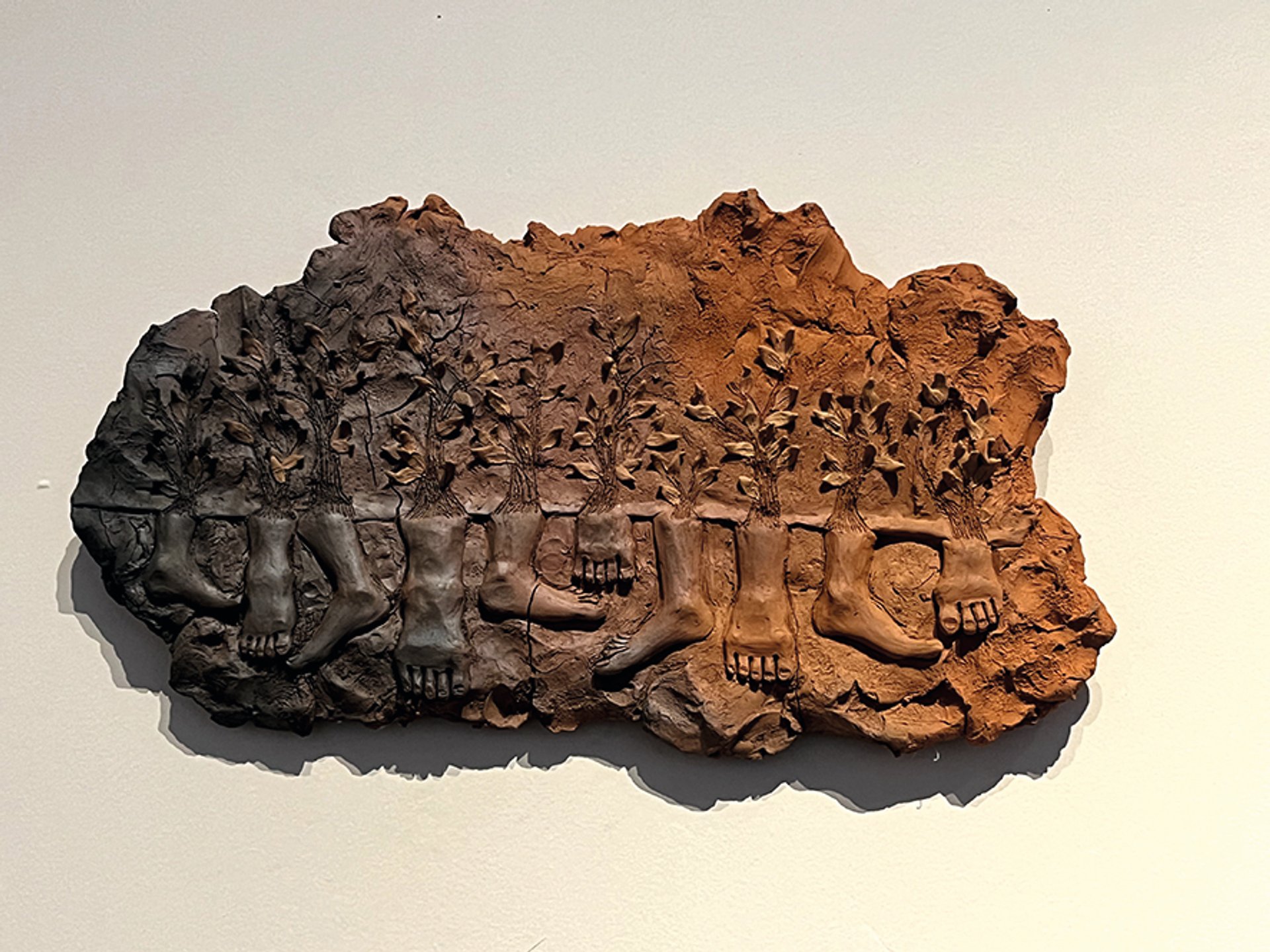
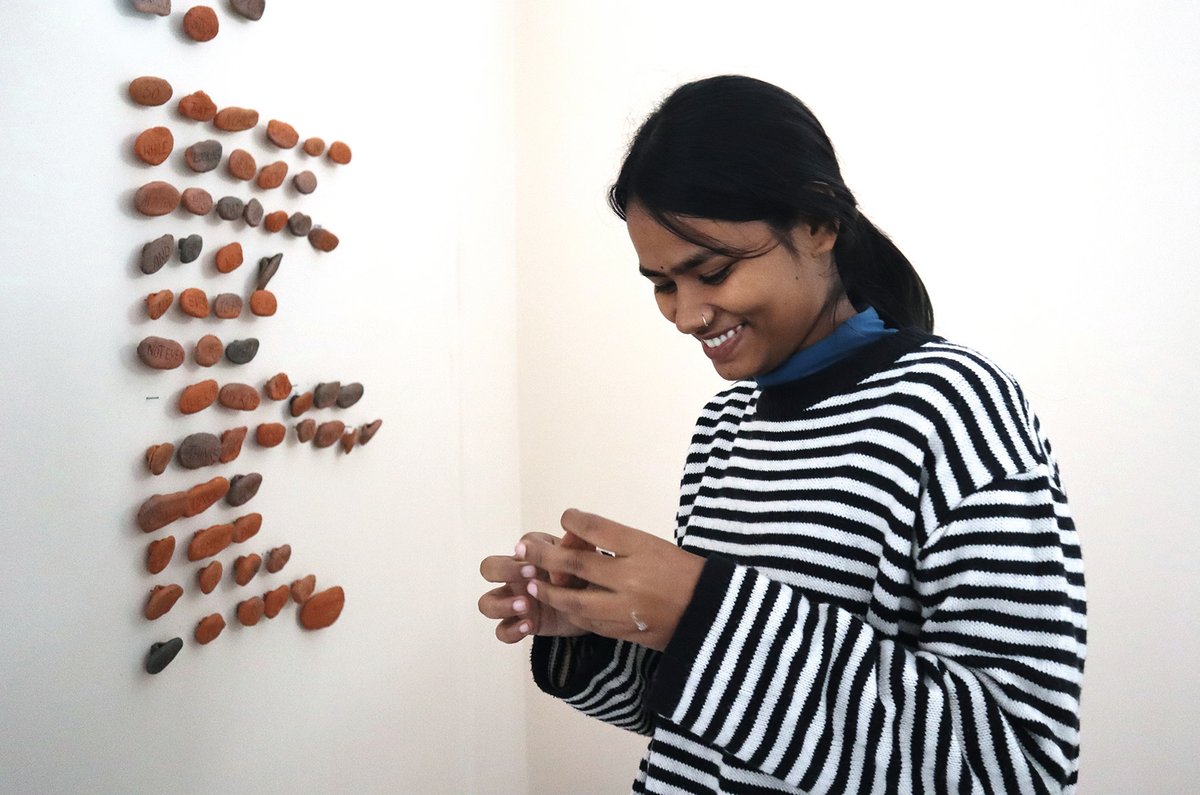
A terracotta relief work by Shrishti Gupta Courtesy of Vinod Karki
In a conversation with The Art Newspaper a few days later, Sengupta mentions that more people are responding to the case now. But not art institutions. “I don’t think arts institutions have had the experience or understanding of how to deal with this,” he says. “I hope that they will respond.” He adds that this case is unique as “this is, in my understanding, probably the first time [in India] that a person who is an artist by profession has been incarcerated and for reasons that have nothing to do with their artistic practice”.
Who is Srishti Gupta?
Gupta grew up near Lucknow in the north of India and attended a Navodaya residential school, according to Vinod Karki, who is a fellow member of the Progressive Artists’ League (PAL). She holds a bachelor’s degree from the College of Art at Delhi University and a master’s degree in printmaking from the Kala Bhavan fine arts faculty at Visva-Bharati University in Shantiniketan. She works across paper-making, weaving, poetry and print. One of her works in 2023 used Faiz Ahmed Faiz’s revolutionary poem Bol (speak). She was awarded the Takshila Fine Arts Scholarship in 2024 and participated in group exhibitions including one at Stir gallery in Delhi as a parallel event to the India Art Fair. One of her works displayed there etched the poem If I Must Die by the Palestinian academic Refaat Alareer in terracotta.
Gupta moved to Delhi in mid-2024 and joined the PAL, founded in 2019 by fine arts students from Delhi University, including Karki. “We feel that art itself is an arena of class struggle,” Karki says.
The collective runs Studio Montage in Sukhdev Vihar, Delhi, organising workshops, performances and discussions—often political—in working-class neighbourhoods and labour colonies. Gupta has been active in these, including staying in working-class neighbourhoods and conducting art activities with residents. She also volunteered with a domestic workers’ union in the Shahbad Dairy settlement in North West Delhi and gave tuition to supplement her income, Karki tells The Art Newspaper. “She is very active among the people,” he says. Like several young artists in this space, the collective’s members participate in a number of social movements across the capital.
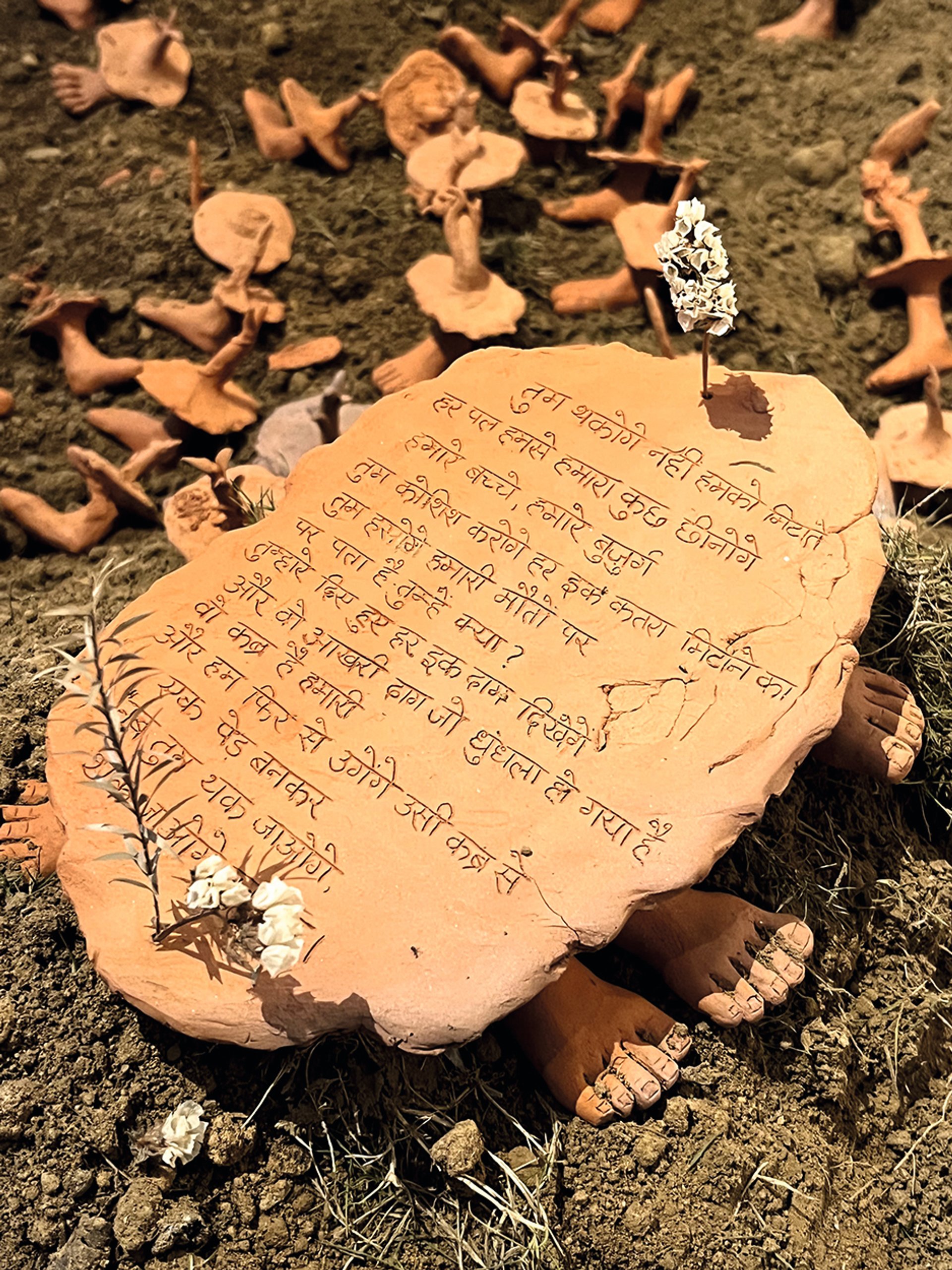
Gupta’s work of the poem If I Must Die by the Palestinian academic Refaat Alareer etched in terracotta Courtesy of Vinod Karki
Shuddhabrata Sengupta had held a workshop in Kala Bhavan when Gupta was a student there. “She had showed me some of her artistic work and poetry and I certainly think that she is a very promising artist and poet,” he wrote in his Facebook post. “People like her should be free to practice their art, to contribute to society with their generous heart and imaginative mind, not have to be behind bars.”
In the Noida movement, around 40,000 factory workers gathered in different areas to demand a higher minimum wage and improved working conditions. While the conditions for workers have always remained difficult, the shortage of cooking gas due to the US-Israel war on Iran had added to their financial distress. Gupta was present at one such protest. The state has named her as an accused with several others in one First Information Report (FIR), accusing them of rioting, criminal intimidation and causing hurt to a public servant to prevent discharge of duty.
A theatre artist, Akriti Choudhary, is also charged in the same FIR. Two days after their arrest, violence unfolded in another such protest. The police booked the two in this FIR too. Both of them are presently named in four FIRs. Akriti Choudhary has also been booked under the National Security Act, which allows for preventive detention and is widely seen as trampling on civil liberties. Kabir Choudhary says that no evidence had been presented against the accused in these cases.
More than 130 arrests
He emphasises that the cases and the suggestion of a conspiracy did not make sense. “If it’s a conspiracy, it’s a single conspiracy months in the planning, then why do you have multiple FIRs?” He says that there were at least 14 FIRs regarding the movement, that new sections of the law and names of the accused were being added in these FIRs and people were still being arrested in these cases. More than 130 people, mostly workers and some activists, have been arrested. Akriti and Gupta’s bail application was rejected by a district court and will now be placed before a higher court. “The purpose is not to punish them,” Kabir Choudhary says. “The idea is to make the process the punishment.”
The Uttar Pradesh state police did not respond to The Art Newspaper’s request for comment.
After the initial spate of arrests, 300 artists signed a solidarity statement with the workers and all those incarcerated. A few more such statements were released. Despite a young visual artist being arrested, the response from the art community was largely muted, but Sengupta’s post triggered additional buzz from the community about the case. Kala Bhavan and the Academy of Fine Arts in Kolkata have also held solidarity protests since then.
Sengupta went to visit Gupta in the Luksar District Jail in late May. He said she was in good health and reading texts by Premchand, an acclaimed Hindi writer, whose works were available in prison. “I was able to reach some coloured pencils, a sketchpad and a notebook to her,” Sengupta says. “The jail authorities were kind enough to permit that.”
Vinod Karki tells The Art Newspaper that PAL would eventually like to display the art Gupta is making while incarcerated. The artist is conducting workshops with her fellow inmates and their children as well, Sengupta says. “She finds that a meaningful way to pass the many hours that need to be passed.”