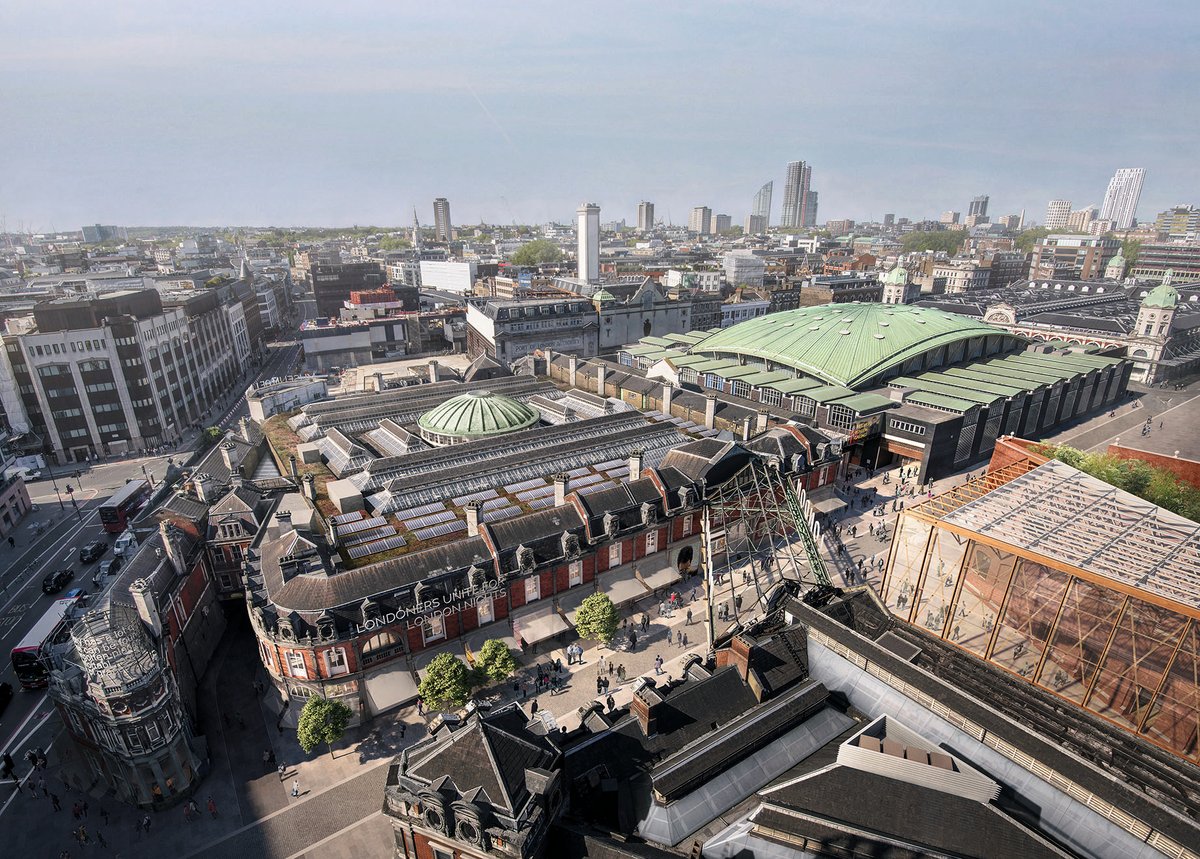
Staff at the London Museum are counting down the days to the opening of their new home in the capital’s Smithfield Market on 28 November. Quite how this erstwhile meat market has come to be reborn as London’s future go-to cultural haunt is one of the capital’s biggest heritage success stories.
In 2014, Save Britain’s Heritage and the Victorian Society succeeded in their ten-year campaign to stop developers replacing the market buildings with office tower blocks and retail. “That was a case that we fought and won!” says Victorian Society director James Hughes. While they had no clue what would happen to the site at that point, Hughes says, “always in our mind was the hope that something better could happen to it, not just for the building, but for the people of London. And that’s actually what’s happening now.”
Smithfield Market has been saved from demolition and is becoming a museum Waldemar Sikora/Alamy
The City of London is an amazing place. It will only remain so if treated the right wayJames Hughes, Victorian Society
More than 100,000 Londoners have contributed ideas to what the museum should be. It now expects to welcome two million people a year to its
Smithfield venue, thereby playing a central role in shifting the focus of the City of London proper from being the capital’s central financial district to a visitor destination.
Two other contested redevelopments—1 Silk Street, which sits opposite the Grade-II listed Barbican Centre, and London’s Liverpool Street Station, also Grade-II listed—underscore the extreme complexity of renewal in this oldest bit of London. At both sites, new high-rise office towers are hailed by developers as vital instruments of economic growth while critics warn of their destructive impact on listed buildings and conservation areas.
Threatened by towers
In May, the City of London Corporation granted planning permission for 1 Silk Street to be transformed with two skyscrapers (16 and 20 storeys high), a plaza and extensive retail space. Lipton Rogers Developments and global property company LaSalle Investment Management say the scheme will contribute 7.5% of the new office space the Corporation aims to create by 2040.
Campaigners have objected to the impact of the development on the Barbican and the Brewery conservation area to the north of the site, citing “an oversized bulk of an office building squeezing out space and light”.
Meanwhile, Network Rail’s plan to redevelop Liverpool Street Station is driven by a forecast 35% growth in the number of passengers by 2041 to 158 million annually. With bigger entrances, an expanded concourse and further retail and ticketing space, the transport hub’s current capacity will be nearly doubled. To fund the project, Network Rail plans to build a 97m-tall tower complex over the concourse.
Campaigners reject the demolition this will entail of substantial parts of the Bishopsgate conservation area and the Grade-II listed station—albeit the newer 1980s and 90s parts, and not anything Victorian. Hughes says: “It’s an extraordinary principle to accept, an extraordinary precedent to set.” He also argues that the plans ignore quite how sensitive, pioneering and conservation-led the 20th-century redevelopment was.
Storied cityscape
The Corporation’s new guidance—which has been co-authored with Historic England—on how developers should consider heritage assets is due to be implemented later this year.
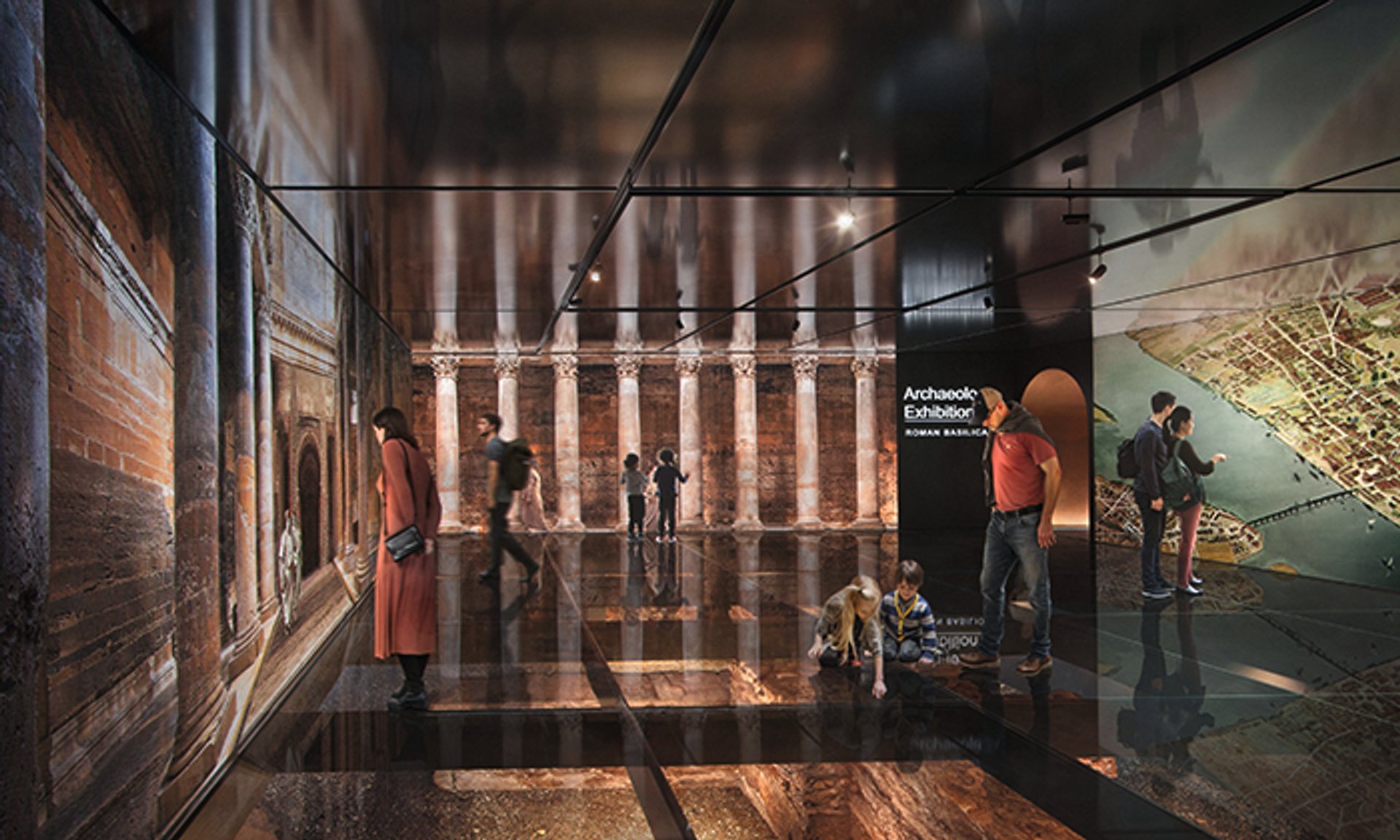
The 85 Gracechurch Street development will integrate a Roman basilica’s remains Courtesy City of London
Anyone planning to build in the Square Mile has 2,000 years of history to contend with. This is where the Romans founded Londinium in the first century AD, and, 200 years later, built a temple to Mithras beneath what is now Bloomberg’s European headquarters.
The district’s irregular street layout remains medieval, having survived the Great Fire of London in 1666. Tom Sleigh, the Corporation’s planning and transportation committee chair, has a map showing in red the ancient public lanes and alleyways that his team has succeeded in restoring to pedestrian use—ten were approved in 2025. To his mind, the best way to preserve heritage is “to keep it active and enabled and used”, and, crucially, to foster investment in the City.
The City of London contains nearly 600 listed buildings, 27 conservation areas, 48 scheduled ancient monuments and five historic parks and gardens, not to mention a rich array of living intangible heritage. Even its airspace is controlled, with towers largely confined to the north-east quadrant, around Richard Rogers’s 1986 Lloyd’s Building, to protect sightlines towards landmarks such as St Paul’s Cathedral, the Monument and the Tower of London.
And yet, planning goes on. In 2025, the Corporation approved half a million square metres of new office space, and the first six months of 2026 have been a boom time for the submission of planning applications. It is all part of a push to facilitate 1.2 million sq. m of new office floorspace by 2040, through new builds and retrofits. The Greater London Authority estimates London’s office workforce will grow by nearly a third in the coming decades, and 80% must be housed right here.
There is a misconception, Sleigh says, that listing—or conservation area labelling—prohibits change. He points out that what listing does is signal the need to treat an important building with care. Quite what “conservation area” means differs from council to council, he says. “What we see it as is summarising a character of the area.”
This highlights the fundamental tension at work. The Square Mile’s single most defining characteristic—what the Corporation’s guidance labels its “spirit”—is commercial. For two millennia, it has been a place of international business. Growth and building anew are in its DNA.
For campaigners, protecting the old is just as much about the future. “The city of London is an amazing place,” Hughes says, “but it will only remain so if it treats what it has in the right way.”