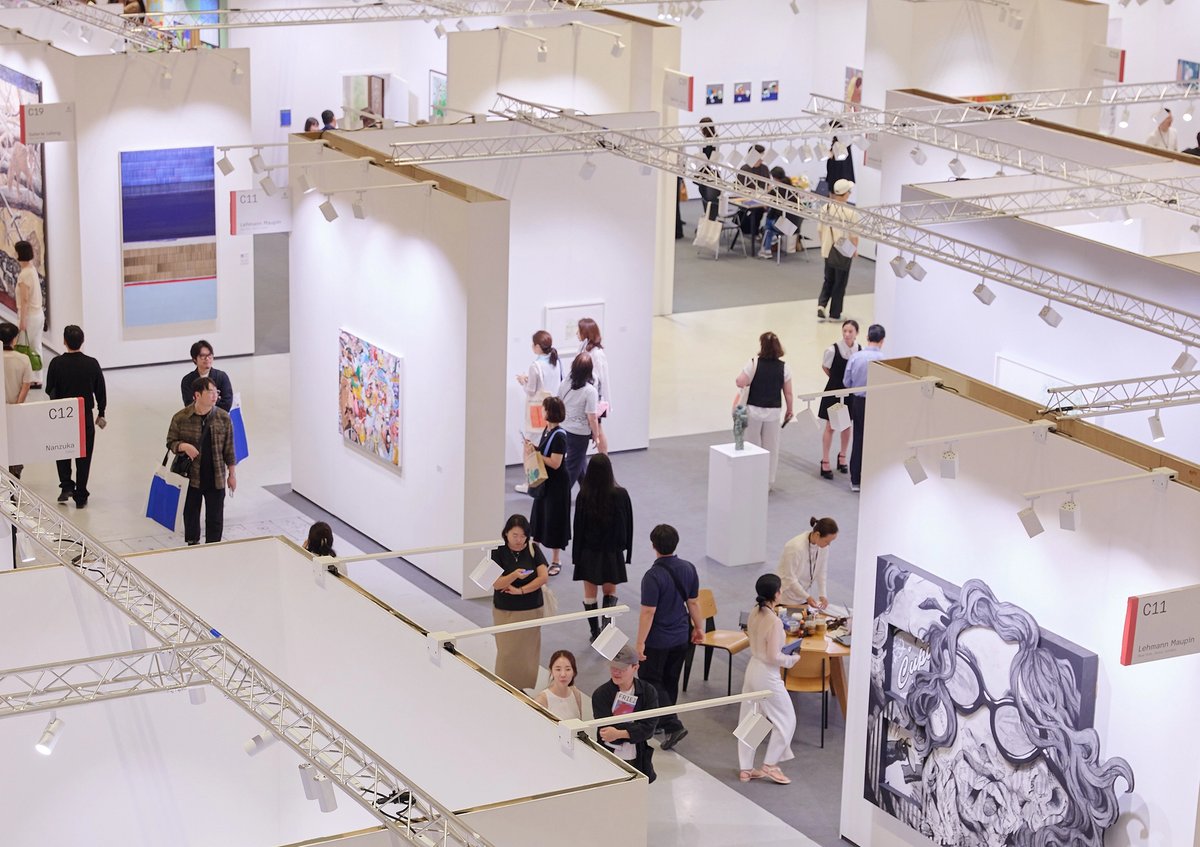
The 26 July implementation of part one of South Korea’s new Art Promotion Act—the country’s first law governing the art market—has left galleries, auction houses and dealers scrambling to comply. Infrastructure has lagged: the enforcement decree was published only two days before the law took effect, and its implementing rule followed in the official gazette on 27 July.
There is still no electronic filing system, and municipal officials who will process the paperwork received their single training session three days before the rules kicked in.
“Aware that a newly introduced system would cause some confusion in the field, we also set a one-year grace period” until 25 July 2027, a Ministry of Culture, Sports and Tourism official told The Art Newspaper on condition of anonymity, adding that the ministry planned weekly briefings for local governments during the law’s first month, “to reduce confusion on the ground and identify improvements to reflect in the system”.
The registration requirement covers six categories of art business, from galleries and auctioneers to advisers and appraisers, which must now report to their local district office. The ministry estimates around 5,000 businesses are affected. Fines of up to 5m won ($3,500) apply for non-compliance beyond the grace period.
According to materials obtained by Kim Jae-won, a National Assembly member of the opposition Rebuilding Korea Party who sits on the culture committee, filings will be processed manually for around a year because no management system has been built. “The ministry had three years after the law passed, yet left municipalities’ preparation to three days before launch,” Kim says, adding that the grace period should be used to check readiness, not as a shield to defer responsibility.
‘Deepening the gaps’
Awareness inside the industry is strikingly uneven. At one major Seoul gallery, which declined to be named, the compliance team came away from a government briefing unconvinced that a second registration—layered on its existing business licence—serves much purpose beyond building the paper trail needed for the resale royalty rules that will be introduced in 2027.
The law formalises what professional galleries already handle on trust, says Emma Son, a partner at Lehmann Maupin’s Seoul gallery. “We already do this a lot,” she says of the commissions many foreign galleries already arrange with artists on resale. She knows of no other country that has tried to force this kind of mandatory record-keeping, and expects whatever benefits follow to concentrate at the high end. “It ends up favouring artists who already trade a lot,” she says. “It’ll just deepen the gap between the rich and the poor.”
The Galleries Association of Korea has been fielding members’ questions, most commonly about where and when to file, says Jung Hyeonkyeong, the association’s secretary-general. The association itself learned that no online system was ready “through media reports”, not from the ministry directly. It lobbied throughout for filing requirements to stay “realistic and minimal” for existing operators, and believes much of that input shaped the final design.
Rate uncertainty
Next year’s resale royalty entitles artists to a percentage each time a work resells through the trade, for their lifetime plus 30 years. Works under 5m won ($3,500) are exempt, as are resales within three years of a direct purchase from the artist for under 20m won ($14,100), an exemption modelled on the European Union’s. What no one yet knows is the rate: the only official signal, a 2017 ministry-commissioned study, modelled 1%-2% with a cap of 15m won ($10,600) per sale, and estimated the total annual pool at no more than 2bn won ($1.4m) across around 376 artists.
The association’s position is that the royalty is “premature”, Jung says: market-support measures should come first and, once introduced, the right would benefit only “a very small number of artists actively traded at auction”, while tighter tracking of sales could burden buyers more. The government is considering a possible minimal-data model similar to music-royalty collection. South Korea will be the first major Asian art market with resale royalties.
An overarching art law was first mooted in Korea’s 2011 free-trade deal with the EU, named as a 2018 policy target, and finally passed in 2023, absorbing an earlier art-distribution bill.
“The year’s head start for registration isn’t a coincidence,” says Kathleen Kim, a lawyer who teaches at Hongik University. “It’s designed to lay the data infrastructure the resale royalty will need.” She notes that the rate and distribution procedure remain undefined, and the collecting body’s capacity to operate is untested. “In the end,” she says, “this will be decided not by the text of the law but by the execution infrastructure behind it.”