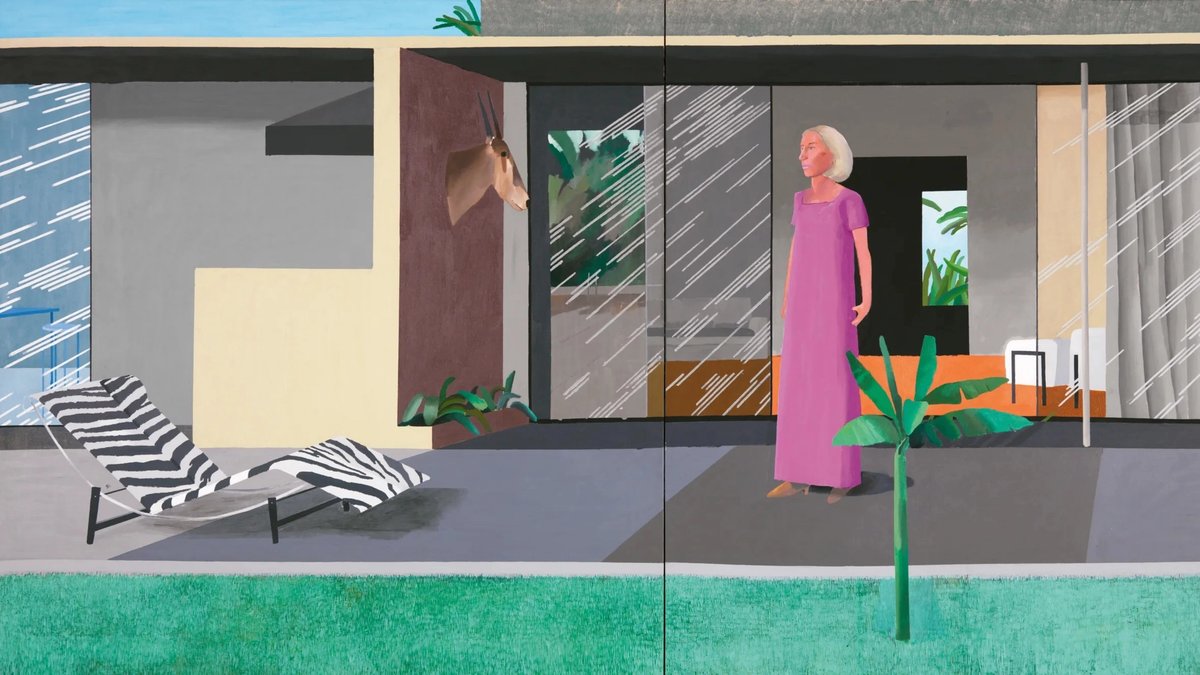
David Hockney is known for his splashy Los Angeles paintings reflecting his love for the light and lifestyle of California in the 1960s. The late Bradford-born artist was invited to glamorous parties in Beverly Hills and swam in celebrity swimming pools that glistened all year round. The pools are now part of Hockney’s Hollywood folklore but his other LA images are just as compelling. Hockney immortalised Betty Freeman in Beverly Hills Housewife (1966–67), presenting a vision of the collector on the terrace of her home looking outwards, swathed in a dress made of pink Indonesian silk. In a new publication, the author and critic James Cahill explores the story behind Freeman and Hockney’s unlikely friendship—we asked him: Who was the woman in pink?
The Art Newspaper: Have you always been interested in Beverly Hills Housewife?
James Cahill: I only came across the painting five years ago. But I have been fascinated by LA for a long time, both the myths and the realities of the place. I think this is why the painting had such an impact on me. Part of what struck me was its enigmatic quality. Here is a woman about whom you know nothing, or practically nothing and yet you’ve been given a vista into her home, into her life, at a specific moment in time. The title seems to assign her a status, but it also holds her at arm’s length, as though she were nothing more than an archetype. I’d also been interested for a long time in this period in Hockney’s art, when he was shifting away from generic scenes of LA (its palm trees and buildings and sun-bronzed boys) toward specific portraits. A catalyst was his meeting with Peter Schlesinger, his first serious boyfriend, in the summer of 1966.
You say: “For Hockney, [Betty] Freeman was an object of fascination, but ever to be contemplated from a slight remove”—is this how he approached the painting?
Yes, I think it was. In the late summer of 1966, Hockney went to visit Freeman at her home in Beverly Hills with the intention of taking photographs of her garden and swimming pool. (This was shortly before he painted his three landmark Splash paintings in 1966-67.) But something about Betty herself intrigued him, and so he took a few Polaroid snapshots of her, standing under the garden portico, turned sideways, wearing a dress of pink Indonesian silk. He then used the black-and-white photographs as the basis for his painting. So there was an inbuilt level of separation, in the sense that he painted the portrait from photographs, not from life.
I also feel that Betty’s aloofness is a key aspect of the final painting. There’s a pervasive sense of her being apart and unreachable. The strip of green turf in the foreground of the picture separates her forever from Hockney and the viewer. I have a strong sense, looking at the portrait, of being invited in and held back simultaneously. It’s a painting about the inscrutability of a person, about what you cannot know at first sight.
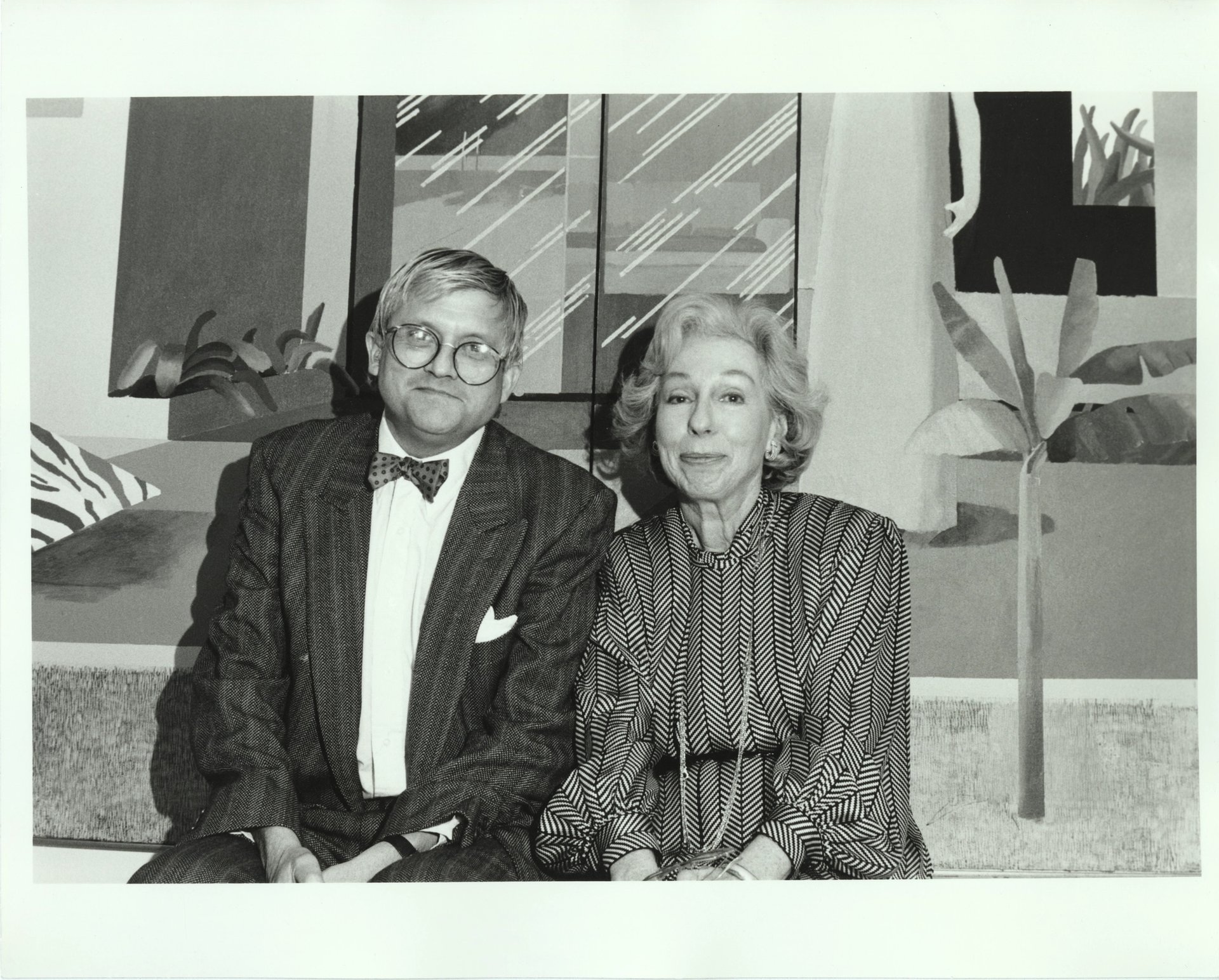
David Hockney and Betty Freeman, 15 November 1987 Betty Freeman Papers. MSS 227. Special Collections & Archives, UC San Diego Library
Which aspects of Betty Freeman’s life and work remain relatively unknown? Her art collecting and study of Sam Francis perhaps.
There’s much about her that isn’t well known, not least her friendship with Hockney. They weren’t well acquainted at the time he painted Beverly Hills Housewife, which is why the picture conveys an air of intrigue, a fascination with the glamorous ‘other’. His later portraits of her are more intimate. They remained friends for four decades, until her death in 2009, and her numerous letters to him are filled with expressions of love and admiration. Those letters were one of the revelations of my research. As was the larger story of her life.
As you say, she was a serious art collector before she met Hockney, one of the few big collectors of contemporary art in 1950s LA. She was especially close to Sam Francis and Clyfford Still, two very different American abstractionists. She adored Francis and they remained close until his death. Still was a trickier customer. She wrote a book on him, at his instigation, but he hated it; she hadn’t afforded him what he considered due reverence. It was never published and they didn’t speak again. She didn’t really “come into her own” until the 1970s when she began actively supporting composers. It is for her work as a patron of music that she is rightly remembered.
The comparison between Beverly Hills Housewife and Piero della Francesca's The Flagellation of Christ (1459-60) is an interesting art historical point—do you think readers will be convinced by the analogy?
I hope so, because Hockney himself was candid about his admiration for Piero della Francesca. In fact, Piero’s influence on him was the subject of an entire show, The Artist’s Eye, at London’s National Gallery in 1981. For me, it’s hard not to see the correspondences between a painting such as Beverly Hills Housewife, or the earlier California Art Collector of 1964, and Piero’s sparse, luminous depictions of space and oddly static arrangements of figures.
There’s something strange and compelling about the rigidity of Betty’s stance in Hockney’s portrait: she has the poise of a Madonna receiving the annunciation, and the same half-turned bearing as the central male figure in Piero’s Flagellation. The house is all planes of light and shade, like the architecture of Piero’s scene. People often talk about the 1960s and 1970s as Hockney’s realist phase, but the paintings from this era have a strong element of artifice and theatricality, which was borrowed directly from Renaissance art.
Is the book also an exploration of the figures in Hockney’s LA orbit?
I talk about a number of the people who were in his orbit: friends such as the novelist Christopher Isherwood and his artist partner, Don Bachardy, but also some of the key players in the LA art scene at that time. Hockney’s work of the 1960s has all kinds of resonances with its wider artistic “moment”, even though its figurative style might seem to set it apart. For one thing, Beverly Hills Housewife shares the concerns of the conceptualist Light and Space movement. As well as being a portrait, it is an examination of light, space, volume and colour. In the book, I also think about the ways in which a work wholly unlike Hockney’s painting, one of Edward Kienholz’s abject, politically-loaded installations from 1966, can usefully be compared with Hockney’s art.
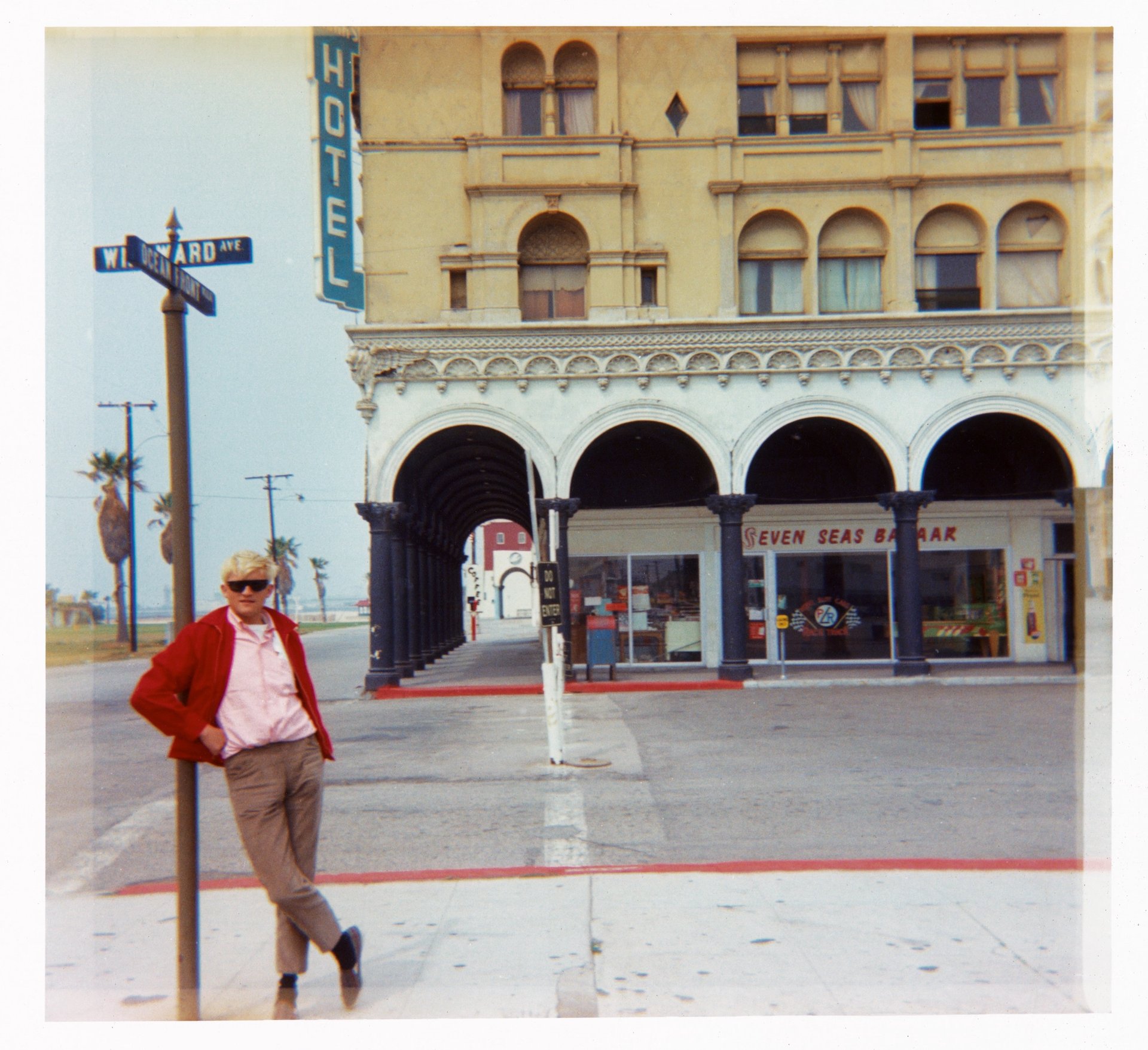
David Hockney, Venice, California, 1964.
Photo John Kasmin. Courtesy of the artist and Lyndsey Ingram
Has the book and your research changed your perception of Hockney, as a person and an artist?
For me, when you’re dealing with an artist like Hockney, who was so prolific and restlessly inventive, you can never really have a fixed perspective. Your perceptions are always evolving the more you discover, and as you return to things that you thought you knew.
Researching Hockney’s long phases in LA has perhaps altered my perspective on his later work, prompting me to see that later work as more integral to his long career. He said himself that the Yorkshire paintings came out of his vast, panoramic scenes of the American West. He also once said that he grew up in Bradford and Hollywood (because it was in Bradford, as a child, that he went to the cinema), and I like the idea that one’s earlier and older selves are always in dialogue, never really separable. We’re very used to thinking about Hockney as a canonical figure in later life, and I hope that this book opens up a different perspective, reminding people of his younger self, his gayness, his numerous artistic innovations. Something of that younger self persisted to the very end.
• James Cahill, The Beverly Hills Housewife: Hockney’s Californian Muse and the World Beyond the Pool, Thames & Hudson, 272pp, £25 (hb)