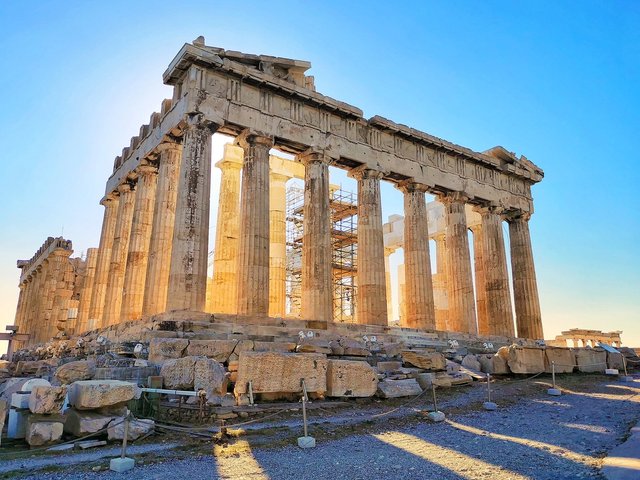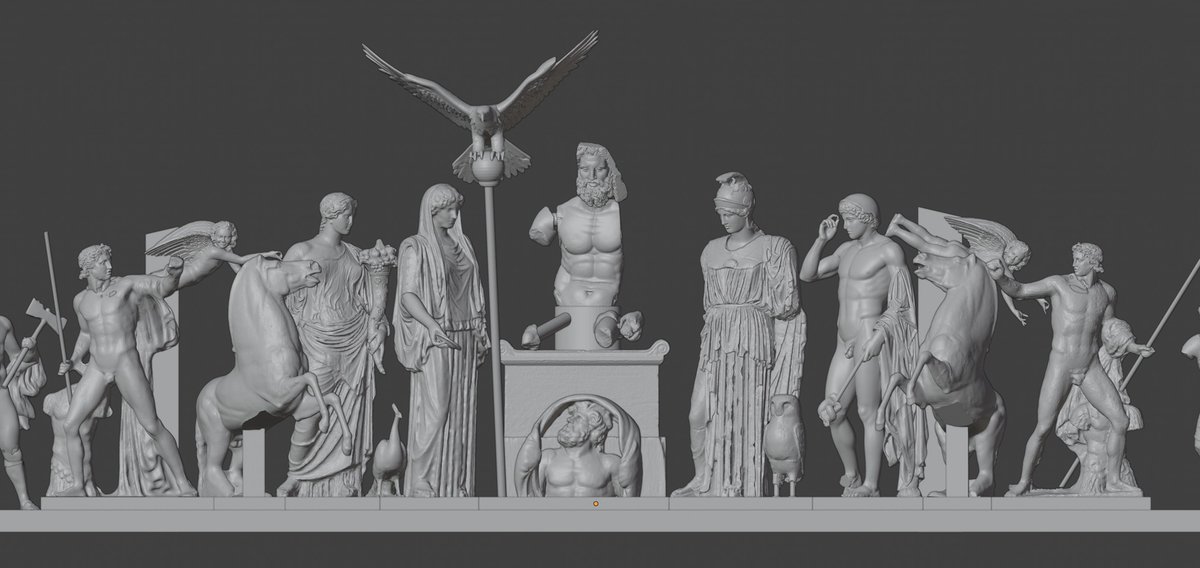
The Greek government has denied a request from Frankfurt’s Liebieghaus Sculpture Collection for the loan of Parthenon marbles from the Acropolis Museum for an exhibition that fully recreates, for the first time, the east pediment over the main gate of Greece’s most famous temple.
The exhibition, Athena, the Stage is Yours: the Parthenon Puzzle, opens at the Liebieghaus in Frankfurt on 18 November (until 25 July 2027). According to Greek media reports, the Frankfurt request for nine fragments from Athens was rejected by Greece’s Central Archaeological Council on the grounds that they would be shown alongside British Museum pieces removed from the Acropolis by Lord Elgin in the 19th century. The Liebieghaus has secured the loan of two fragments from the British Museum.
Greece has for decades demanded the return of the Parthenon marbles from London. The Greek ministry of culture’s press office did not respond to an emailed request for confirmation of the denial of the loans to Frankfurt, and The Art Newspaper’s phone calls to the ministry were not answered. A British Museum spokesperson confirmed that it “will still be loaning”.
“The cancellation of the loans from Greece does not detract from the exhibition’s concept, or its scholarly significance,” Elisabeth Pallentin, a spokeswoman for the Liebieghaus, wrote in an email. “The exhibition is based primarily on new findings resulting from many years of research at the Liebieghaus.”
The east pediment, which portrays the birth of the goddess Athena, is probably “the most famous image of antiquity”, says Vinzenz Brinkmann, the curator of the exhibition. Comprising 39 figures—including depictions of Athena and Zeus in the centre that are 3.5m tall—it was destroyed at some point between the fifth century AD and 1670. It is not known when or why that destruction took place, though there are plenty of theories.
The exhibition is the result of decades of research akin to “putting together a jigsaw puzzle without having all the pieces”, Brinkmann says. Eighty percent of the east pediment is still missing; the rest is in fragments in museums around the world. Until now, no one had succeeded in fully reconstructing the group of figures. “In the past 200 years, there have been a lot of proposals, but we saw that there were always gaps," Brinkmann says.
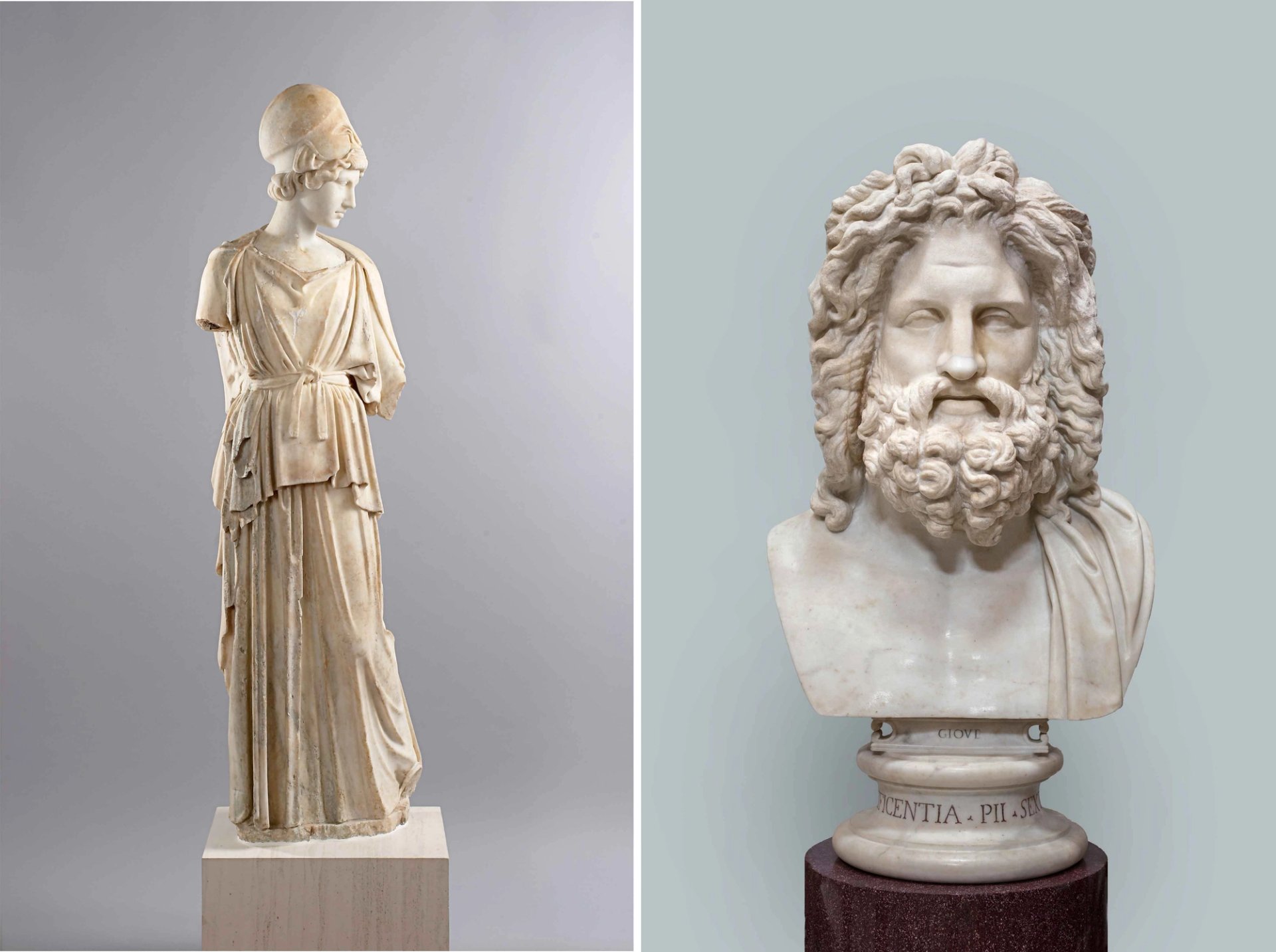
Above left: A Roman replica of a sculpture of Athena by the artist Myron (around 450BC). Above right: A sculpture of Zeus (second century BC), found at Otricoli Athena: Photo: Rühl und Bormann; © Liebieghaus Skulpturensammlung. Zeus: Vatican Museums
The most serious work on the east pediment had been done long before by a British Museum curator, Arthur Hamilton Smith, Brinkmann says. Smith partially recreated the east pediment using plaster casts from the British Museum and cooperated with colleagues in Athens to obtain more casts; his reconstruction went on display in the museum in 1908. “He did a fantastic job in preparing the way,” Brinkmann says. “That was our basis.”
Using scans and a 3D printer, the team recreated the fragments Smith’s casts had represented. But the majority of the pediment was still missing. A breakthrough came when the team began investigating a series of nine reliefs from the lids of Roman sarcophagi that proved the key to unlocking the mystery. Most of these were in the Vatican Museum and other Rome locations, Brinkmann says. “They had been overlooked, but the Romans copied everything the Greeks did.”
None of these sarcophagi reliefs showed the entire ensemble of the east pediment; each depicted a different subset of the 39 figures, Brinkmann says. His team was able to establish that the remaining fragments of the east pediment and the depictions on the reliefs were a 100% match, allowing for the rest to be reconstructed.
The original fragments of the east pediment will be shown in vitrines at the Liebieghaus, Brinkmann says. A scaled-down plaster recreation (4m long, 50cm high) of the entire ensemble will also be on display. There will be digital recreations as well as full-scale reconstructions of some of the figures in the ensemble.
The larger of the two sculpture fragments on loan from the British Museum is the broken-off pair of feet of a striding figure and a tree stump. Although British Museum curators assume that the striding figure was originally on the west pediment, Brinkmann now believes it was on the east pediment.
The base with the two feet is nearly 50cm high and 1.4m long. It is not displayed in the British Museum’s main Parthenon gallery, which reconstructs larger fragments of the two pediments at the ends of the room. As a minor fragment, the pair of feet are normally shown in one of the two modest adjacent side-rooms (this sculpture was recently removed prior to its transport to Frankfurt).
The other sculpture is a fragment of hanging drapery with folds, possibly from the rear of a sculpture. It has not been displayed for some time.
The marbles have been housed in the British Museum since 1817. The British Museum says it is prevented from returning them to Greece by the British Museum Act of 1963.
In 2002 Andy Burnham—the now-British prime minister—was one of seven members of parliament to introduce a private member’s bill which, according to the British Committee for the Reunification of the Parthenon Marbles, proposed amending the act. It was eventually dropped.
But Burnham has since backtracked. He recently told the Financial Times that he sees their return as “ultimately an issue for the British Museum”.
Brinkmann is internationally known for his research into polychromy in ancient Greek and Roman sculpture. An exhibition he curated, Gods in Colour: Painted Sculpture of Classical Antiquity, has travelled the world, having been shown in several US institutions, as well as in Athens, Oxford, Istanbul and the Vatican Museum, among other locations.