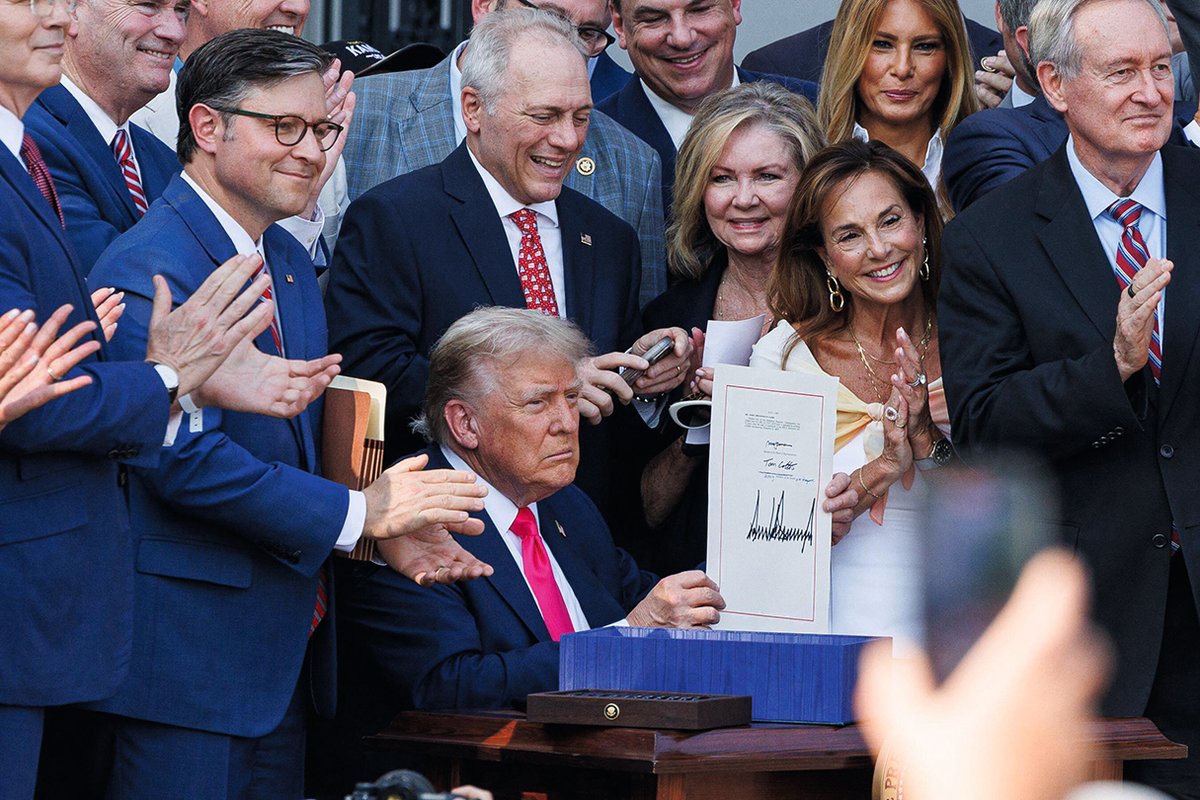
When, on 4 July 2025, US President Donald Trump signed his landmark policy and spending bill—H.R. 1 or the One Big Beautiful Bill Act— into law, he claimed it would make the country “a rocket ship”, boosting the economy. Experts in arts higher education and the cultural sector are worried it will have dire effects on their field.
The Working Families Tax Cut Act, as the legislation is now known, introduced, among many other things, changes to the financial support available to students at the federal level. First, the graduate and professional PLUS loans scheme has been terminated. Second, in the extant direct loans programme, different caps have been introduced on the amount that can be loaned, thereby effectively penalising students choosing academic pursuits that are not on the Department of Education’s list of programmes granting professional degrees (which includes disciplines like veterinary medicine, law and forensic psychology, but not anything related to arts and culture). Third, and most crucially, it implements an earnings-based accountability framework, which will determine which programmes qualify for their students to access federal financial aid.
This last change has many art schools worried. As anyone working in arts higher education will attest to, the notion that the value of an arts degree should be measured solely by how much its recent graduates are earning is, to say the least, outdated. As Lee Ann Scotto Adams, the executive director at the Strategic National Arts Alumni Project (Snaap), puts it: “It’s a one-size-fits-all approach that does not work for artists, designers and musicians.”
An F for the earnings test
Quite what impact the act will have on American arts education is not an easy question to answer, if only because the implementation has been slow. The bill was enacted in July 2025. From 1 July 2026, the graduate and professional PLUS loans scheme was cancelled and differential limits on extant loan schemes were implemented. The earnings test will come into effect from 1 July 2027.
Last January, the government published preliminary estimates of how many programmes would fail this test, also known as the “do no harm” test. Across associate degrees, BAs and MAs, the arts at large feature prominently. Among bachelor degree programmes, 17.7% of graphic communications, 12% of film, video and photographic arts, and 11% of music programmes would fail, as would 8.5% of fine and studio arts programmes—“and that includes schools like the Juilliard School and the New England Conservatory”, says Scotto Adams, referencing two of the top-performing arts institutions in the country.
Among graduate programmes it gets worse. Nearly half (44.1%) of fine and studio arts programmes would not pass.
The pass rate estimates for associate degrees, meanwhile, are abysmal: 79.4% of film, video and photographic arts programmes and 73.8% of fine and studio arts programmes would fail. These are undergraduate courses taken over two to three years at community or junior colleges, but also at schools like the Pratt Institute, which sells itself on ranking fifth out of 303 US and international art and design universities. Because they are shorter, associate courses can be cost-effective routes for students to get the knowledge they need before they start working. But students still have to be able to pay for them. And, of course, “start working” in the art world is an ill-defined proposition.
Scotto Adams describes Snaap as the “go-to source for earnings on arts and design graduates”. Data from the non-profit’s surveys go back almost two decades, to 2007, providing ample, granular proof of how non-linear art graduates’ careers often are.
During the public consultation period for the bill, Snaap submitted substantial public comment, warning the Department of Education of the inequity built into the flattening approach this earnings test takes to assessing a degree’s outcome.
“The biggest thing for us,” Scotto Adams says, “is that the earnings, three to four years after graduation, for an arts alum, whether at the undergraduate or graduate level, don’t really provide a complete or representative picture of the programme-level outcomes in arts and design fields.”
Further, the Department of Education is comparing recent graduate earnings against the median earnings of local high-school graduates aged between 25 and 34, which, as Scotto Adams points out, represents up to 17 years in a career: “It’s not a comparable time horizon.”
Ideological implications
A bigger question revolves around what the motivations behind the act are, and whether it is possible to understand the changes it introduces as not being ideologically driven. After all, student debt is a big deal. Holding institutions to account and weeding out exploitative, for-profit schools has rightly long been a priority for the Department of Education.
Richard Paulsen, an economist at the University of Michigan, has studied the impact of student loan debt on arts graduates’ career choices. He has found that having debt decreases the likelihood of working in the arts by over 25% and of working as an artist by over 30%—particularly for students of Black, Hispanic and working-class backgrounds. But his conclusion is not that arts students should therefore not have access to loans. Rather, it is that government should devise policies that help to alleviate such debt.
“Even if it’s the case that the average art graduate is not making a tonne of money—and certainly the median art graduate is not making a tonne of money—there is, in my view, a lot of value to society in having a thriving creative sector,” Paulsen says. The long-term implication of these changes, in his view, is that “it’s going to keep potentially some really good artists out of the arts because they can’t pursue their degree, because they can’t afford to, because the student loans are no longer available”.
Joanna Woronkowicz, a cultural economist, senior research fellow at Snaap and associate professor at the Indiana University in Bloomington, concurs. She describes the earnings test as a “very crude solution”.
“I’m an economist, so I do see the value of thinking about productivity and economic outcomes,” Woronkowicz says. “But if you want to think about productivity, you also have to think about how to foster a competitive market and innovation. And all of those things come through providing people with funding access. You can’t just cut it off and think that the arts are going to thrive.”
Some colleges and universities are pre-emptively making changes and contracting. Florida A&M University, a historically Black university in Tallahassee, is closing its studio fine arts programme and merging its wider arts programmes. State legislatures are also following the federal government’s lead. The Indiana Senate Bill 199, which passed into law last March, specifies that state educational institutions with “degree programs that meet the definition of a low earning outcome program under federal law must request approval from the commission to continue the degree program”. This kind of shift risks making access to arts programmes even more inequitable, because if your state’s institutions close their programmes, your only options are to head out of state or go to a private university, both of which are typically more expensive.
Johanna Taylor, an associate professor at Arizona State University’s Herberger Institute for Design and the Arts, says of her cultural policy colleagues in higher education that, over the past year, “we were in a holding pattern, unsure what to do. Now everyone’s mobilised.”
“Policy is a reflection of cultural values,” Taylor says. “It’s as if the federal government is saying: ‘We are following this American cultural narrative of: you are a product of your own success.’ That is all about the individual American exceptionalism narrative—that’s what we’re valuing.”
Taylor points out that arts programmes are not the only ones affected—so, too, are education, social work and other fields of study. To her mind, the fact that the law is now enacted could be a galvanising force: “It’s an opportunity for us to collaborate with others and not just see it as an attack solely on the arts. All of these other precarious industries, both within higher education but also the career pathways beyond them, can align and say, ‘We have this greater value on society, on community wellbeing’, and create a stronger narrative, rather than just be further decimated or pushed to the sidelines.”