We are living in a second Gilded Age. At least, a very, very select few of us are.
Economists have crunched the numbers charting the growth of extreme wealth in the US over the last 120 years and have come to the conclusion that today’s ultra-rich are now even richer than they were during the era of the so-called Robber Barons.
Gabriel Zucman, a professor at the Paris School of Economics, for example, shows that between 1910 and 2025 the wealth of America’s richest 0.00001%, when expressed as a share of national income, increased from 4% to 12%. “The wealth and power of oligarchs far exceed their Gilded Age peak,” Zucman wrote on Substack in January.
Surging stock prices, particularly for tech companies driving the artificial intelligence (AI) revolution, have created staggering paper fortunes across the globe. In June, Elon Musk briefly became (for two weeks), the world’s first trillionaire, following the record $1.7 trillion initial public offering of SpaceX, whose shares subsequently slumped. In March, Forbes published its annual World’s Billionaires List, announcing a record 3,428 individuals in this category, 400 up on 2025, worth a record $20.1 trillion.
This gargantuan accumulation of wealth is at last having a transformative effect on the major auction houses’ sales figures. Global revenues at Christie’s, Sotheby’s and Phillips reached an aggregate $9.4bn (with fees) in the first half of 2026. Christie’s led the way with $4.5bn, up 71% on the same period last year, followed by Sotheby’s $4.4bn, up 58%. Phillips weighed in with $507m in the first half, up 60%. Further, and equally significantly, the Texas-based specialist collectables auctioneers Heritage posted sales of $1.4bn, an increase of 47% on last year’s first-half result.
A boost from single-owner sales
“From a fine art point of view, the confidence that has come back has been fuelled by S.I. Newhouse in New York and Joe Lewis in London and many of the other single-owner sales,” says Anders Petterson, the founder of the London-based art market analysts, ArtTactic, referring to auctions that reaped $631m and $406m for Christie’s and Sotheby’s, respectively. According to ArtTactic’s data, single-owner offerings accounted for 32% of the value of the Sotheby’s, Christie’s and Phillips fine art auction sales in the first half of 2026.
“It was building on the momentum created by the [Pauline] Karpidas and [Leonard A.] Lauder auctions at the end of last year,” says Petterson. “It’s the wealth transfer that everyone is talking about. Most of it’s driven by the older Impressionist and Modern markets, it’s not the contemporary side,” he adds. “Who is buying these older works? That is the question, given that everyone is wondering where the younger collectors are going to come from.”
To the wider world, auction results like the record $181.2m given at the Christie’s S.I. Newhouse sale for Jackson Pollock’s monumental 1948 drip painting Number 7A create the impression that the art market is behaving as it always has, with the world’s wealthiest prepared to pay inordinate sums for trophy works by the most revered names.
That wider world is going through a period of profound, rapid change. As John Naughton, the technology correspondent of the Observer, eloquently put it in July in an article reflecting on the relationship between J.M.W. Turner’s Rain, Steam and Speed (1844) and AI: “We’re in the middle of a traumatic phase transition—from a disintegrating socioeconomic order into a future that is unknowable and could conceivably be dystopian.”
Serious phase transition
Comparing auction results from the first half of 2026 with those achieved in 1926, during the first Gilded Age, suggests that the art market is going through a serious phase transition too.
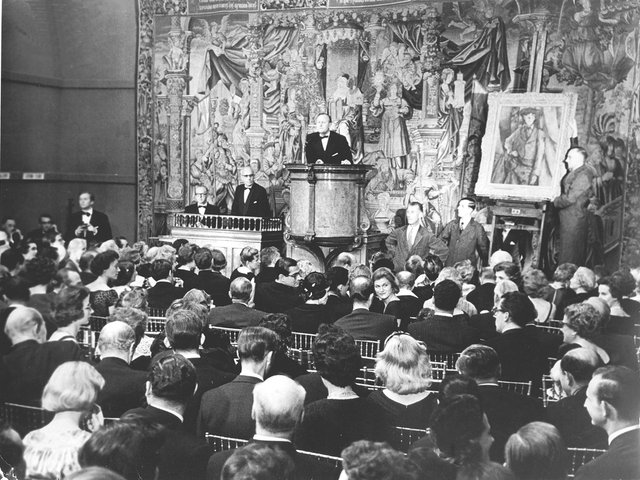
Back in 1926, three years before the Wall Street Crash, Thomas Lawrence’s winsome 1794 portrait of the young Sarah Goodin Barrett Moulton, known as “Pinkie”, fetched 74,000 guineas, around $377,000, in London, setting a world record price for any work sold at auction. The painting was bought by the then-dominant London dealer Joseph Duveen, who sold it on to the American railway magnate Henry Huntington. Gerald Reitlinger in his classic 1961 study of the art market, The Economics of Taste, describes the price as “out-and-out madness for this pretty superficial thing”.
That record for the Lawrence was one of a series of colossal prices paid for 18th-century English portraits by Gilded Age multimillionaires such as Huntington, Henry Clay Frick and Andrew Mellon. For America’s newly rich, buying paintings of English aristocrats by Gainsborough, Reynolds and Lawrence was a convenient, if expensive, way of acquiring social and cultural prestige.
A hundred years ago, when the mansions of the super-wealthy were decked out in the opulently historicised “Goût Rothschild”, huge prices were paid across a spectrum of traditional collecting categories. Auctions in 1926 saw a Louis XV secretaire by Bernard II van Risenburgh sell for a record £10,237, a set of five 16th-century Brussels tapestries by Jan Raes for £3,517, a pair of Louis XVI gilt-bronze urns for £3,570, an 11th-century German illuminated manuscript for £2,050 and a 15th-century Italian pharmacy jar for £1,050, according to The Economics of Taste. To give some perspective, that same year, a painting from Monet’s 1891 Poplars series fetched £900.
A Rothko or a leather jacket?
Compare these results with the stand-out prices achieved so far in 2026. Yes, Sotheby’s managed to sell a 1957 Mark Rothko abstract for an as-expected $85.5m in May, but there was far more excitement in July when the auction house offered a Tom Ford leather jacket owned by Jensen Huang, the founder of the AI behemoth, Nvidia. Estimated at $40,000-$60,000 in a single-lot online charity auction, it was contested by 45 bidders up to $960,000.
At Phillips, watches grossed $235m in the first half of the year, outperforming Modern and contemporary art, which took $224m, reflecting the recent slump in the prices of 21st-century art, Phillips’s speciality.
Then there was the record $3m given at Heritage Auctions in June for the highest-graded sealed copy of the 1980s Nintendo Super Mario Brothers video game.
Even more staggering was the $16.5m paid in February at the online auctioneers Goldin for a rare 1998 Pokémon “Pikachu Illustrator” card in pristine GEM MT condition. Owned by the WWE wrestler and influencer Logan Paul, who had bought it for $5.3m in 2021, the card was bought by the 33-year-old New York venture capitalist A.J. Scaramucci, son of the former White House communications director Anthony Scaramucci. The price was the highest ever paid for a gaming card.
“I mean, Picassos are great, but Pokémon means way more than just a Picasso painting to people,” Scaramucci said after the auction. He added that this had been the first purchase of what would become a “planetary treasure hunt” that he and his younger brother would pursue for similarly compelling rarities across a range of collecting areas.
The auction houses have become a kind of luxury eBaySylvain Lévy, collector
It is unlikely these will include art. For Scaramucci and others in the relatively small cohort of affluent buyers under the age of 40 who pay serious prices at auction, popular culture and luxury frame their collecting instincts. For them, Pikachu and Patek Philippe are far more relatable than Picasso and Pollock. These gilded individuals do not need to own old paintings to validate their new-found wealth.
“The auction houses have become a kind of luxury eBay,” says Sylvain Lévy, a Paris-based collector who specialises in Chinese contemporary art. “People are so rich they can afford any kind of caprice. It’s a different kind of buying, a different way of living. They’re not prepared to pay a lot of money for things they feel aren’t part of their lives,” Lévy adds. “They’re not interested.”
Generation gap
This is the central challenge facing the art trade over the coming 10 to 15 years. According to Bloomberg, around $1 trillion of art is going to be transferred down the generations over the next decade. But, as Philip Hoffman, the founder and chief executive of The Fine Art Group, which manages 350 family office collections, told Bloomberg: “The next gen don’t want it.”
For how much longer can the current older generation of “connoisseurial” collectors support the elevated prices of big-name Modern and classic contemporary art?
In the meantime, the resale market for big-ticket young contemporary painting seems to have not so much collapsed as evaporated. In 2022, at the height of the speculative boom for hot, “red chip” names, paintings by Avery Singer, Christina Quarles and Flora Yukhnovich sold for auction records of $5.3m, $4.5m and $3.6m respectively. In the first half of 2026, the highest auction price for works by any of these former market darlings was $63,737, according to Artprice.
Given the extraordinary amounts of wealth out there in this second Gilded Age, we should buckle up for more auction results that represent “out-and-out madness” for superficial things. But they will not necessarily be made of paint applied to canvas.