The critics have given The Bayeux Tapestry at the British Museum five stars, but they visited in privileged circumstances, with plenty of space and time to savour the experience. So what is it like for the paying public? I went yesterday, on the first day.
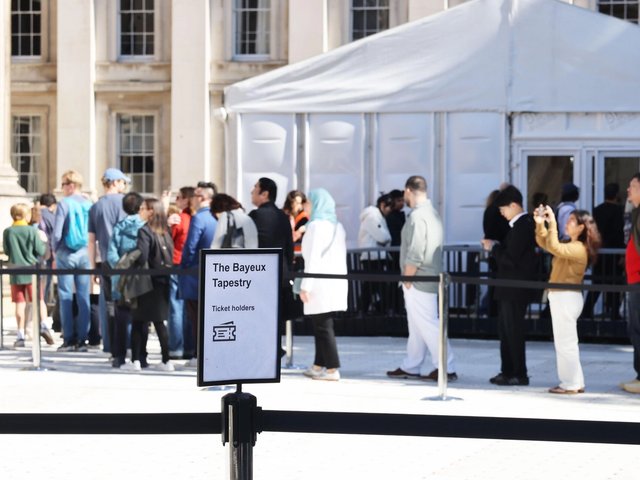
Precious ticket in hand, I joined a 20-minute queue to enter the exhibition. We then climbed the stairs to an upper-level, to find another line of people disappearing into the distance. This main queue took 25 minutes, with visitors experiencing a mixture of slight frustration and great anticipation of what lay ahead. The wide corridor was dimly lit, enabling our eyes to become accustomed to the low lux level required for the tapestry, with occasional explanatory texts illuminated on the walls. We then descended to the display.
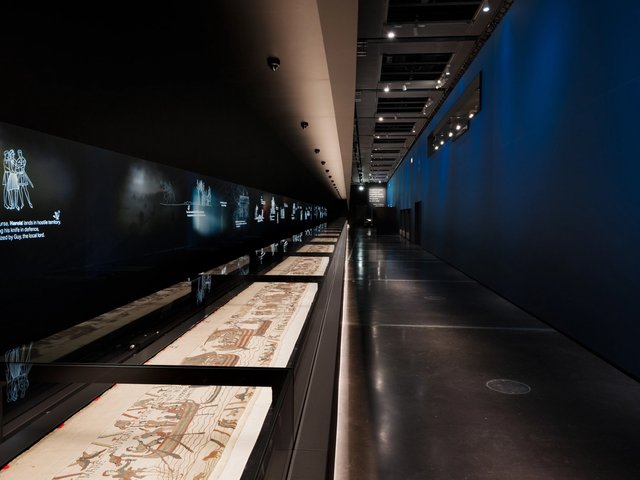
The first sight of the 70m-long Bayeux Tapestry is truly impressive, however many images one has seen beforehand. With eyes adjusted to the darkened gallery, the ancient tapestry appears bright. Despite some fading, its colours are still remarkably well preserved for a textile that is 950 years old.
I joined the long line of around 100 visitors shuffling along the tapestry, slowly but steadily. Every two minutes an announcement urges people to “keep moving” (it is repeated in French, although this addresses the one overseas group who will be able to see the tapestry in their home country). Museum staff were invariably helpful and welcoming, but politely firm when it came to moving people on.
It is a tribute to the carefully arranged display that one can see the tapestry so clearly and close up. It is presented flat, at roughly waist level, so one looks down at an angle onto the unfolding story.
The story of Edward the Confessor’s death, William the Conqueror’s return to England and the defeat of Harold is complex and difficult to grasp within one’s precious minutes in the exhibition. But nearing the end, the ferocity of the 1066 Battle of Hastings is all too powerful. With limited time in front of the tapestry, having read up on the history beforehand enhances the experience.
For most visitors, it may be better to concentrate on the tapestry’s artistic quality. Along with the unfolding events along the main central strip, there are two delightful borders, at the top and bottom, with an astonishing array of lively birds and beasts.
Time flies, and after 35 minutes we had reached the end. With a standard ticket costing £33, that works out at almost £1 a minute. And with 58 scenes, it was 35 seconds for each. But the experience was memorable. For the first public day, it was all remarkably well planned and organised. The next tranche of tickets go on sale on 21 October and are likely sell out within hours (the exhibition runs until 11 July).
After leaving the shuffle, the exit is through the gift shop. The Bayeux Tapestry has been very expensive to mount, but it should still bring in a much-needed profit for the British Museum.