One major value proposition of virtual reality (VR) has always been its potential to foster empathy. A VR headset, or so the thinking goes, can change a viewer’s political point-of-view as it changes her literal one, aligning her with the subject experience of another person and thereby laying the groundwork for a new social paradigm based on mutual understanding. It’s a heady promise, though perhaps limiting in its reliance on the shock-and-awe of firsthand experience. At this year’s Toronto International Film Festival, which now features an immersive storytelling strand, eyebrows were raised by news reports of a virtual-reality Lesbian Simulator.
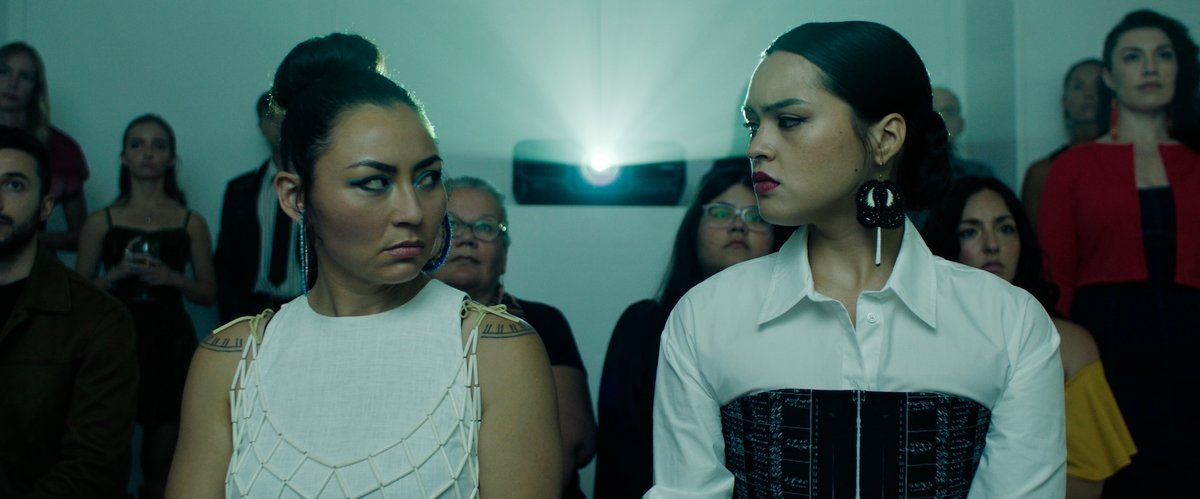
Also at this year’s festival is In the Heart of the South, whose co-writer and director, Nyla Innuksuk, has created VR works exploring the Canadian Indigenous experience, including a piece for the augmented reality-forward Sámi pavilion at the 2022 Venice Biennale. In In the Heart of the South, Yura (Anna Lambe) is an award-winning Inuk artist attempting a similar transition to feature films. Yura’s big site-specific VR piece takes gallerygoers through a historic residential school—Canadian institutions in which Indigenous children were separated from their families, forcibly assimilated and often abused—and now, a “storyteller” on the rise, she is being scouted by production companies. But continuing to work through her people’s trauma becomes trickier when an old friend reappears in her life, challenging Yura’s claim to her past—changing her perspective, one might say, and disrupting her narrative.
Yura is introduced as the face of a new VR headset, the marketing copy of which calls it a device for “participatory story creation” and promises “canon-breaking” new narratives. The aesthetic worthiness and social importance of Yura’s project sits uneasily amid the marketing jargon of the art business and the symbolic politics of the market, full of eggshell-walking white progressives whose visible self-consciousness about accidentally performing a microaggression surely itself constitutes a microaggression.
Yura seems comfortable with—or reconciled to—her place in the Toronto art world, wearing upscale First Nations jewellery to events where she is introduced to white collectors. She is advised to claim “space” for her work, which is on the one hand empowering and affirming, but on the other hand implies something cutthroat and zero-sum about her professional milieu, where every door that opens for her closes for someone else. The phrasing also invokes Canada’s history of claiming space through settler-colonialism, and fulfils the paranoia of an artist leveraging ethnic histories for professional opportunities.
Yura is getting meetings with Canada’s national film board (which is excited to tell—no, to support—Indigenous stories), and she is good in a room, able to tell executives what they want to hear about impact. At a hip woman-run production company, grappling for the first time with a for-profit entity’s development notes and taking on board their desire for “elevated genre”, she pitches a story based on a formative experience out on the ice with a childhood friend, who claimed shamanic powers, and spins it into a contemporary horror-revenge thriller about what happens when the two girls are reunited in adulthood. (Innuksuk’s first feature film, 2022’s Slash/Back, is about Inuk girls from her own home of Baffin Island fighting off an alien invasion.) Later, staring at a blank document saved as “Movie based on me”, she starts typing about her long-lost friend and, like magic, there Sesi (Zorga Qaunaq) appears on her doorstep, blowing in like an ill wind.
Sesi seems more connected to the contemporary Inuk experience, potentially including sexual exploitation and substance abuse. She dismisses another Inuk video artist’s piece as trauma-dumping, and makes fun of the evidently successful Yura for her “white-girl breakfast” of avocado toast. Yura begins to wonder whether metabolising narratives of collective suffering for her work isn’t, in the final analysis, ethically dubious and personally corrosive, though Sesi may also resent her for a more personal betrayal.
Lambe and Qaunaq, co-stars on the CBC and Netflix comedy series North of North, share a chemistry that comes through in their contrasting affects, as Sesi crashes Yura’s parties, starts chatting up her professional peers and, through her very presence, alters the direction of her screenplay-in-progress, which seems to evolve with the movie. Yura remembers Sesi as the shaman of the dyad; Sesi remembers it the other way around, but as Yura incorporates genre elements into her script, she develops a skin rash, and the film’s soundtrack begins to hum with ambient menace.
Brightly lit and tonally even, In the Heart of the South does not feel like a thriller or, aside from a few too-subliminal background flourishes, much look like one. The representation-politics buzzwords that pepper almost every scene are snarky jokes about the transactional wokeness of the publicly and philanthropically funded arts world, but the screenplay is so steeped in the language of the think piece that the whole movie ends up coloured by it. Dialogue about “who holds the power, who gets to turn their trauma into narrative” is defanged by the climax, when Innuksuk intends for it to bite back at Yura. Nevertheless, in being so overwhelmed by the anxieties of a minority artist wondering if she has gotten too good at the representation game, In the Heart of the South is in any case an immersion inside her perspective as complete as any VR experience.
- In the Heart of the South had its world premiere on 10 September at the Toronto International Film Festival and plays again on 18 September