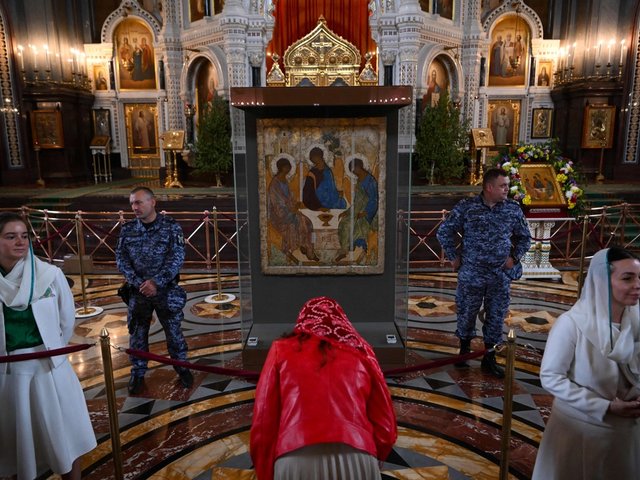
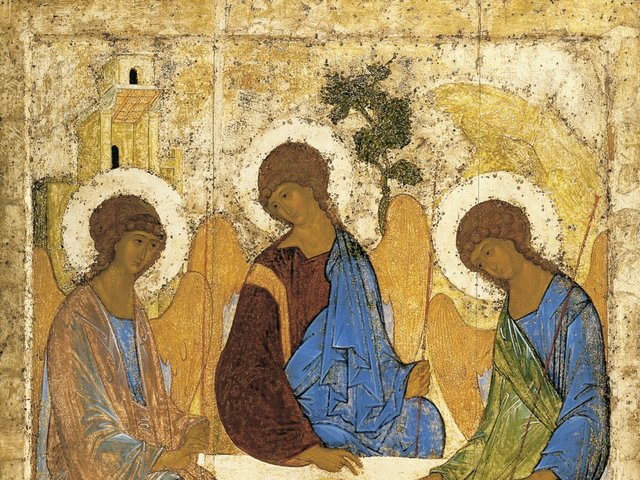
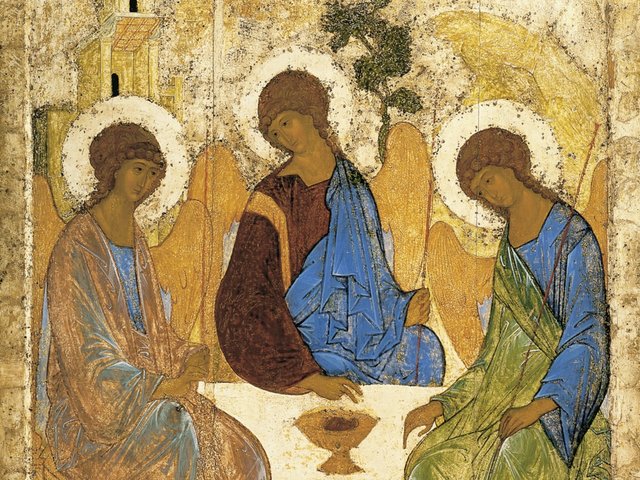
Russia’s most valuable religious and artistic treasure, the early 15th century Trinity icon by Andrei Rublev, is in danger following the reported breakdown of a climate control capsule in which it was installed. The work was transferred from the State Tretyakov Gallery to the Russian Orthodox Church under President Vladimir Putin’s orders in 2023, and is currently housed in the Trinity-St. Sergius Lavra monastery near Moscow.
Ksenia Chernega, a nun who runs the Moscow Patriarchate’s legal department, told the RBC news site on 15 September that the icon has been temporarily replaced in its capsule by a copy. RBC reported after conversations with staff at the monastery that the copy was installed in August. The Tretyakov’s press service told the official Tass news agencyon 14 September that the icon “is in the Lavra’s restoration workshops” and museum staff are “checking its condition”. According to the terms of the 2023 physical transfer of the icon to the church, it officially remains state property.
The Trinity icon depicts three angels, intended to symbolise the Christian Trinity, visiting the Prophet Abraham. The scene is based on the Old Testament story of the Hospitality of Abraham.
Patriarch Kirill I, the head of the Russian Orthodox Church, first displayed the work in Moscow’s Cathedral of Christ the Savior near the Kremlin in 2023, then moved it to its “historic spot” at the Trinity-St. Sergius Lavra. The 14th-century monastery, often described as the Russian church’s Vatican, is a Unesco World Heritage site.
Tass reported in 2024, that “an enhanced new case” had been “specially ordered” from Germany to preserve Rublev’s icon in the iconostasis of the Lavra’s 15th-century Trinity Cathedral. The name of the German producer of the case has not been revealed.
Ekho, a news platform created by journalists in exile of a once popular radio station now banned in Russia, first reported on the threat to the Trinity on 12 September, citing sources who asked to remain anonymous.
One source “familiar with the situation” told Ekho that approximately two months ago humidity inside the case had spiked to 80 %. This far exceeded the level suggested by Elena Pronicheva, the Tretyakov’s director at the time, who told the official Ria Novosti news agency that the temperature should be maintained within 1 degree of 19C and “relative humidity from 50 to 55%”.
A specialist brought in from Germany determined that the case had malfunctioned, the source told Ekho. The specialist repaired it, they continued, but it broke again several hours after his departure. “Complexities of international relations” prevent the German specialist form returning, the source said, adding that the case is meant for a museum, not the “extreme conditions” of a church.
The three pieces of wood that form the icon are becoming warped from the humidity, Ekho reports, and threatening the painting.
Ekho’s report went viral after Facebook posts by Russian intellectuals in exile: Xenia Loutchenko, a writer and journalism professor based in Berlin who has been declared a terrorist by the Russian state, and Oleg Voskoboynikov, a medieval historian now based in Italy who, like Loutchenko, left Russia after its full-scale invasion of Ukraine.
“Rublev’s Trinity is perishing,” wrote Loutchenko on 13 September, before the Tretyakov reported that its staff were the ones examining the icon in the Lavra’s workshops. Although access to Facebook is limited in Russia, some commentators from art and church circles got on via VPN to defend the Lavra’s in-house restorers.
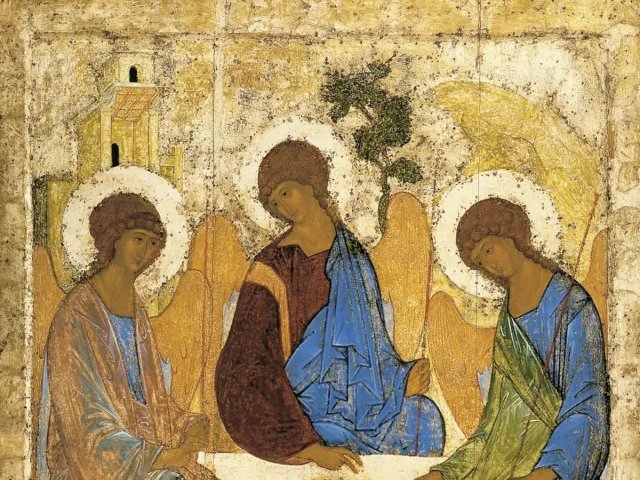
Arts writer Sofia Bagdasarova meanwhile wrote in her Telegram channel: “Regarding the photo circulating online that shows a crack in an icon with a strange substance oozing out, my sources have assured me that it is not a fake but a genuine image—what is being squeezed out is restoration glue caused by the swelling of the wooden panels.”
Restoration of Rublev’s Trinity in the early 20th century, revealing its original colours, had a profound impact on avant-garde artists, including Kazimir Malevich and Natalia Goncharova. Andrei Tarkovsky’s film Andrei Rublev depicts the iconographer realising he can overcome the brutality of rival princes and Mongol raids with sacred art.
Earlier this year, Putin transferred two other historic works from the Tretyakov Gallery to the Russian Orthodox Church. The Vladimir Icon of the Mother of God, created in Constantinople in 1130 and the 14th century Don Icon of the Mother of God were both displayed in April at Christ the Savior Cathedral, where Putin came to venerate them.
Icons and religious relics have been used as symbolic tools by the Kremlin during Russia’s invasion of Ukraine. They have been brought out a religious processions held to rally public sentiment. Last month, meanwhile, Putin visited the Cathedral of the Archangel in the Kremlin to venerate the relics of 14th century warrior prince Dmitry Donskoy after they were unexpectedly discovered there, and part of the Russian Orthodox saint’s hand was sent to troops fighting in Russian-occupied eastern Ukraine. Patriarch Kirill has vocally supported the war and reinforced its spiritual significance.