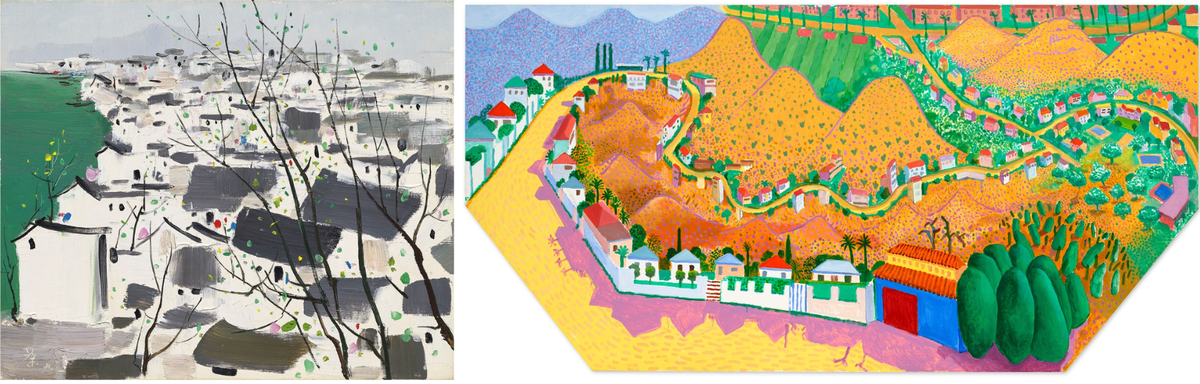
This month, Christie’s Hong Kong posits that artistic dialogue can continue past an artist’s life with the first-ever pairing of the Modern Chinese master Wu Guanzhong (1919-2010) with British painter David Hockney (1937-2026). “While they come from very different cultural backgrounds, both artists spent their careers exploring how Eastern and Western artistic traditions could inform one another and open up new ways of seeing the world,” says Christian Albu, Christie’s deputy chairman, head of auction and private sales, 20th- and 21st-century art, Asia Pacific. “We felt there was a compelling opportunity to place their works in conversation and reveal these shared concerns to a contemporary audience.”
The idea for the non-selling exhibition Through the Master’s Eye—David Hockney & Wu Guanzhong (22-29 September), which will run alongside the auction house’s autumn preview and sales, was inspired by Hockney’s three-week visit to China with Stephen Spender and Gregory Evans in 1981, just as the country was starting to reopen to the world. An ensuing book, China Diary (1982), shows visits to sites in Beijing and Guilin as well as meetings with Chinese poets and painters.
There is no evidence though that Hockney's encounters included Wu, who at that time was a professor at Beijing’s Central Academy of Fine Arts and Crafts (now the Central Academy of Fine Arts). Hockney also visited Wu's native Jiangnan Eastern China, where Wu created one of his greatest works Two Swallows (1981), depicting traditional dwellings in Ningbo.
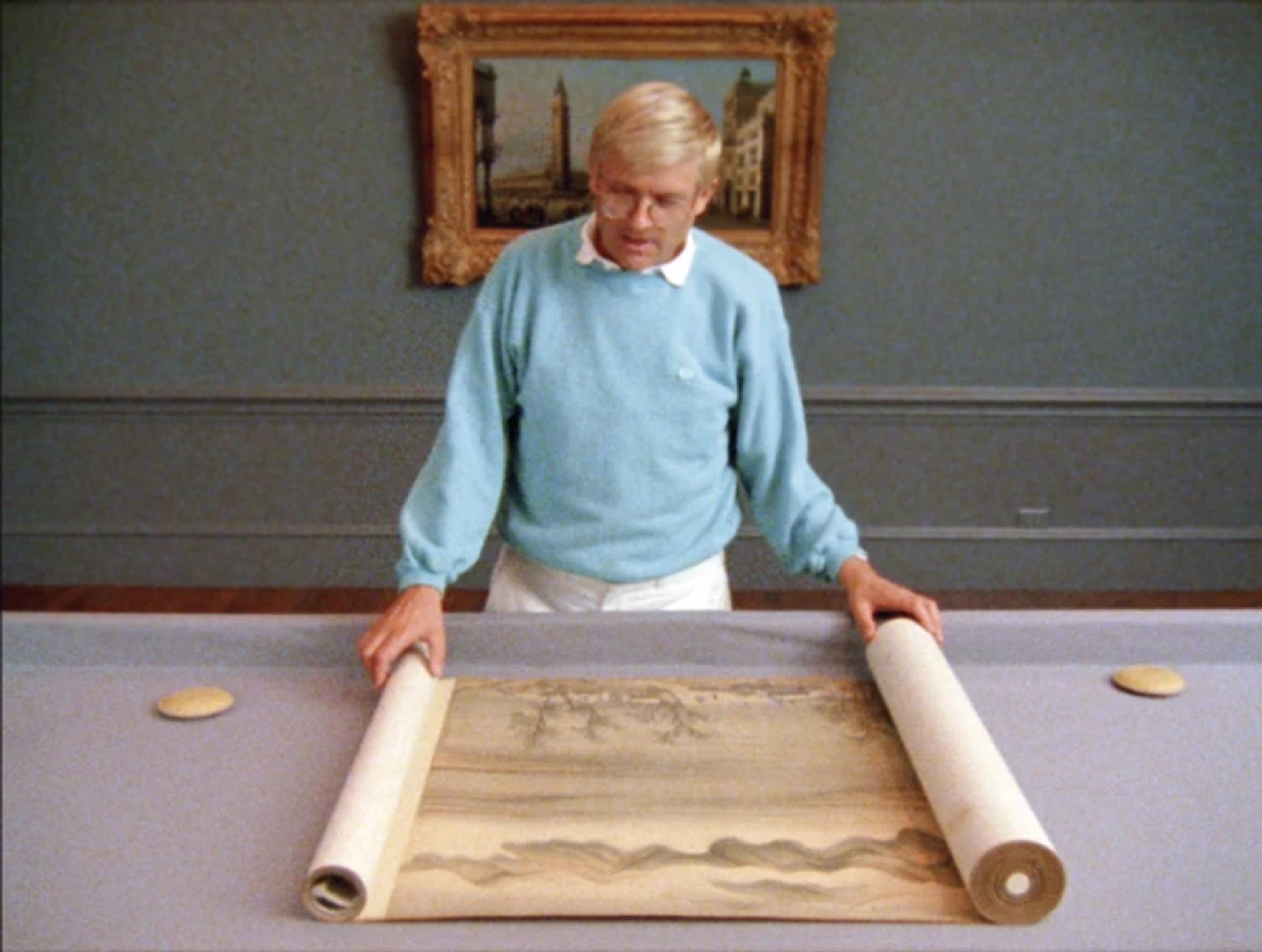
David Hockney examining a traditional Chinese scroll by Wang Hui and his assistants, a still from the 1988 short film A Day on the Grand Canal with the Emperor of China, or, Surface Is Illusion But So Is Depth, which he co-directed with Philip Haas Images: CHRISTIE’S IMAGES LTD. 2026, courtesy of Milestone Film and Philip Haas
From that trip Hockney absorbed some ideas from Chinese traditional landscape painting, he said in a 1984 interview for the Smithsonian Museum, referencing the book The Principles of Chinese Painting (1947) and the idea that scroll paintings contain time as well as place. Wu spent three years, 1947 to 1950, studying in France, and his career was shaped by his explorations of how Western traditions could be infused into Chinese techniques.
“Both artists looked beyond the conventions of their own traditions and found inspiration in artistic practices from other cultures,” Albu says. “Both artists were deeply committed to landscape as a subject, but neither approached it as a straightforward depiction of nature. Instead, they used landscape as a vehicle for exploring perception, memory, movement and space. Their works reveal a shared belief that artistic traditions are not fixed or isolated but can evolve through dialogue and reinterpretation.”
While Hockney is more recognisable in the West, Wu “occupies a unique position” in Hong Kong and greater China, Albu says, widely recognised and appreciated “across generations” as “one of the most important figures in modern Chinese art”. Hockney is familiar to Hong Kong’s international and younger audiences, but his engagement with Chinese painting traditions is not so widely known. “One of our goals is to present a different perspective on Hockney by examining these influences and connections in greater detail,” Albu says. “The exhibition aims to create a meeting point between two artists who are each highly respected in their own spheres but are rarely discussed together.”
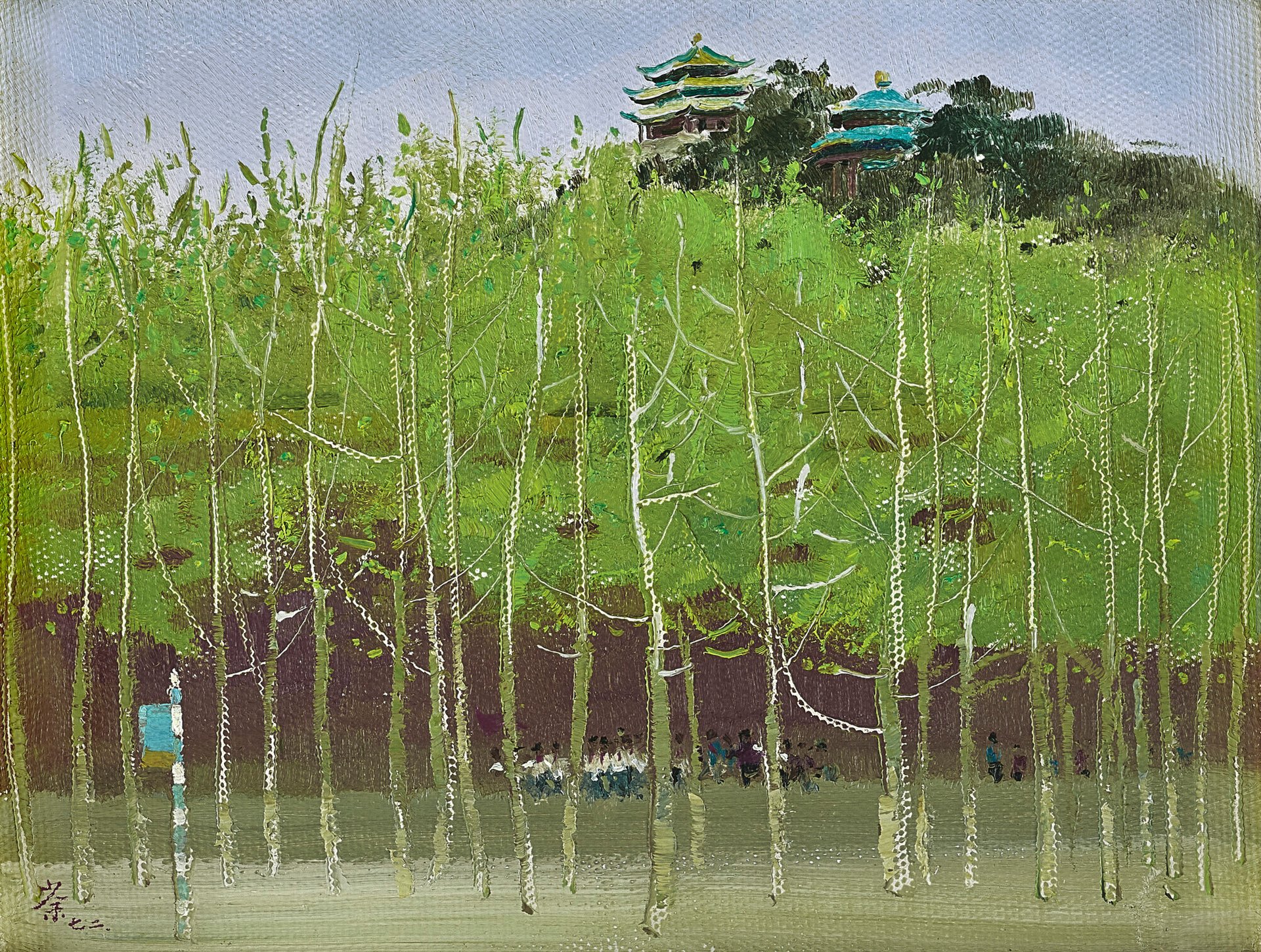
Wu Guanzhong's The Palace Wall (1972) Images: CHRISTIE’S IMAGES LTD. 2026
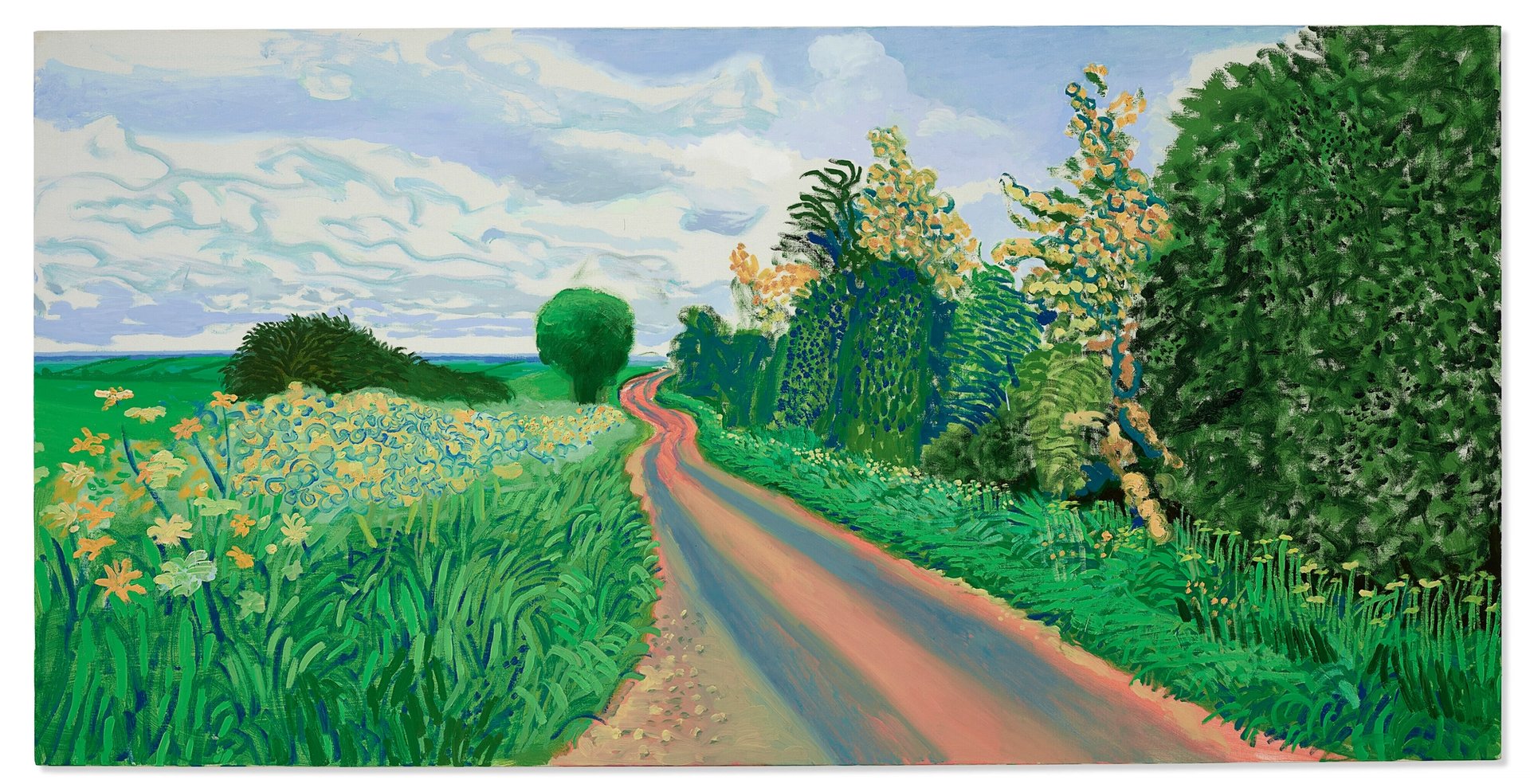
David Hockney's Early Blossom, Woldgate (2009) Images: CHRISTIE’S IMAGES LTD. 2026
The exhibition pairs about seven Hockney works and 15 by Wu, sourced from various private collections. Also on display, for context, are two scroll paintings by the Qing Dynasty artist Wang Hui (1632-1717), who likely influenced both Hockney and Wu. “[Wang’s] work synthesised centuries of Chinese painting traditions while demonstrating remarkable mastery of composition, spatial organisation and narrative progression,” Albu says. Hockney “was especially drawn to the way handscroll paintings unfold gradually over time, inviting the viewer to travel through a composition rather than absorb it from a single viewpoint,” an influence visible in works like Nichols Canyon III (2017), he adds.
Albu says Christie’s timed the exhibition alongside Hong Kong’s autumn preview in order to “present a focused scholarly project while also highlighting exceptional works. Hong Kong, as a city situated between cultures, provides an ideal setting for this cross-cultural dialogue”. The exhibition was formulated specifically for Hong Kong but Albu hopes it will “contribute to a broader conversation about cross-cultural artistic exchange and encourage further research into the relationship between Eastern and Western art histories”.