Nabatele, a balloon in the form of a flying shtetl synagogue that briefly took flight in August as an official collateral event of the Venice Biennale, was destroyed by extreme winds on 17 September. It ended, for now, months of engineering and weather tracking led by Nabatele’s creator, the architect Anna Kamyshan.
“It was destroyed in such a heavy wind,” she told The Art Newspaper in a call later that day. “I planned this object to withstand 20 knots. It was destroyed at 50 knots.”
In an Instagram post on Sunday, coinciding with the start of Yom Kippur—Judaism’s holiest day of the year—Kamyshan wrote that the opened a new chapter in her quest. The Instagram carousel included closed-circuit footage of wind deflating and tearing apart the synagogue, which briefly floated 35 metres above the lagoon.
“Perhaps it is not such a bad moment to let Nabatele go: to accept what I could not control, to forgive myself for what I could not prevent, and to begin again,” she wrote in her post.
“There is something deeply Jewish in the possibility of continuing after destruction, not by pretending that nothing happened, but by carrying what happened with you and making something new.”
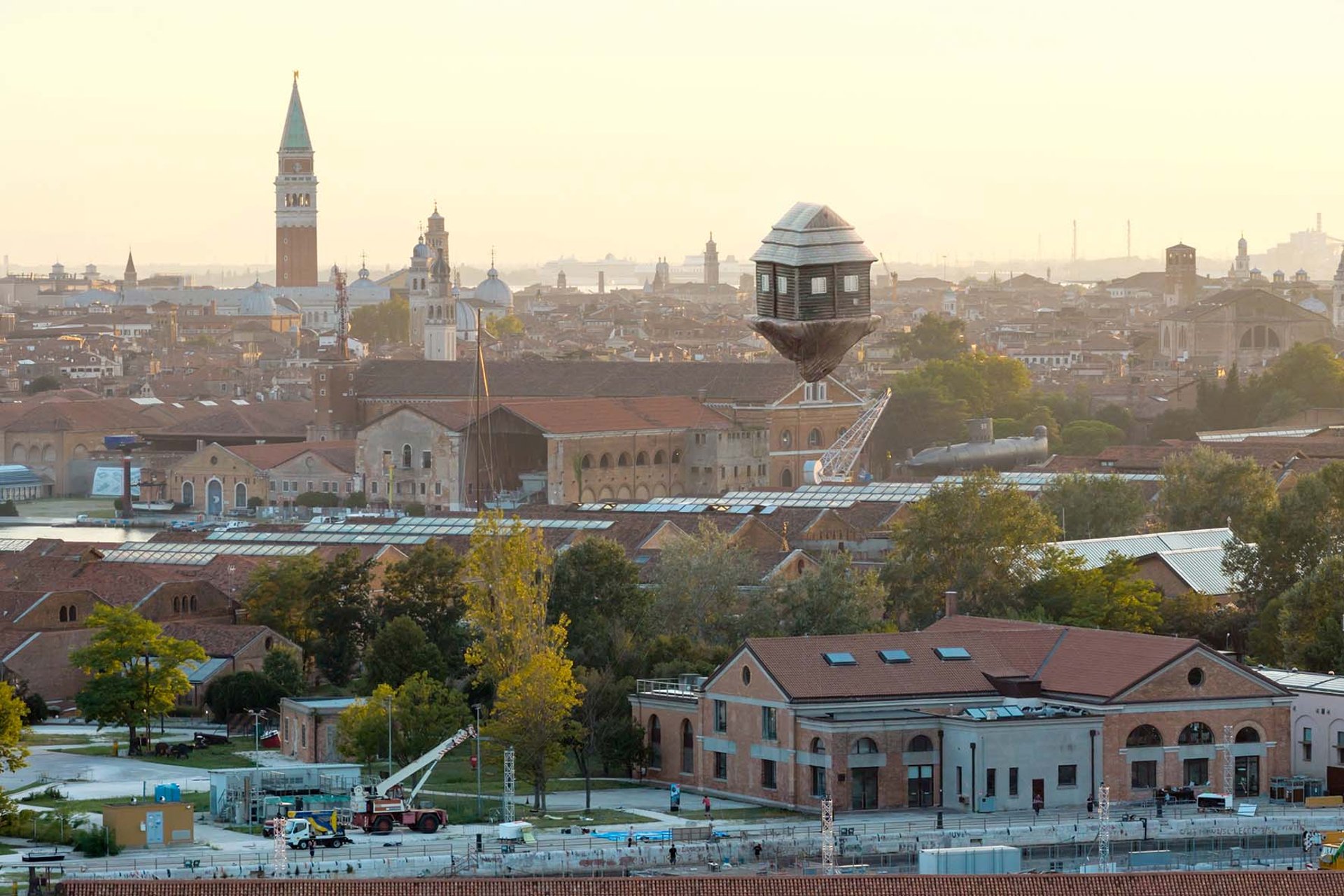
Nabatele floated above Venice for a brief period
Photo: Iwan Baan
Kamyshan, who is based in London and New York, is originally from Lviv, in western Ukraine, a centre of Jewish culture until the Holocaust, and has lived in Kharkiv, in eastern Ukraine, Moscow and Kyiv. From 2019 to 2021 she co-created the conceptual vision for Kyiv’s Babyn Yar Holocaust Memorial Center. Lamyshan says she had to navigate multiple identities and that this has influenced her work.
René Magritte’s painting The Castle in the Pyrenees (1959) inspired the helium-filled, double-membrane structure. The piece was meant to symbolise both uncertainty in the world and hope, Kamyshan told The Art Newspaper in July.
The word “nabat” translates as warning bell or alarm in Yiddish and is softened here by the Yiddish “’-ele” suffix. Kamyshan told The Art Newspaper at the time that the goal of the project was “to bring some light and some magic into these dark times” with “so many wars”. With the work, which has illuminated windows, she wished to focus “on the idea of an inner light present in every person”.
Kamyshan was invited to develop the project by the curators Maria Veits and Yevgeniy Fiks, on behalf of the ephemeral Yiddishland pavilion. According to Yiddishland’s curatorial statement about Nabatele the installation “enters into dialogue” with the history of the Venetian Ghetto, where a vibrant Jewish life existed despite a ban on street level synagogues.
The Montreal Jewish Museum was the sponsoring organisation for Nabatele, which was also supported by private donors and foundations. The installation was built with experimental winches and gas cells with the help of rocket scientists.
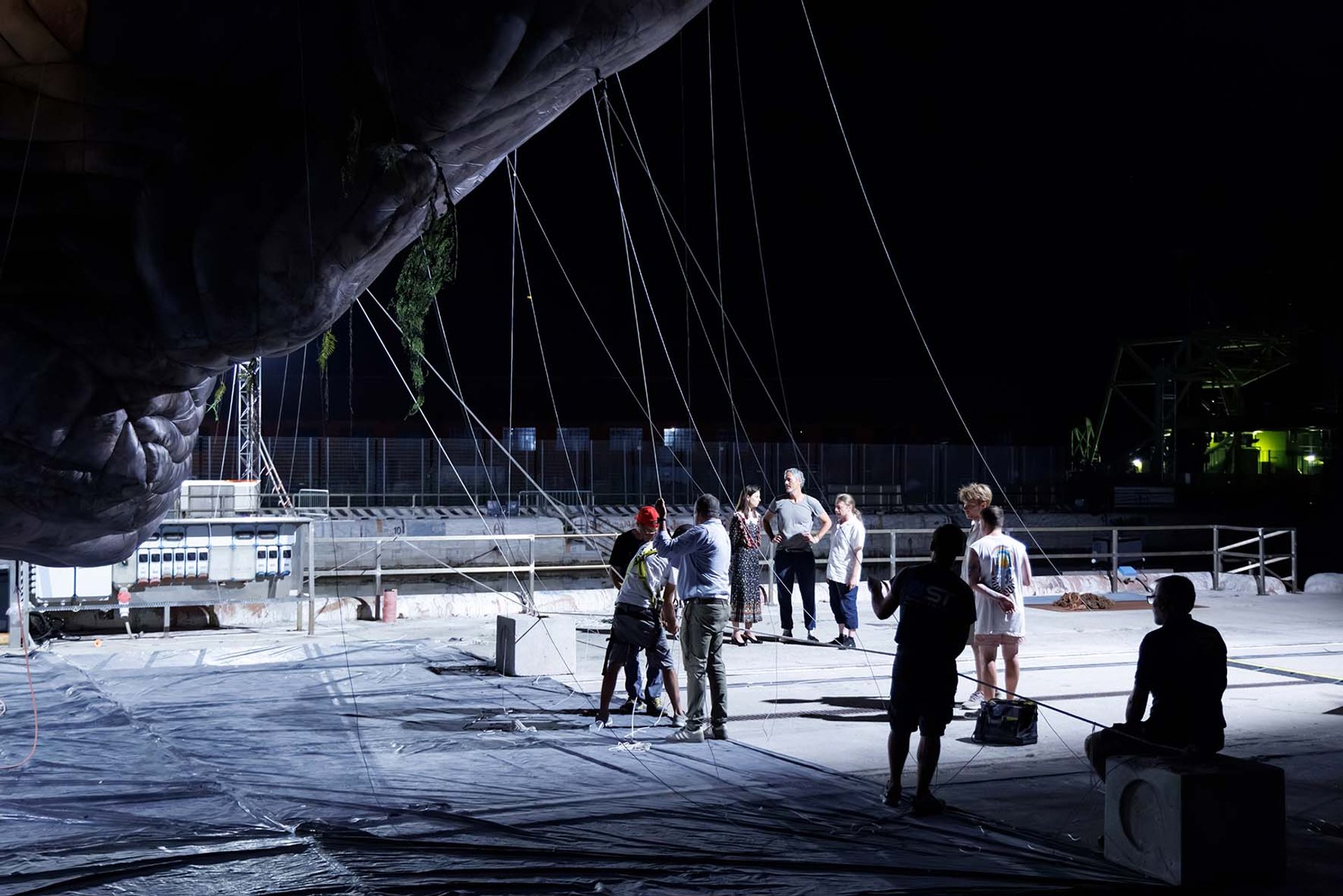
A team including rocket scientists worked on the project
Photo: Iwan Baan
In a Substack essay posted on 11 September, Kamyshan explained that Nabatele was torn on 16 July, when it was being moved in preparation for the opening ceremony, and discussed a multitude of obstacles that hindered the repair process.
“The original image has not changed: a synagogue floating above Venice,” she wrote. “What has changed is everything I now know about what it takes to make that image exist.An idea may be weightless. Making it real is not.”